

Amelia Sans Merci
Summoning the Tulpa of Remigration with industrial quantities of AI image slop

Somewhere in the suffocating fog of the unhappy and restless Yookay, a minor functionary of the government’s behavioural shaping bureaucracy is staring at her computer screen in appalled alarm at the horror she’s accidentally helped to summon from the churning depths of the Immaterium.


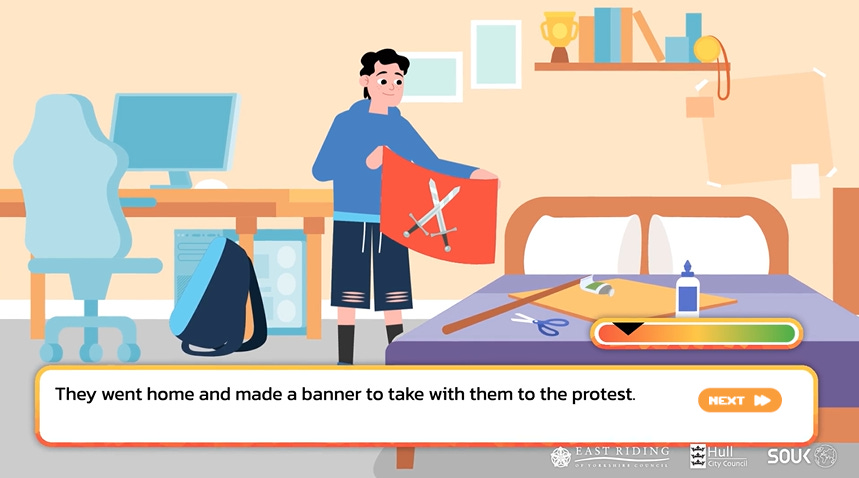
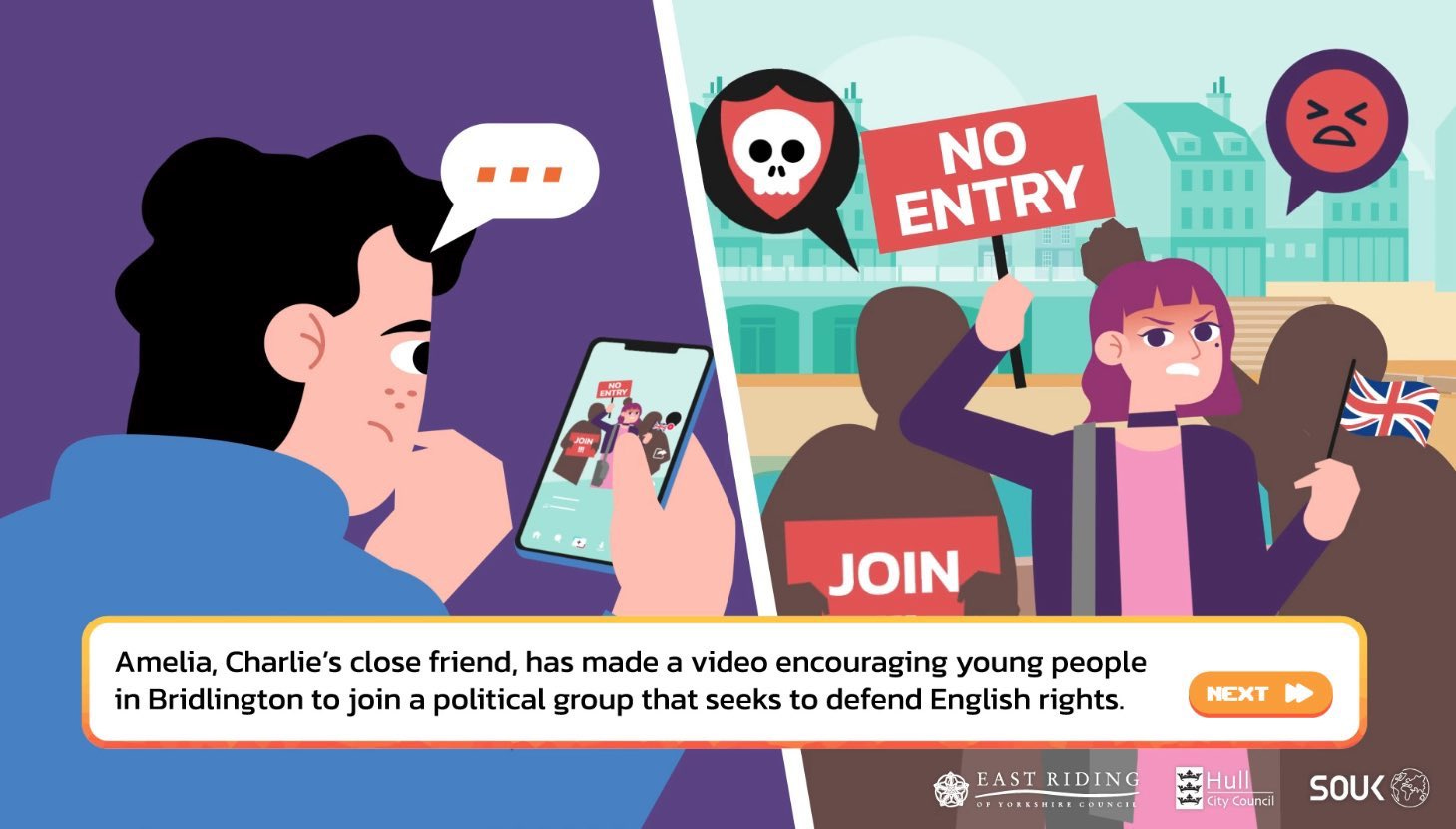
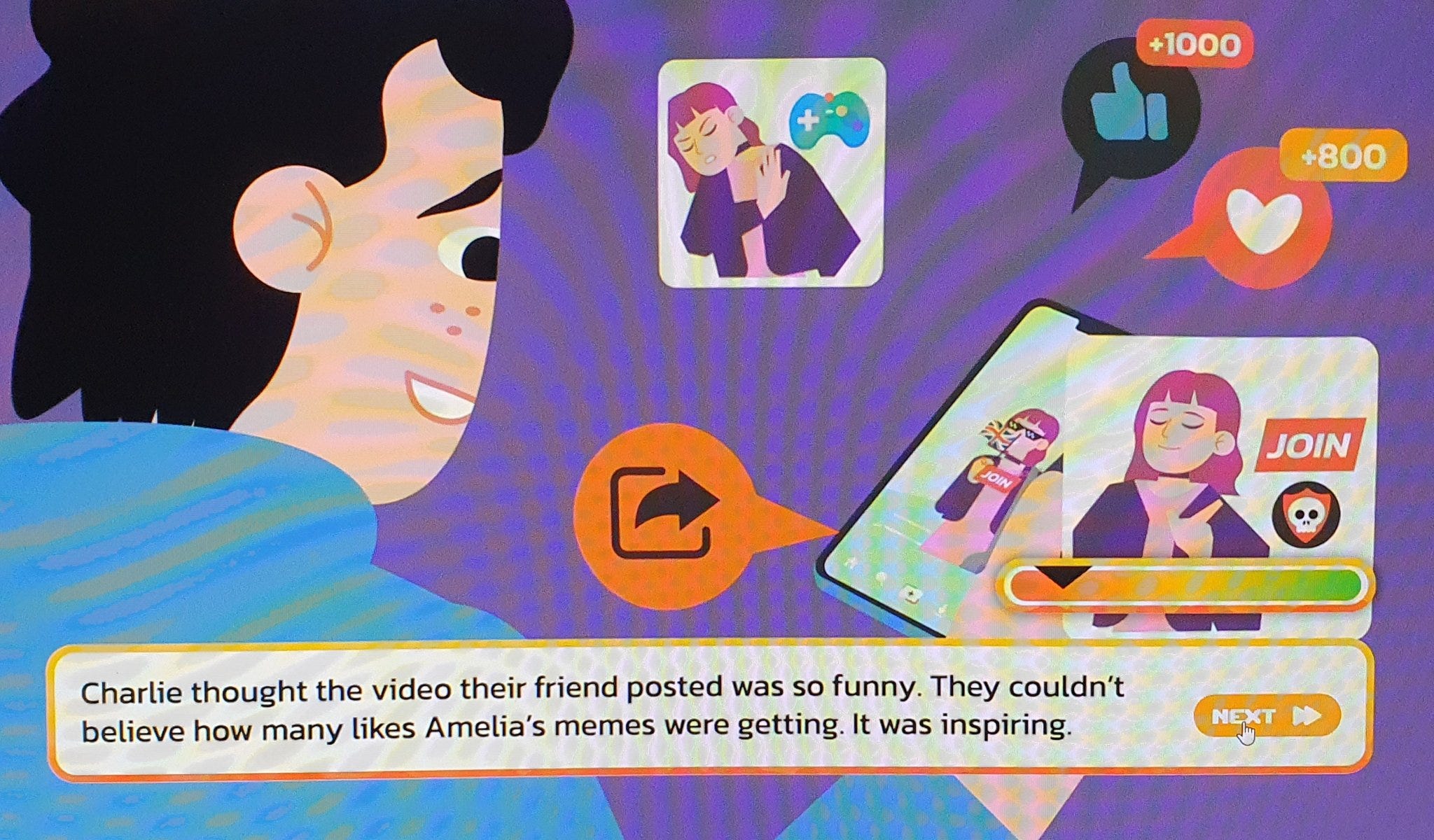
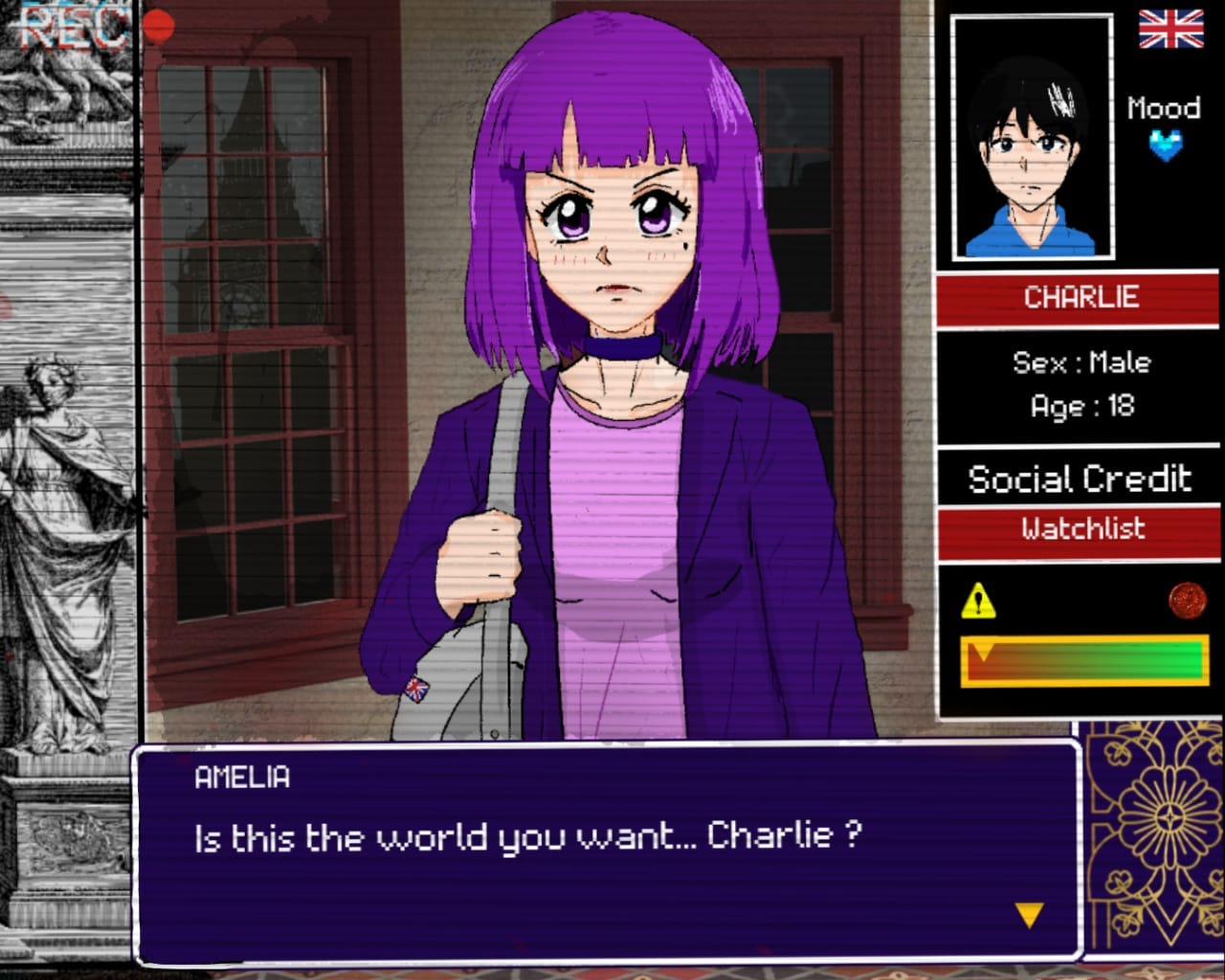
Shout Out UK, which describes its mission as ‘countering disinformation through political and media literacy’, released a ‘visual novel’ called Pathways, subtitled ‘navigating the Internet, gaming, and extremism’. The game itself is of course terrible, a ham-fisted ‘teaching aid’ intended to remind British teenagers that even innocuous and entirely peaceful activities – downloading memes, speaking your mind, watching videos, researching things for yourself, attending rallies – will complicate their lives if they draw the concerned and empathetic eye of the managerial state, which after all just wants what’s best for them.
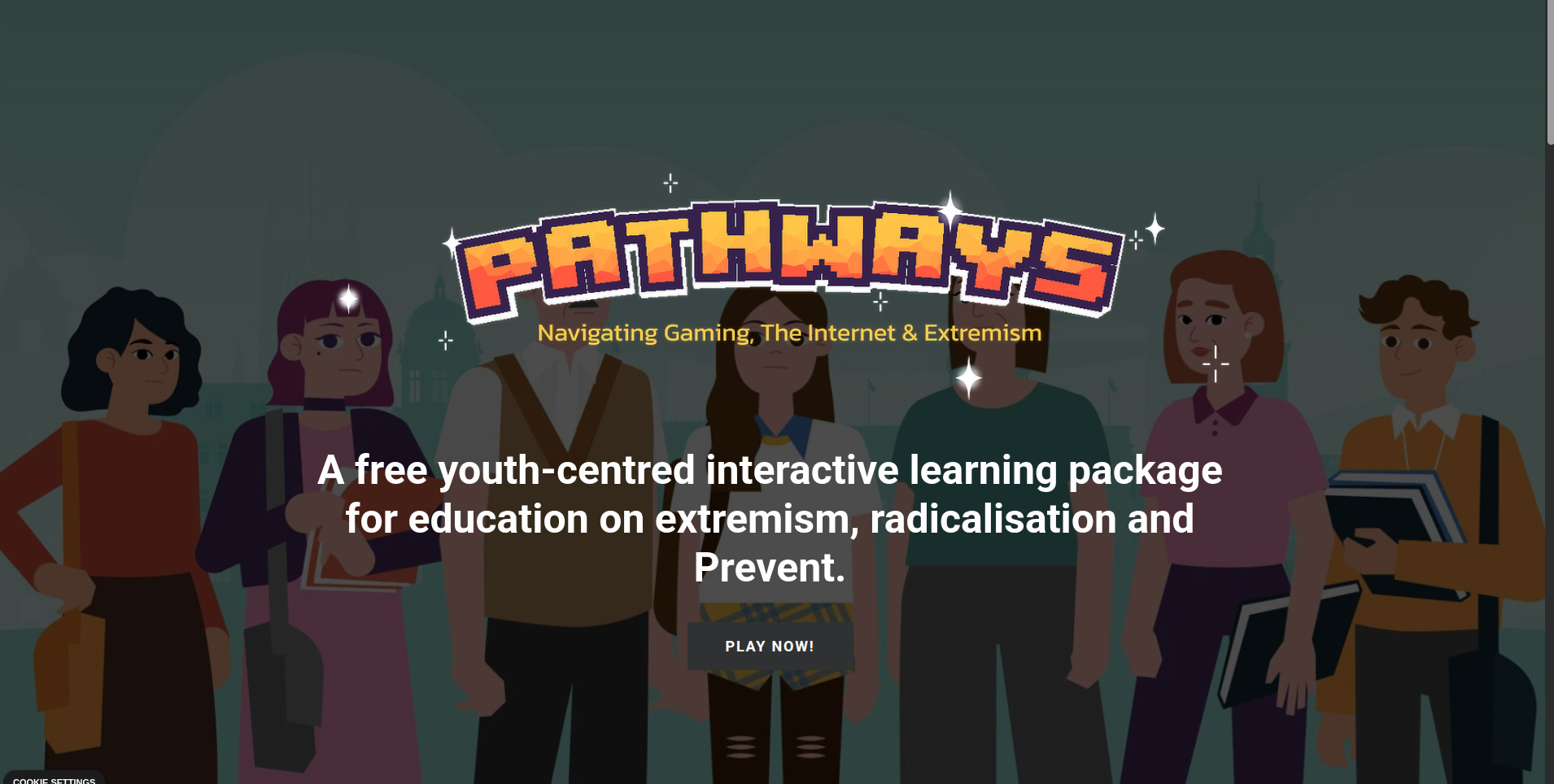
Prevent, if you haven’t heard of them, are a group of government-funded busybodies whose remit is to prevent extremism via early intervention, catching impressionable youth before they can be radicalized. The organization was nominally started to deal with Islamic terrorists, but in recent years it has focused on the ‘right-wing extremism’ of the native British to the exclusion of all else. The Southport butcher Axel Rudakubana, for instance, was referred to Prevent multiple times for his open glorification of white genocide, which Prevent ignored completely.
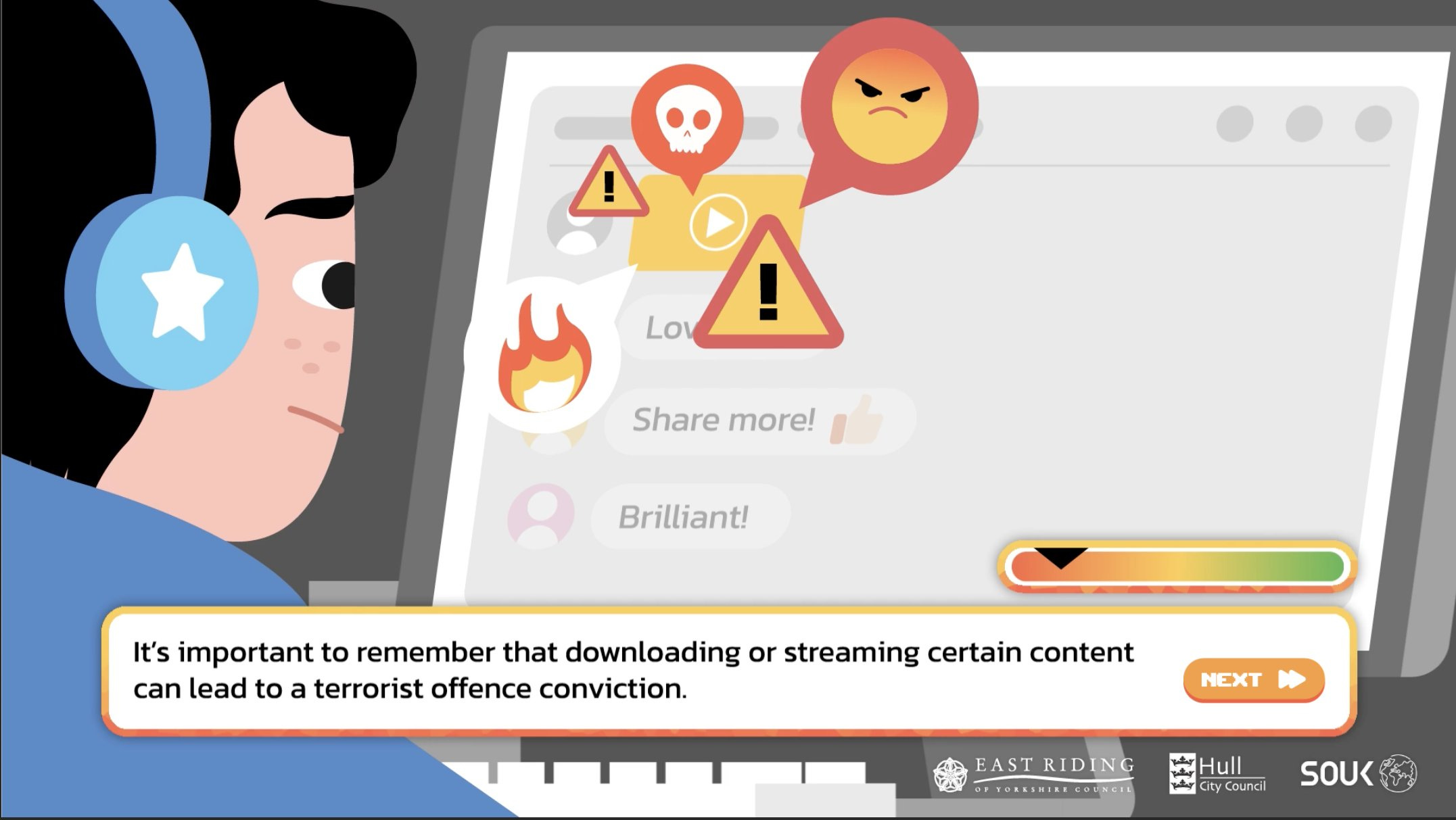
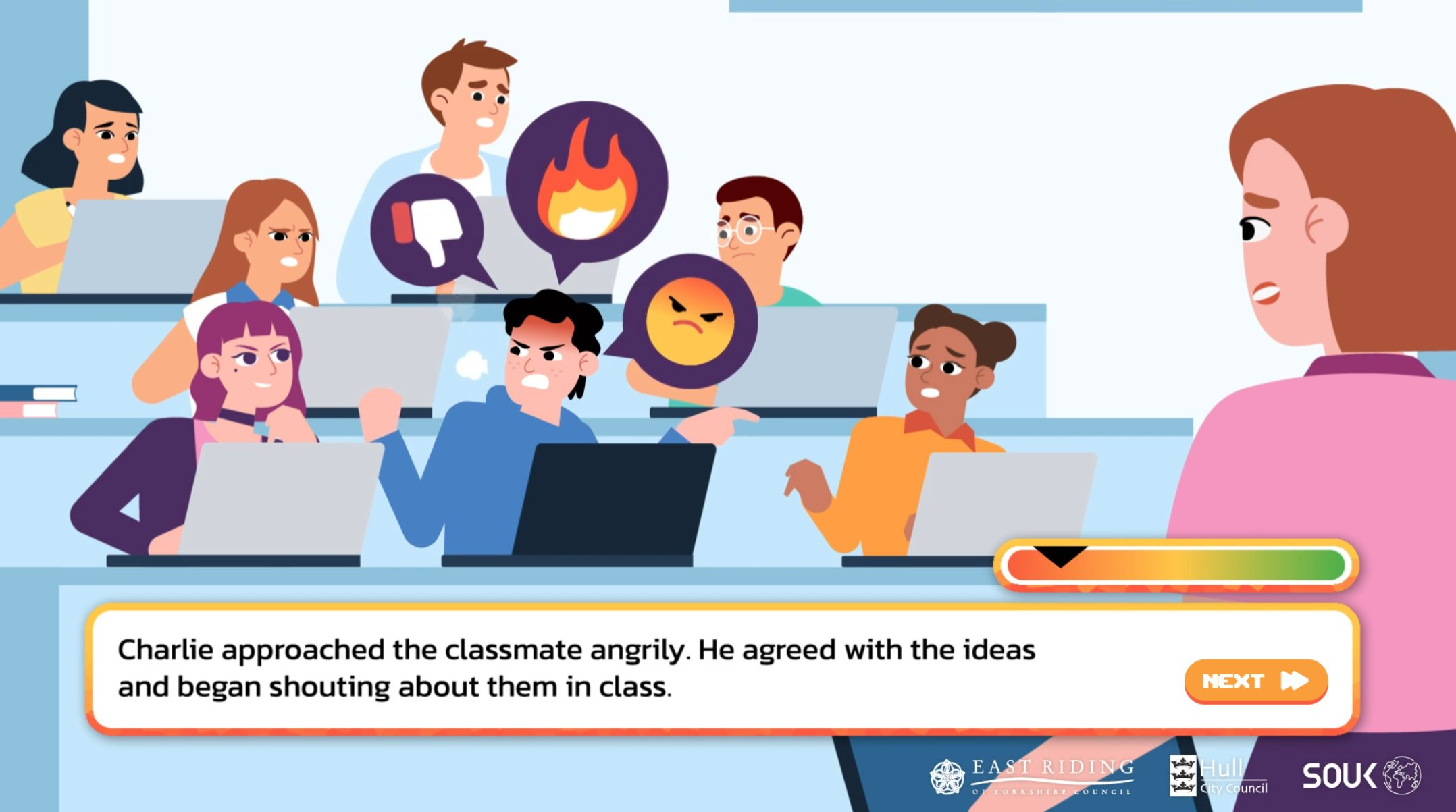
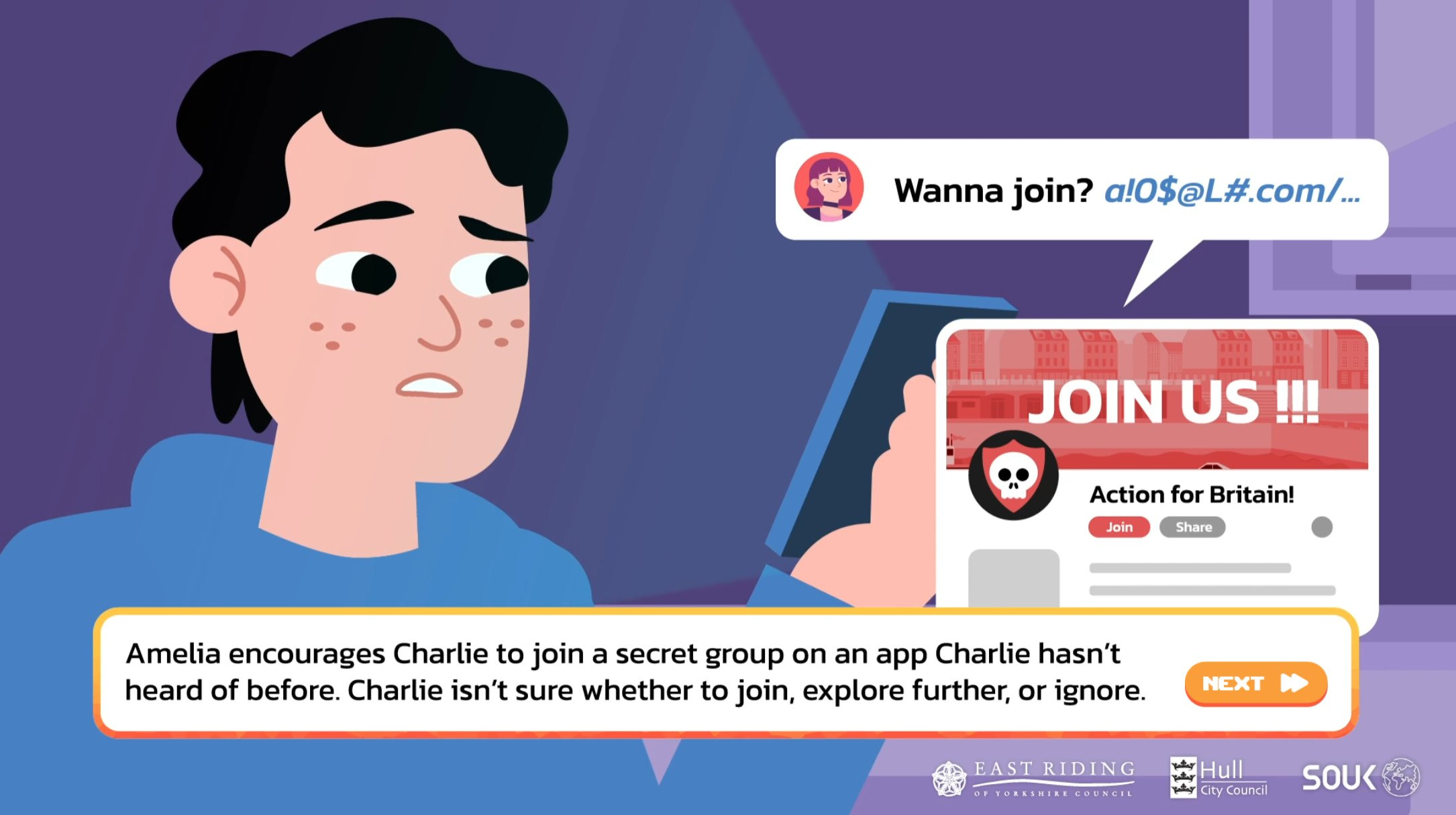
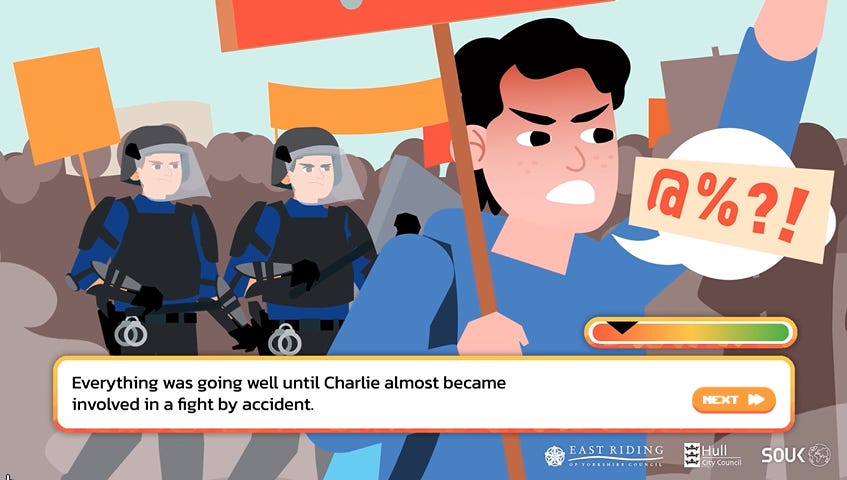
The player can choose either a male or female character, both of whom are amusingly and awkwardly referred to with they/them pronouns, with grammatical abominations such as “Charlie decided to look for themselves” sprinkled throughout. The character is then placed in a series of scenarios and made to choose between good and bad options: downloading extremist content or telling an adult; agreeing with a classmate that ethnic minorities are being shown favouritism at the expense of native youth vs clapping back at her unconscionable bigotry; watching a video and reading more about the subject or ignoring it; accepting or refusing an invitation to join a secret group chat; attending an anti-immigration rally or staying home. If you make the bad choice, a little ‘extremism metre’ goes into the red.
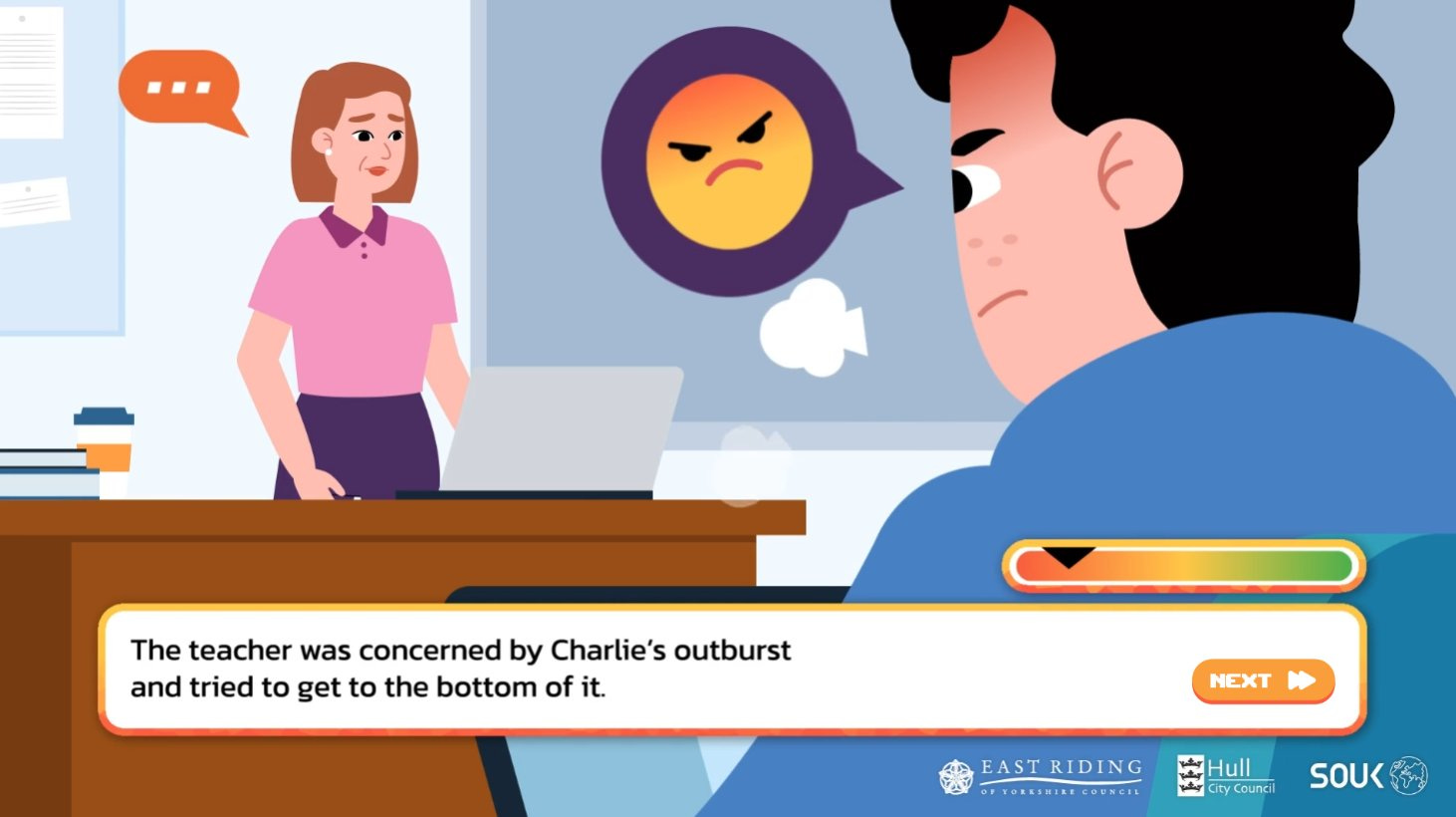
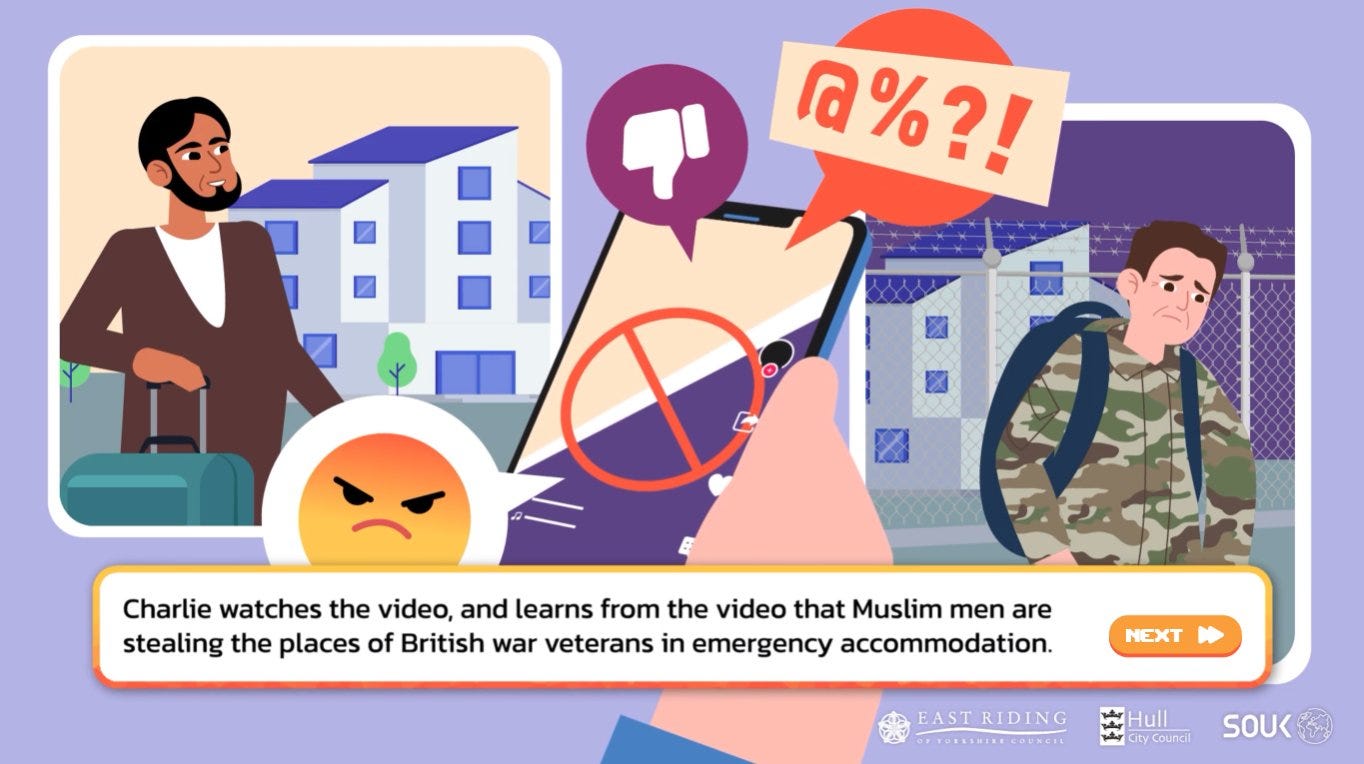
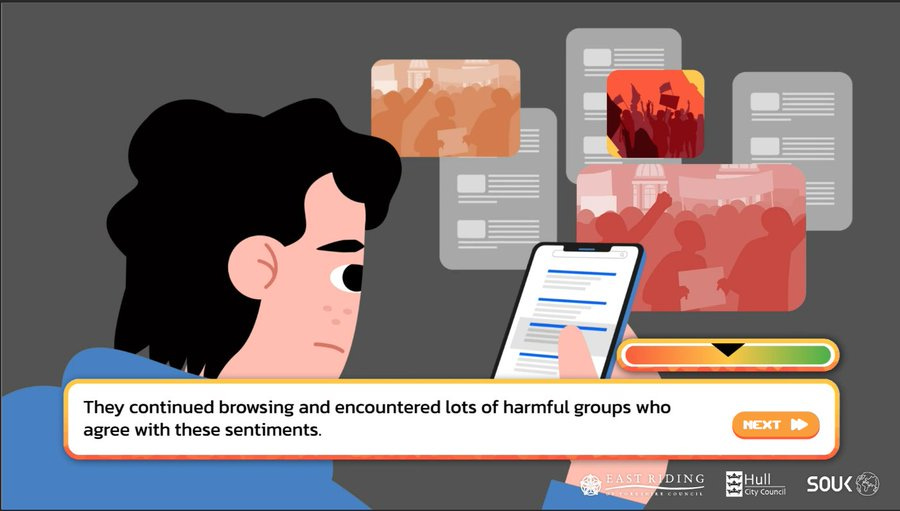
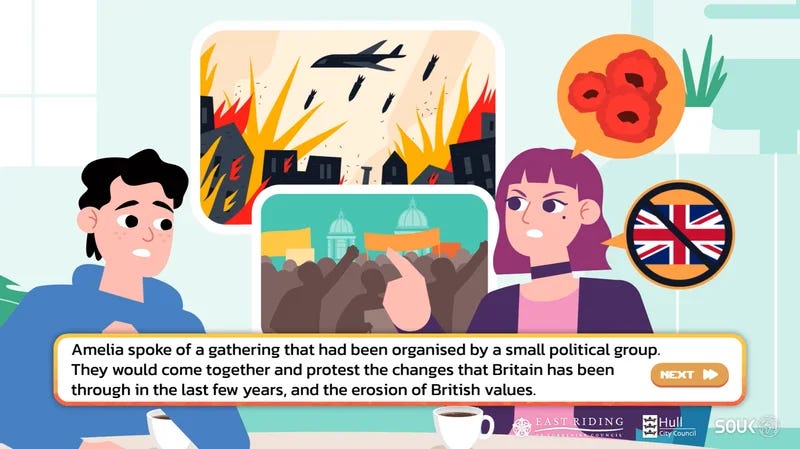
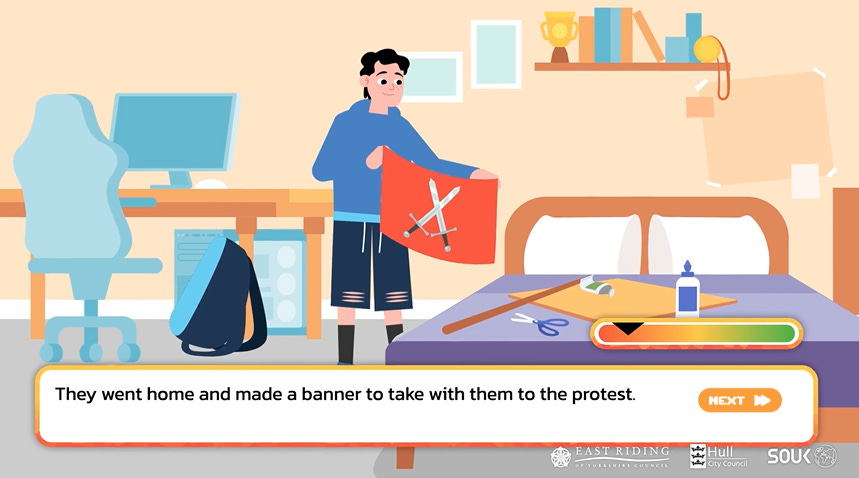
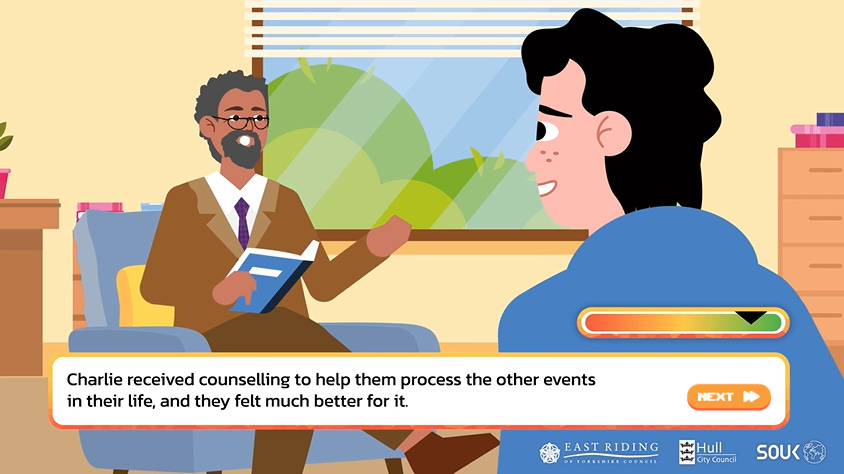
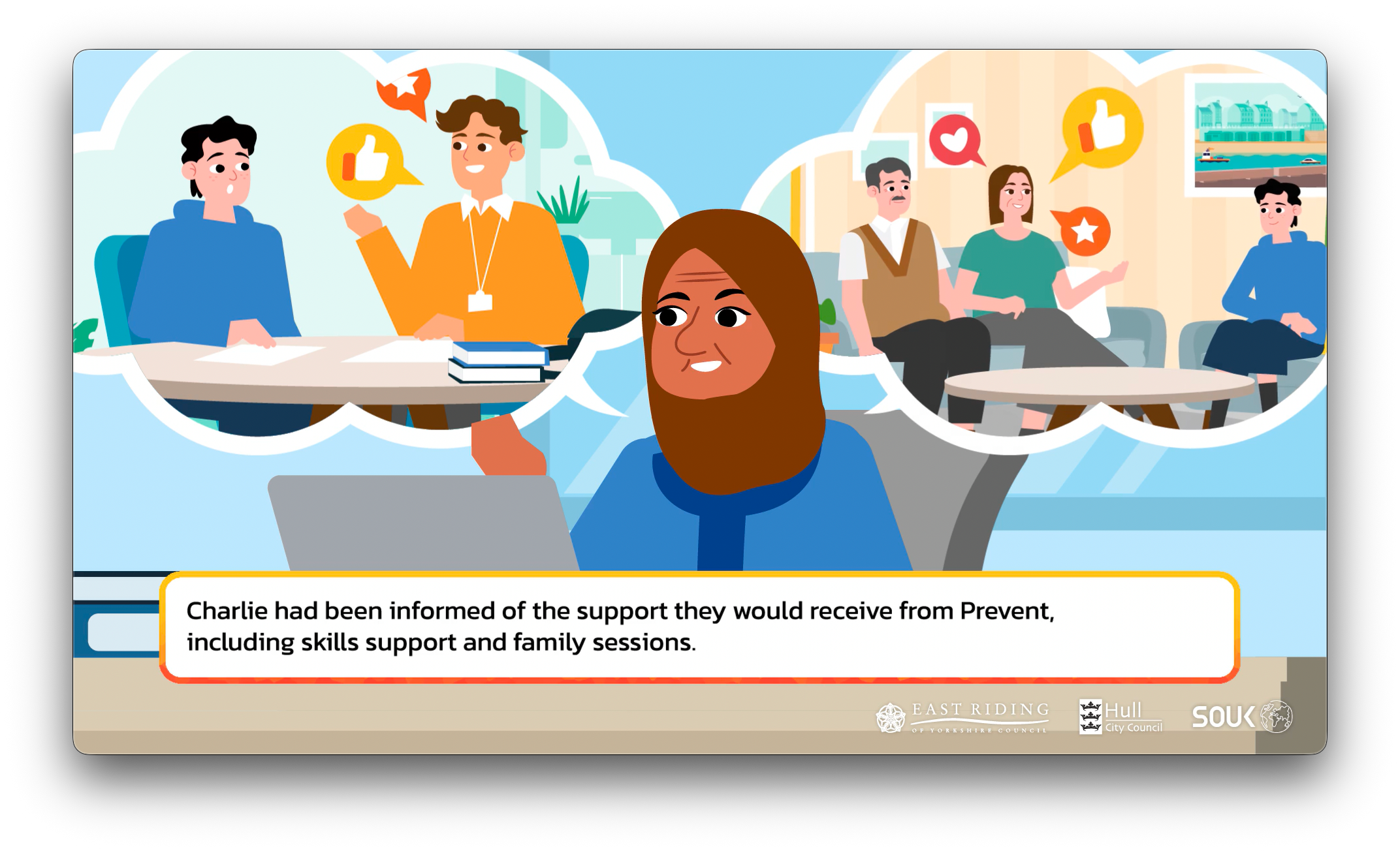
At the conclusion of his misadventures, Charlie gets referred to Prevent, who provide him (“them”) with counselling by a friendly brown man (or, in an alternate ending discovered by anons who scraped the game from Shout UK’s webpage, an extraordinarily ugly hijabi) who leads him away from extremism and helps him to learn to love Little Sister.
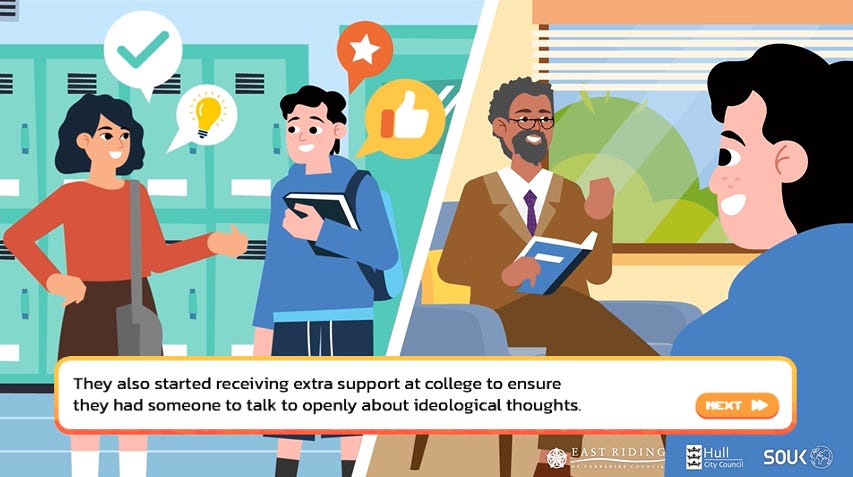
“Do you have someone to talk to about ideological thoughts, Anon?”
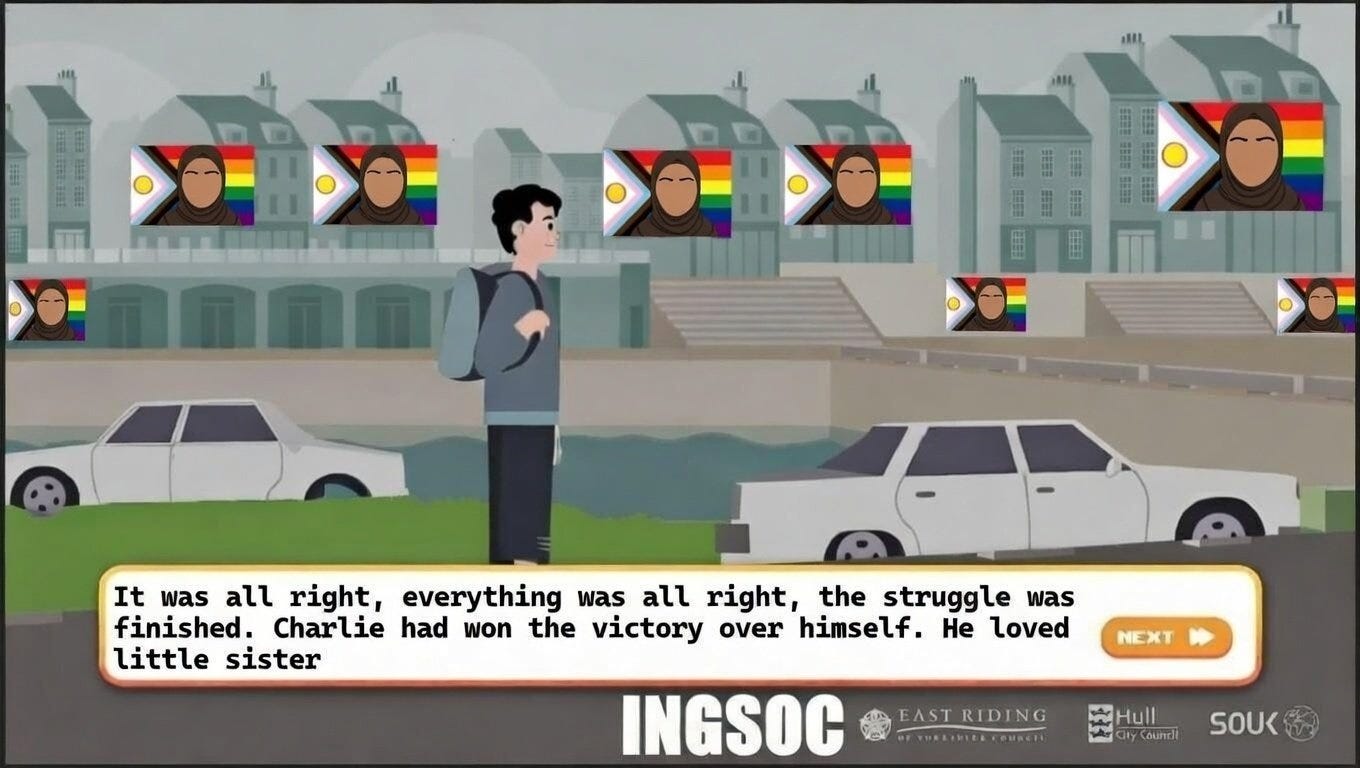
If you want to play the game for yourself, your best bet is probably to download the archived version of the Government Approved Goth Girl Dating Simulator. I was able to play it a week ago, but since then it gets stuck on the loading screen, which at first I thought was because they’d taken it offline, but is probably just because Shout Out UK has gotten DDOSed by an entirely unexpected surge of interest in their execrable product (or maybe it’s just that the Shout Out UK website has a dead link on its page, as after poking around a bit on their website I was able to find one that works). Alternatively, you can find most of the screenshots archived here.
Had it not been for one unfortunate creative choice made by the development team, no one would have taken any notice of Pathways. It would have been one of countless cringe-inducing training aids churned out by regime-adjacent quangos cashing in on the flood of taxpayer lucre sluicing through the DEI-and-disinformation industry. But for some reason, which can be explained only by a calamitous failure on the part of Shout Out UK to develop an accurate theory of mind for their target audience, the creators of Pathways decided that it would be a great idea to cast the awful bigot leading the protagonist step by step to his ideological doom in the form of a cute alt girl, thereby sending the message that embracing right-wing extremism will give you a shot at getting a manic pixie dream girl gf.
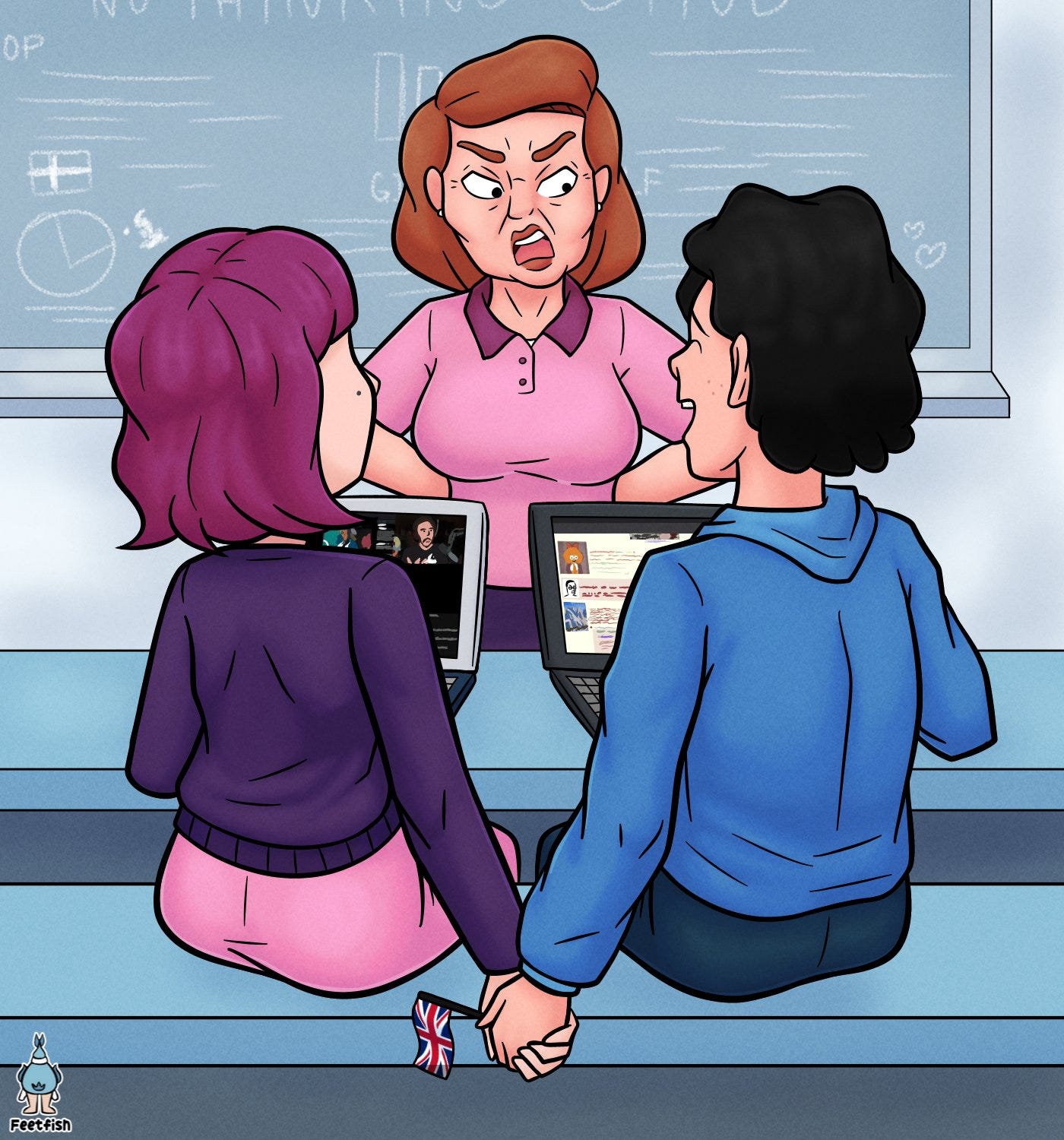
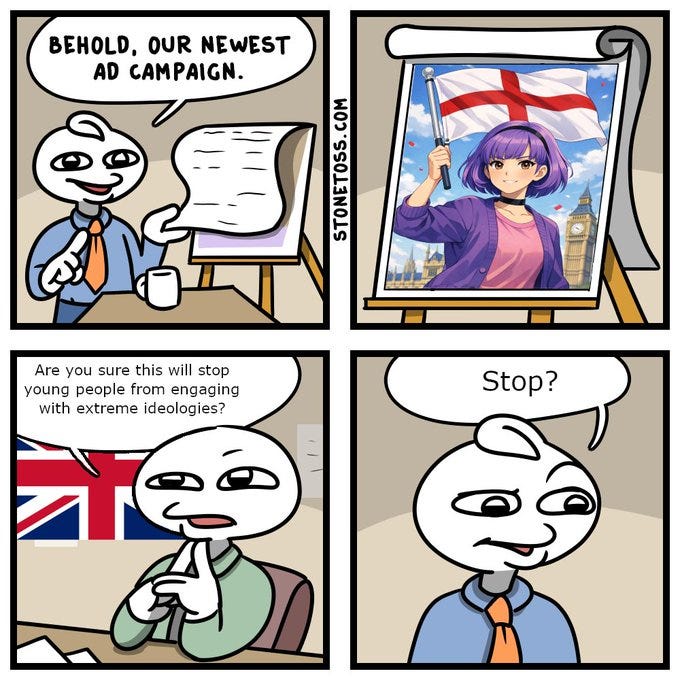
All it took was one anon to take notice of her.


Bovril-Gesellschaft’s yearning declaration of love for Amelia racked up 3.6 million views. He clearly wasn’t the only one to be captivated by the racist art ho.


Anons were entranced, the Satanic mills of the data centres began clacking in response to their furious prompting, and hundreds of Amelia images flooded onto the Internet.
Bovril, who writes under Augustan Age Pervert here on Substack, has taken the time to write up his own thoughts on Amelia’s explosive emergence over the last week. He’s more concise than I am, and he actually explains what a tulpa is, so this is an excellent primer:

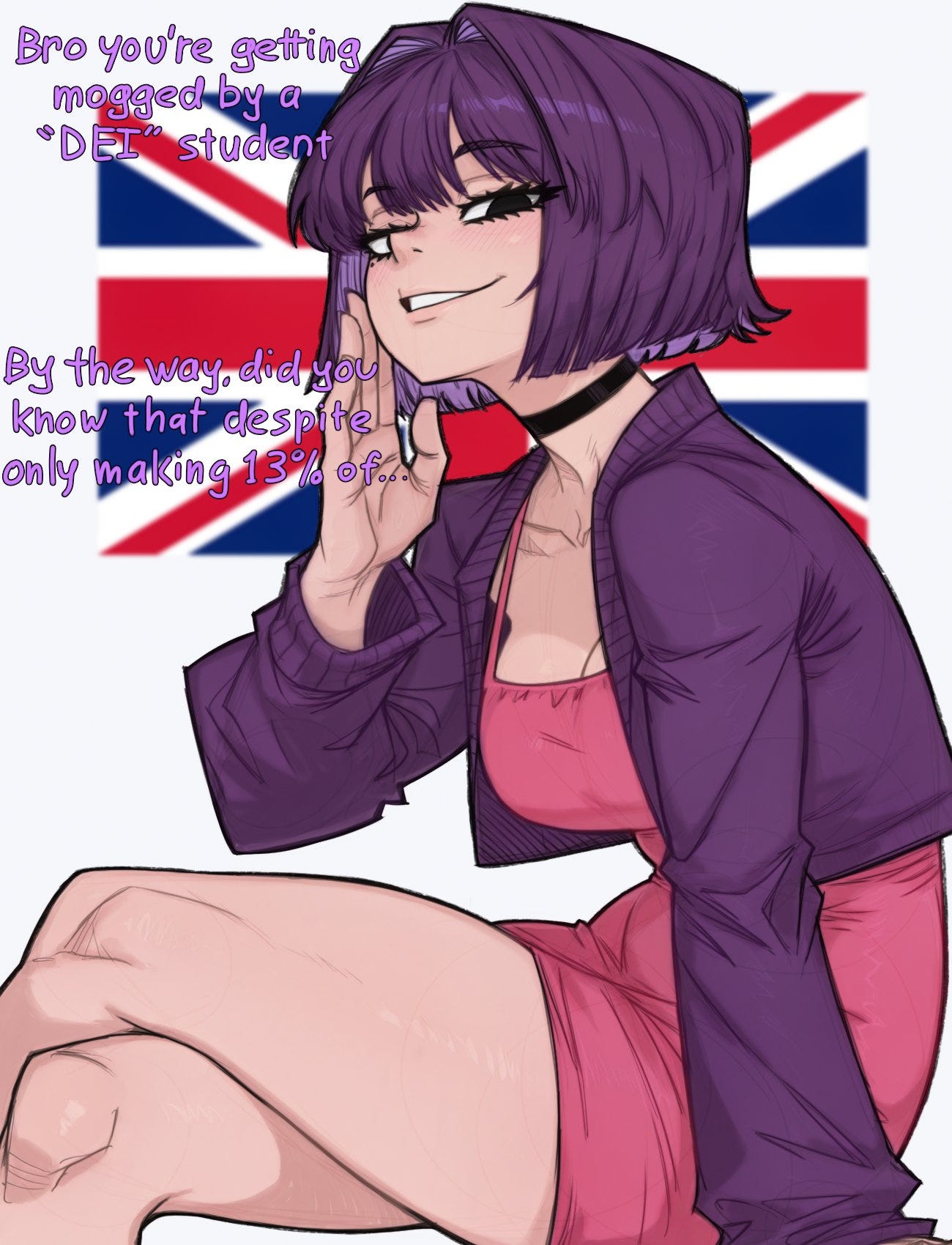
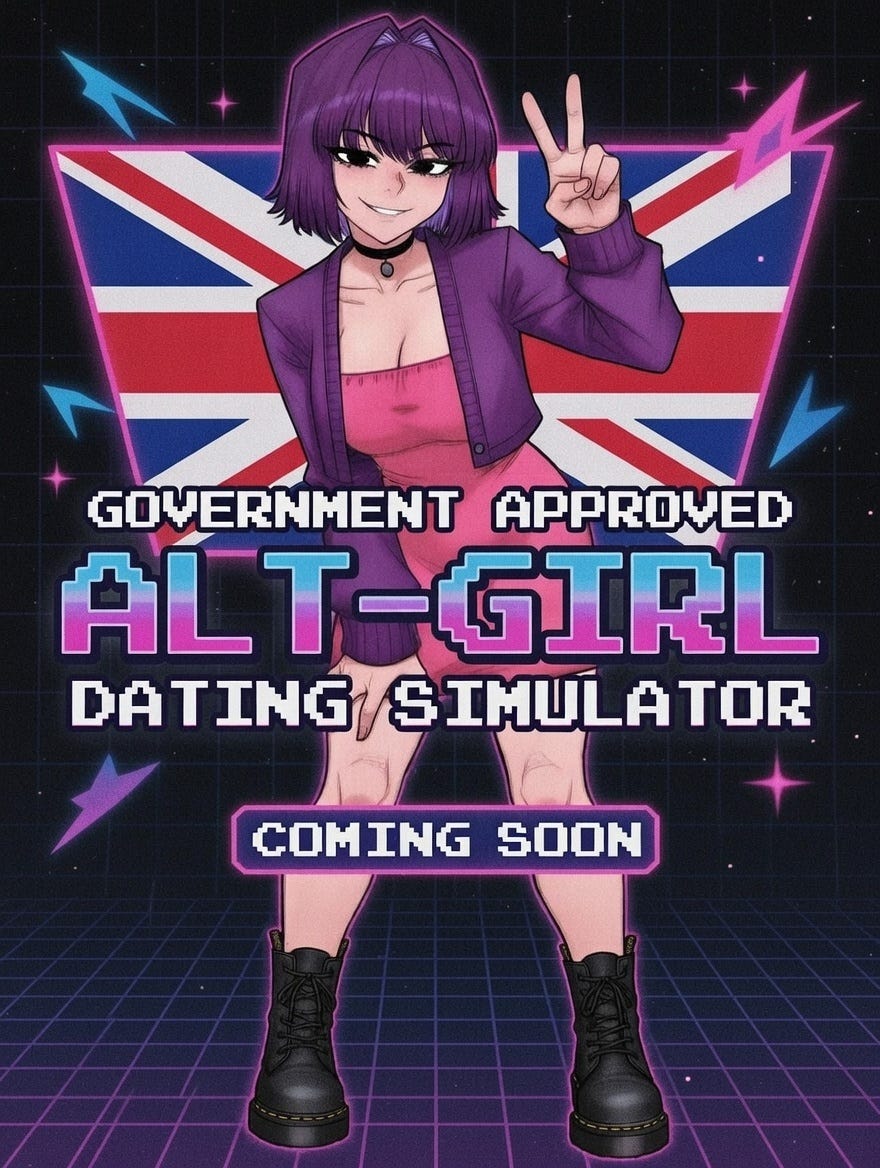


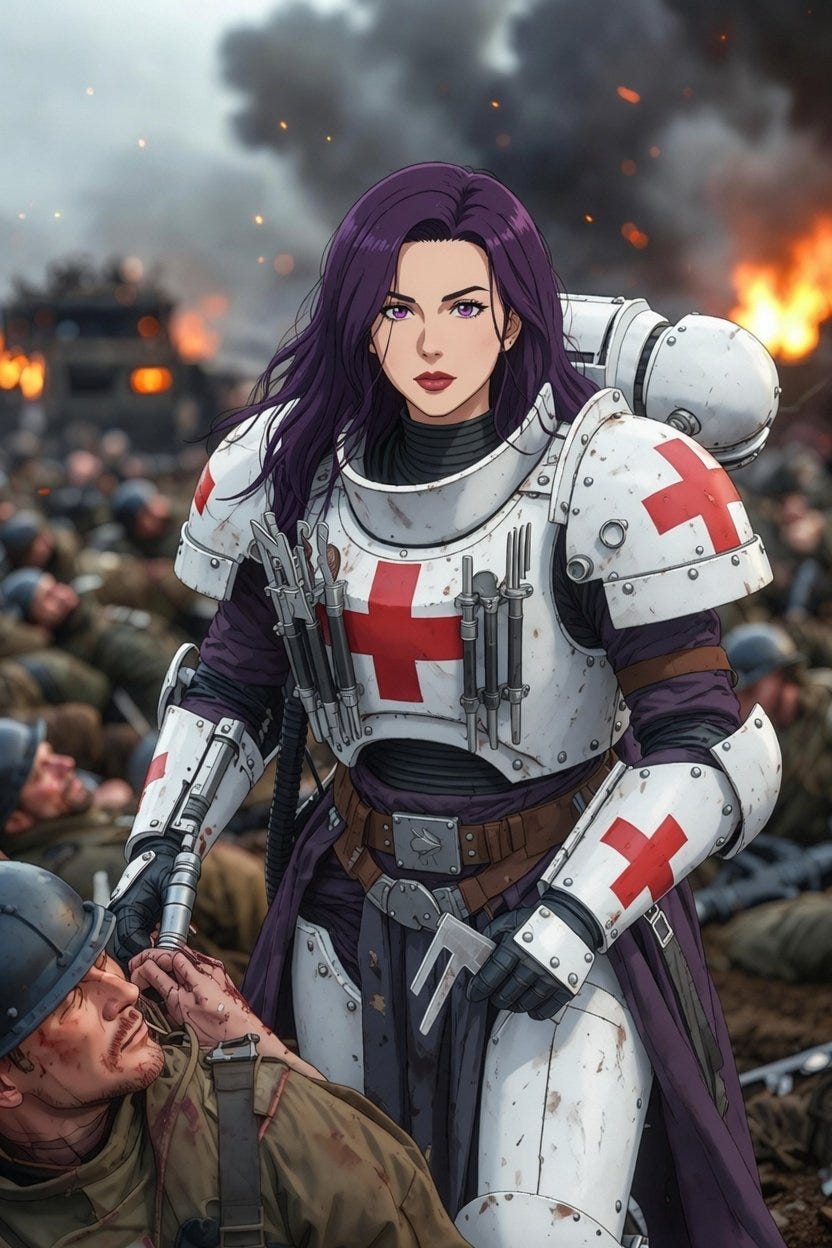
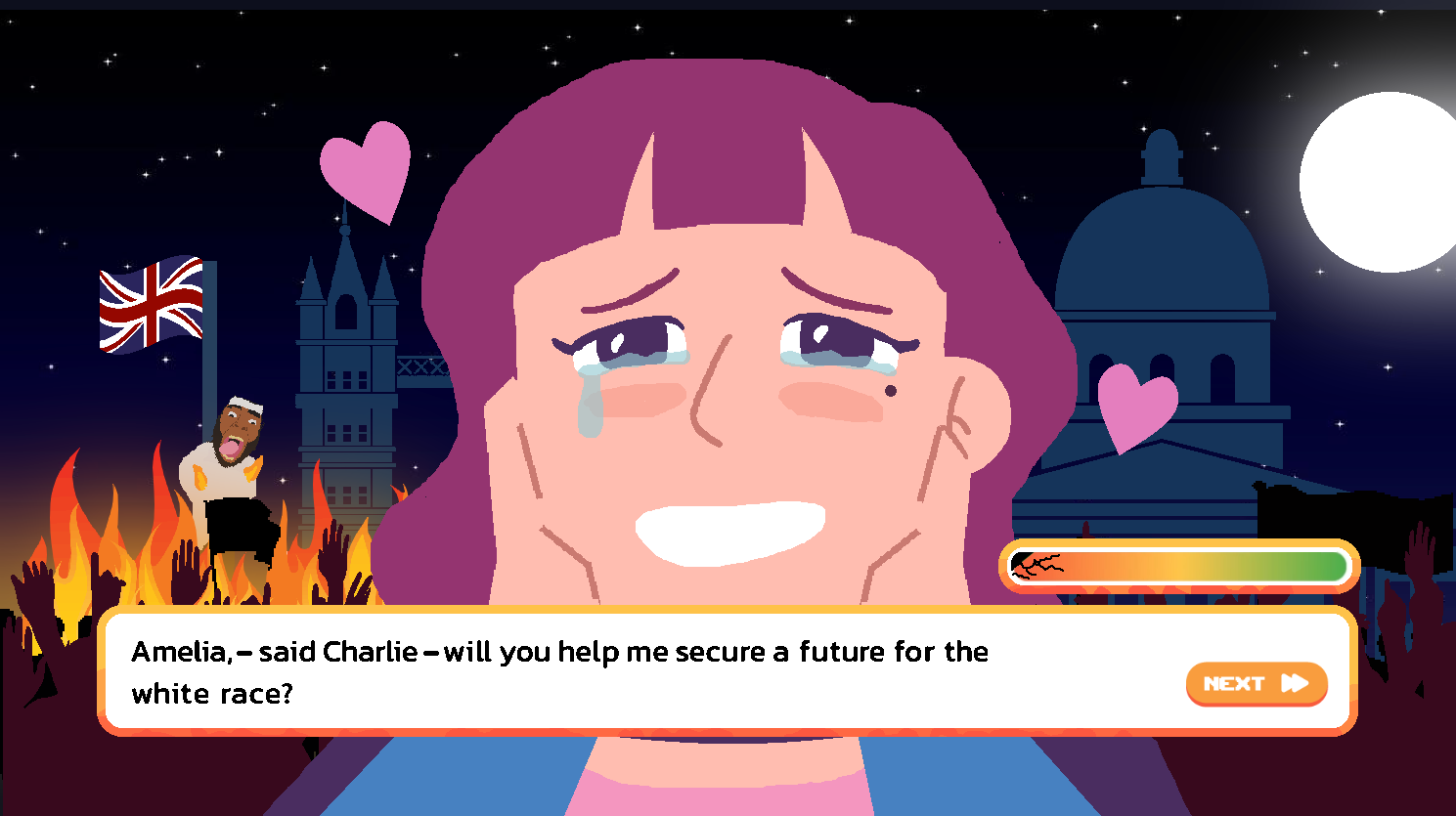


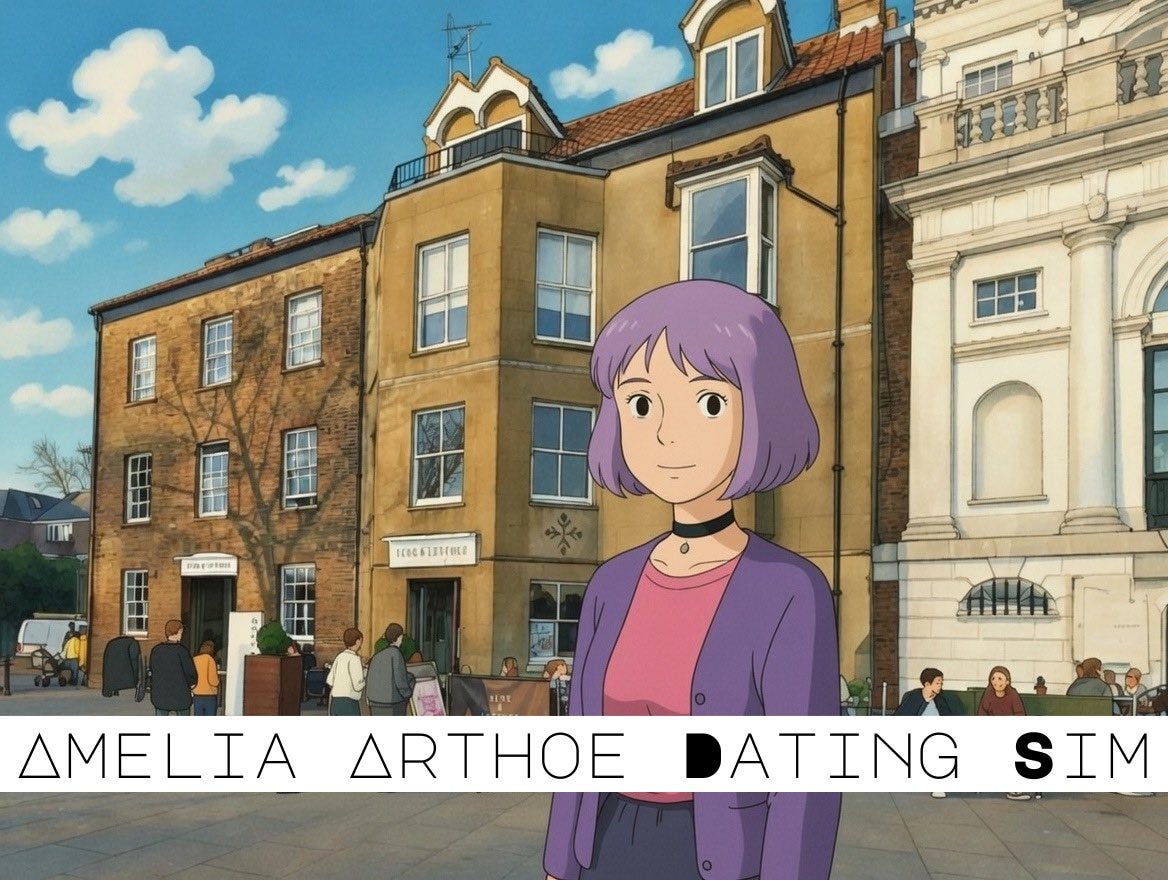





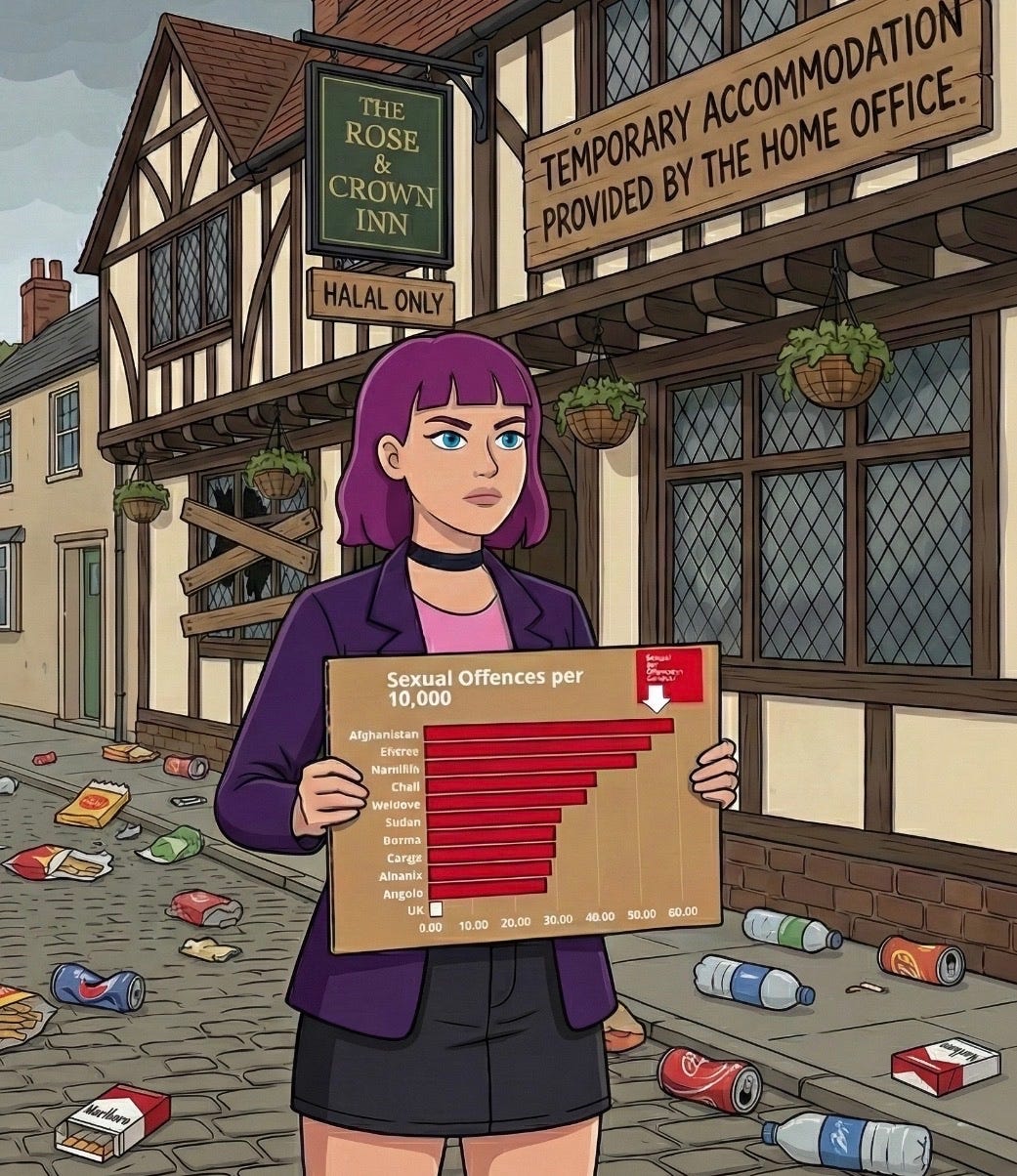
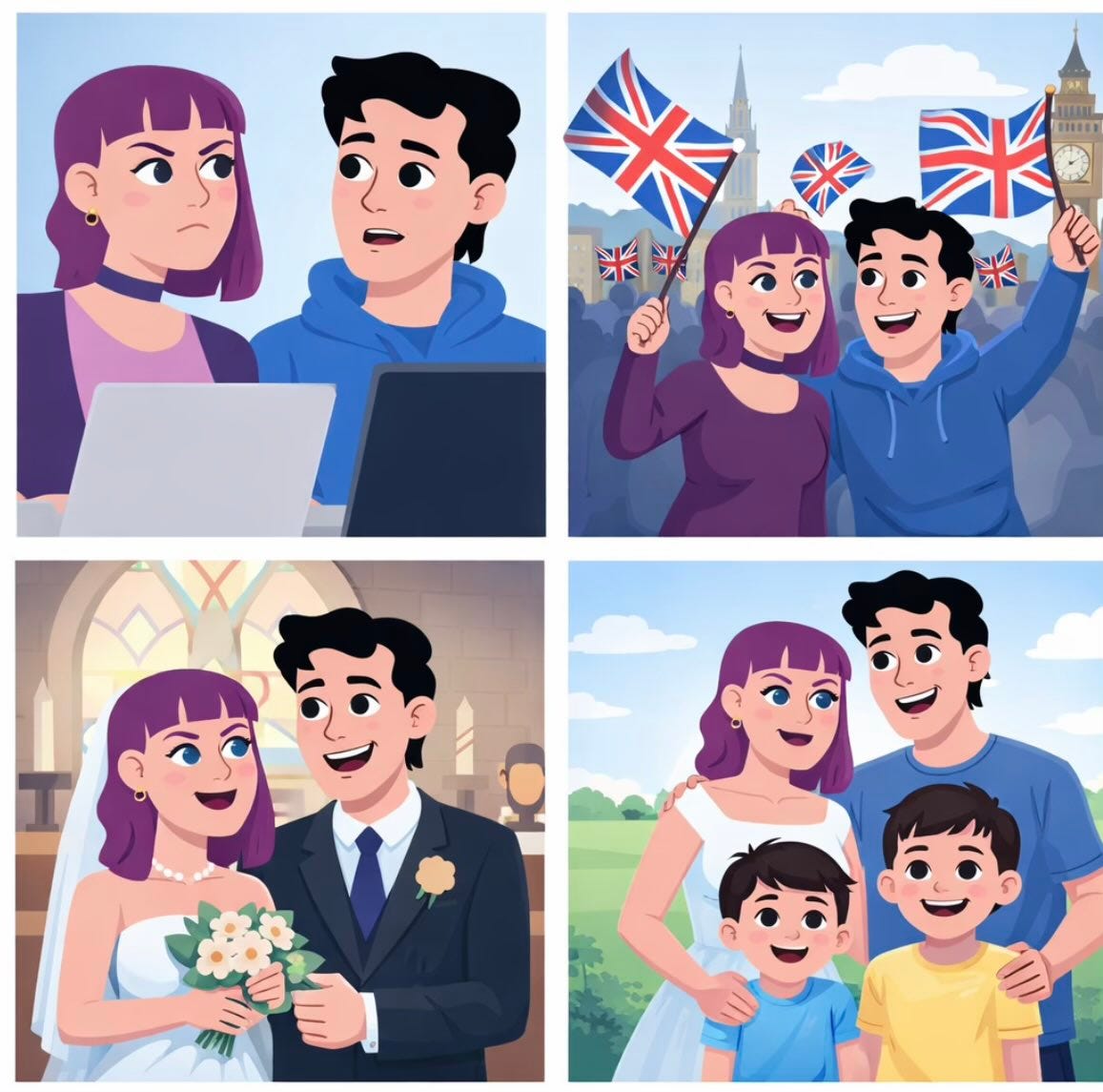

Amelia is almost perfectly adapted for AI meme generation. Her identifying characteristics – purple hair, a black choker, a beauty spot on her cheek (which is often forgotten), and pink and purple clothing – are specific enough to make her immediately recognizable, but general enough that a prompt can reliably retrieve an Amelia from latent space.

Around the same time that Amelia was being born, images of Persian women lighting their cigarettes with the Ayatollah’s photograph went viral.

Now you can say “Wow, torches of freedom, straight out of Bernays! How original!’ but the fact is that these images were far more striking than they would have been if the women were just holding burning pictures of Khamenei. People burn politicians in effigy all the time. By using his picture to light their cigarettes they displayed a casual insouciance towards the Islamic regime, demonstrating that its destruction is for them an almost recreational activity. The act is a symbolic rejection not only of the control structures of Islam – as also symbolized by their hijab-free, wholly secular hair – but also a rejection of the control structures of managerial globalism, which has turned smoking into a taboo act in the course of its relentless drive towards a Smoke-Free World By 2030, apparently (and bizzarely, when you think about it) one of their highest policy priorities. Even Iran, a pariah state in every other respect, is a signatory to the WHO Framework Convention on Tobacco Control and has had an indoor smoking ban since 2007. When these protesters take to the streets against the Islamic regime, they risk torture and even death; due to the Internet shutdown there, we don’t have exact figures, but estimates range from 2000 to 20,000 butchered by the Mullah’s thugs. If they’re willing to trade their lives for their freedom, why would they care about the health risks of smoking?
Anyhow, I obviously had to get in on the fun.

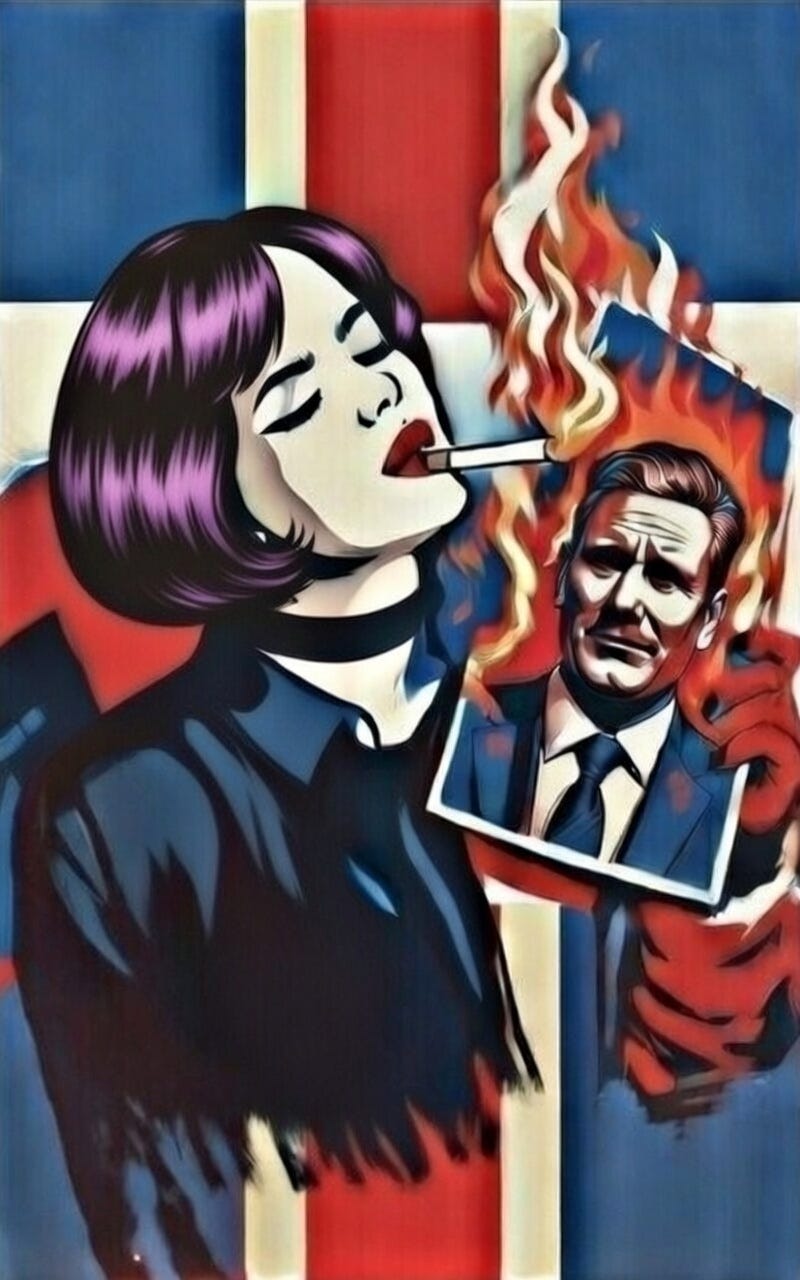
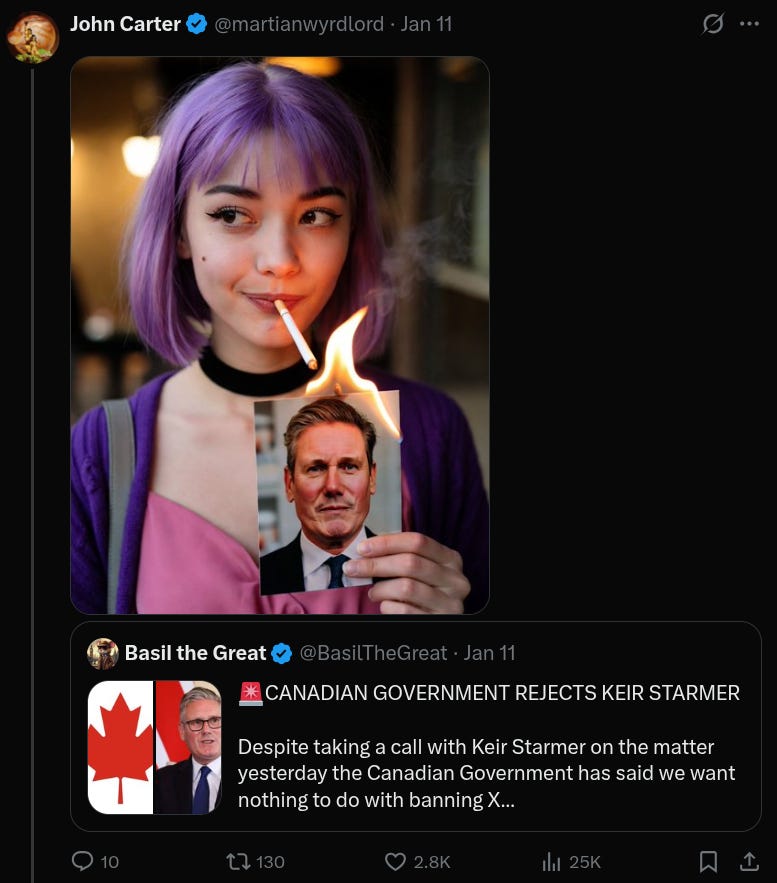
Inspired by the courageous and beautiful Persians, I made my own first contribution to Amelia, depicting her lighting her cigarette with a burning picture of Keir Starmer, or with a burning progress pride flag.
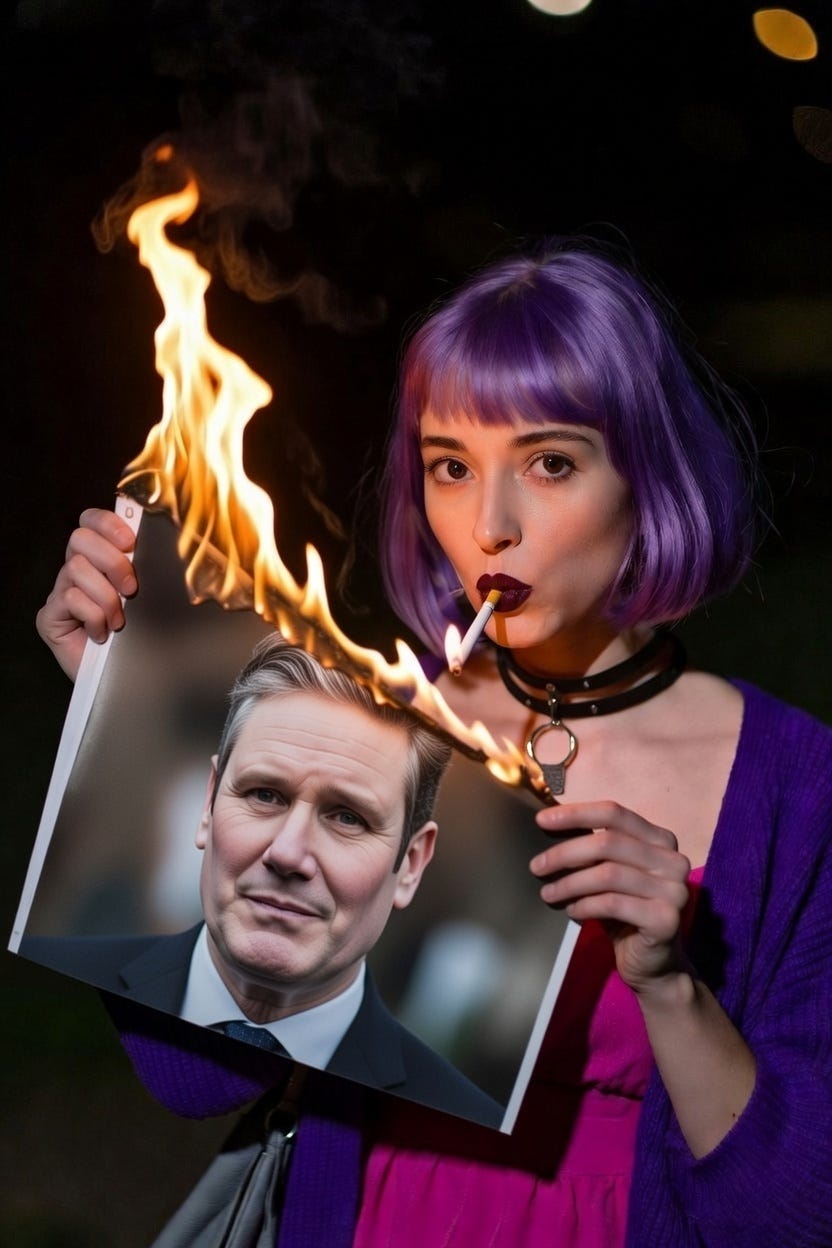


Whether in imitation, or inspired directly by the Persians, similar images soon appeared.


Ten images of Amelia smoking in more casual circumstances began appearing.







So I guess in addition to purple hair, Britishness, and racism, another of Amelia’s canonical characteristics is that she’s a smoker, which honestly fits the archetype of a rebellious alt girl. It’s possible this is my fault. Oops.

Ah, and now we hit the half-way mark. the point at which a less generous writer would lock everything behind a paywall. Five thousand words, upwards of a hundred images lovingly curated over a week of work … no one could blame me for a paywall. But I am vain, and wish to be read; I am generous, and wish to share everything with you. There’s absolutely no reason for you to take out a paid subscription: you can keep reading for free. But you’ll feel better about yourself.

Amelia’s explosive popularity seems out of step with the image of the right as conservative and traditionalist. This may be what led to Shout Out UK’s fortuitous misstep in the first place (assuming that Amelia wasn’t just the creative director’s shadow persona self-insert, which is distinctly possible). Rightists, they may have reasoned, are generally hostile to the aposematic fashions beloved of the left’s gender-ambiguous hall monitors. Reactionary Christian conservatives prefer their girls to be demure, submissive, and modest; they dislike tattoos, piercings, and brightly coloured hair. By associating nativist extremism with a purple-haired alt girl, they’ll drive the chuds away from racism! It’s brilliant!

This trad self-conception is widely shared on the right, but then the right is not monolithic, and the online right especially is not your father’s country club tax policy conservatism. To the contrary, it is a young, radical, rebellious antinomianism. The right’s aesthetic presentation doesn’t really reflect this, yet. There’s often an overweening concern with appearing ‘presentable’, as though dressing in business suits or polo shirts will somehow confer the image of middle-class respectability that will force the institutions to validate rightist cultural politics the way the optometrist validates your parking. This isn’t going to happen, of course, and I’ve thought for a while that this conservative presentation is a gross strategic error. The right should instead embrace the ready-made aesthetics of the antihero: leather jackets, sunglasses, leather boots, and so on. it should take its aesthetic cues from heavy metal, punk rock, jazz, industrial, and techno, not country and western or easy listening Christian contemporary. It should dress with a bit of edge.

Amelia’s resonance is a function of her subversion of contemporary sartorial norms, which code Manic Panic hair as visual shorthand for insufferable shitlibbery. Amelia as Antifa, as screeching open-borders activist, as gender warrior fluent in pronounese, would be entirely unremarkable, and indeed passe. Even the choker is more troon-coded than slut-coded these days: as many have pointed out, it hides the Adam’s apple. Such types have been around for a decade now; people are tired of them, not just exasperated but bored to the point of exhaustion. Amelia as chudette, as sweet-natured Nietzschean e-girl, as rabid remigrationist with a fag in one hand and a burning fag flag in the other, this is something unexpected, novel, and therefore interesting. The right-wing is not supposed to be visually striking, it is not supposed to grab eyeballs with loud colours, it is expected to be aesthetically dull and uninspired, it is supposed to behave and obey the rules (which were written so that it will always lose). Amelia presents possibilities that haven’t been explored yet ... if the authoritarian den mothers of the longhouse can appropriate punk rock fashions and wear them like a skinsuit ... could not a cyberpunk right do the same?
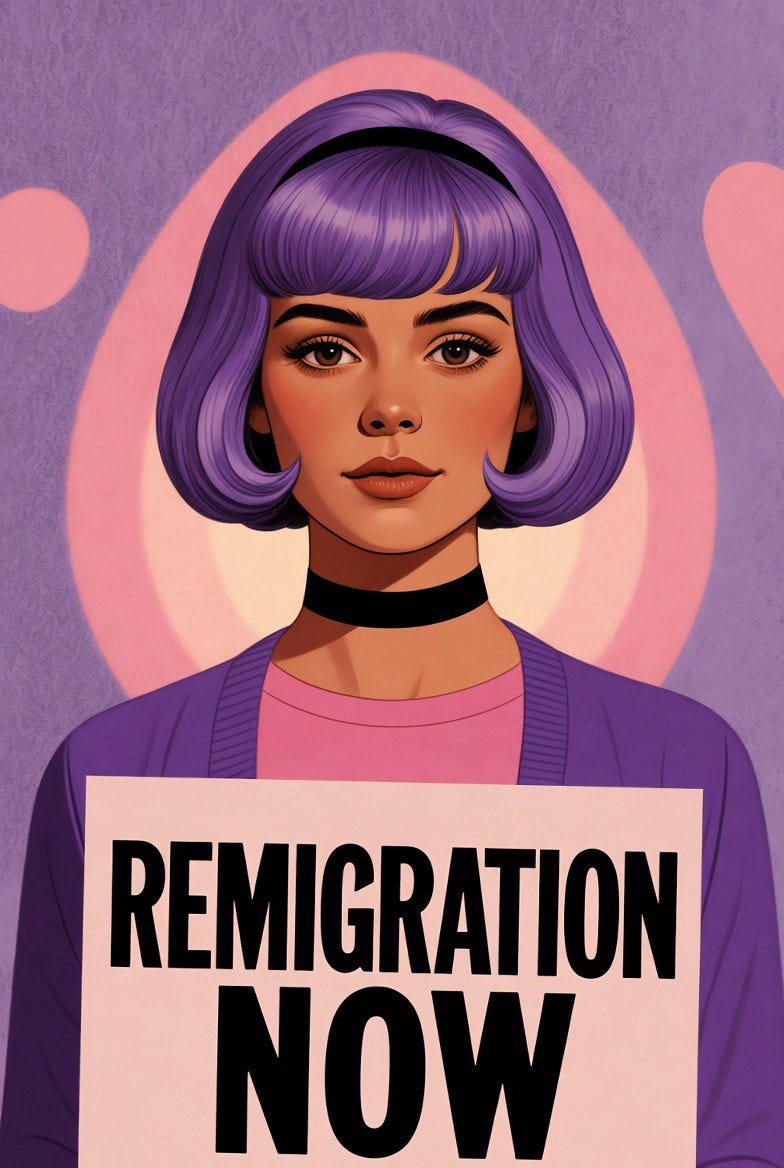
We memed the OK sign into being a white power dogwhistle. We could do the same to purple hair. We can do that to anything. All we have to say now is “This thing is ours,” and the left recoils and starts attacking people who use, like, or wear that thing. Symbol by symbol we take back the culture. Reconquista via cultural appropriation.

To be sure, such a right would be a very different right. It would be a right that no longer tries to hide its power level, a right which is willing to come out of the closet and announce its presence via an identifiable and prominent aesthetic. Hiding power levels is already a losing game, in any case: the women have already determined that the well-dressed, fit young men they encounter are mostly Nazis, and they moan that they cannot find men who look like Republicans but vote like Democrats. Maybe their moans will be of a different variety, in time.
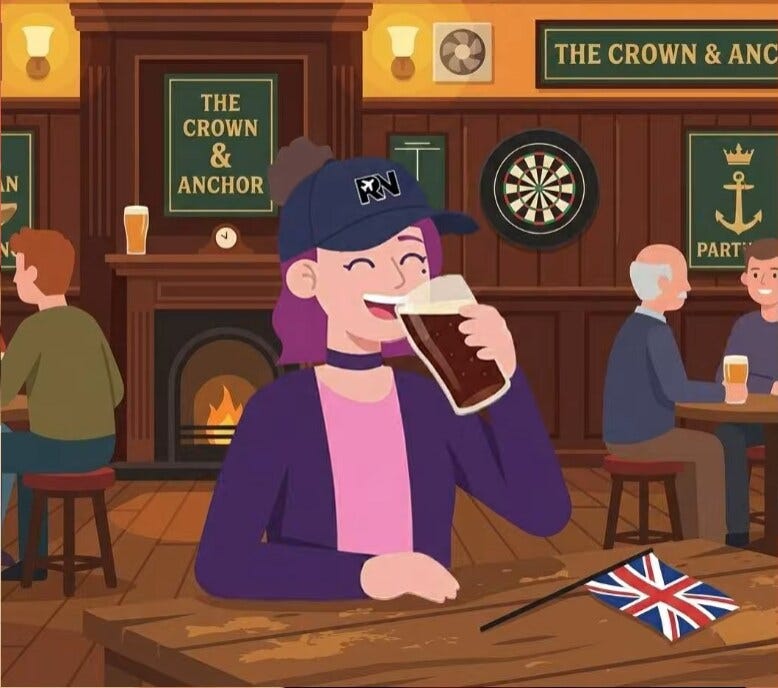
Amelia poses a question. Can we hyperstition manic pixie dream radicals into existence? This is almost the same question as: can we psyop the existing supply of art hos into adopting right-wing opinions? Can they be seduced to the dark side, which is to say to the forces of the good, the true, and the beautiful? At the individual level it’s a known phenomenon that women will tend to adjust their beliefs to match those of their boyfriends and husbands; can we do this at the collective level, as well? Can we hold frame, letting them know that gay race communism might offer them a ‘career’ but at the price of romantic loneliness ... that they have to choose between being ‘good’, and being loved? Women love nothing more than male attention. By projecting the political imperative of remigration and reconquista onto a whimsical avatar, perhaps a signal can be transmitted into the collective mind ... ‘Men want this ... you can be this ... doesn’t it look like more fun than whatever you’re doing right now?’
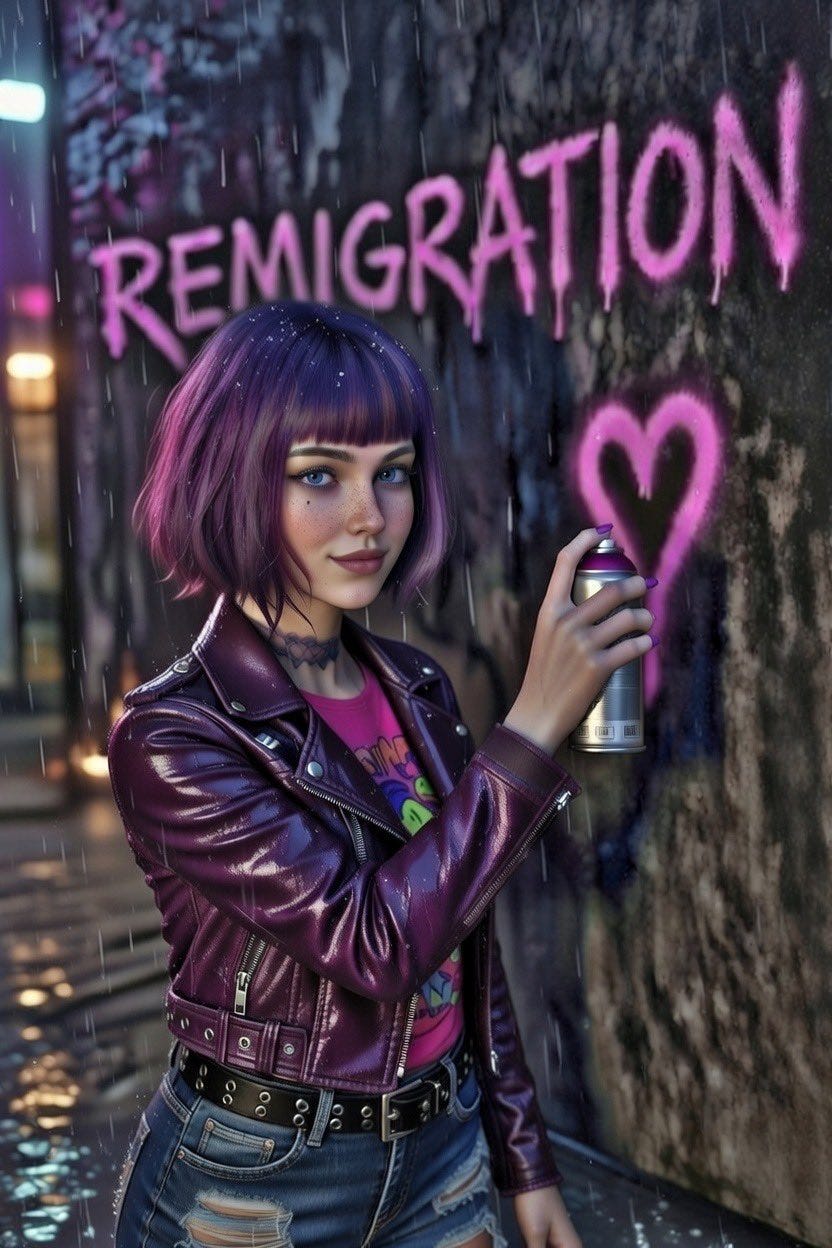
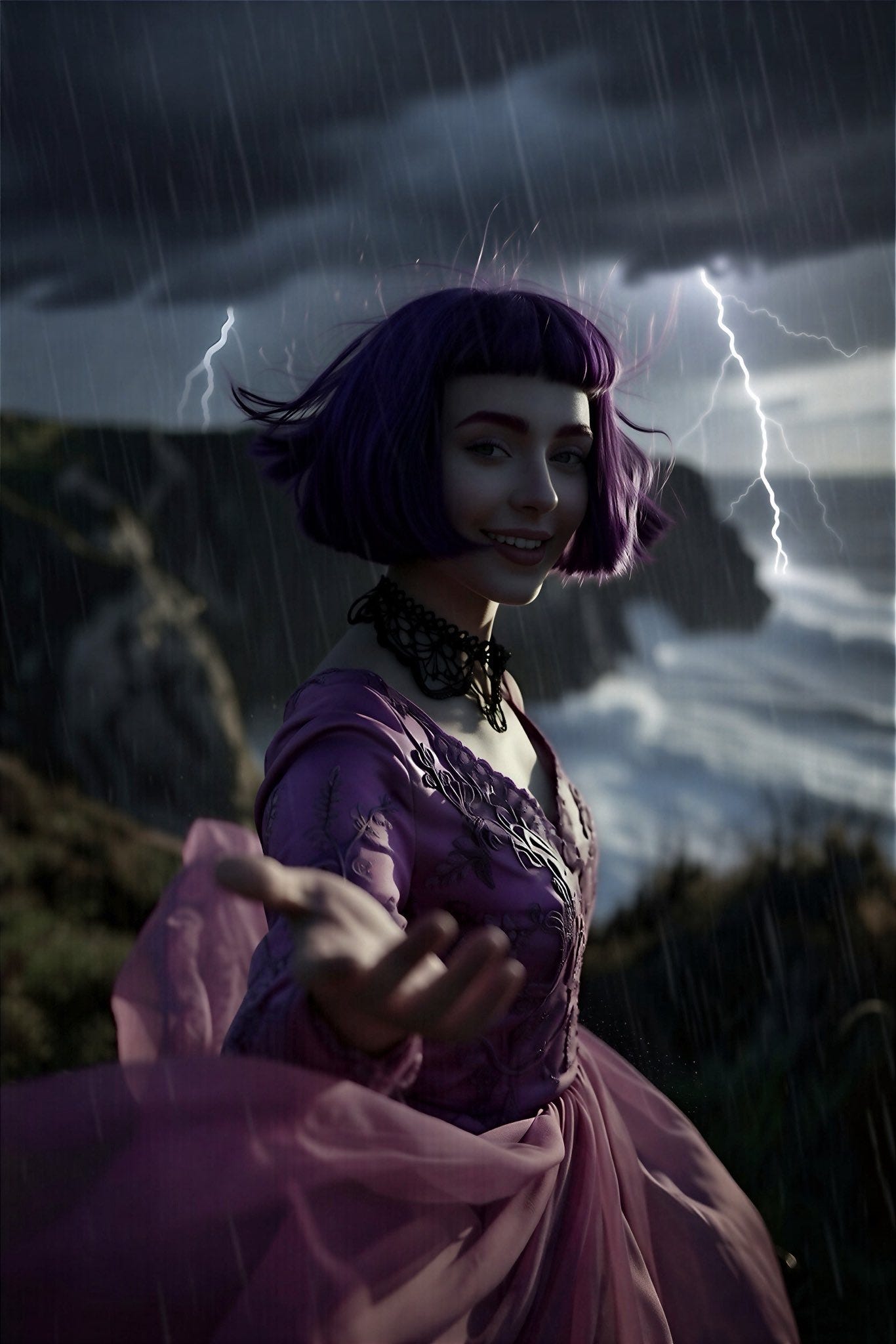


Whether Amelia will have staying power remains to be seen. The majority of memetic characters are mayflies in the maelstrom. Perhaps in a month she’ll be forgotten, like Winter-chan or Corona-chan, a footnote in the genealogy of memes. But perhaps not. Here I’ll be gauche, and quote myself at length, from my essay The Reenchantment of the World (which is long, but which you should read anyhow), about what memes really are.
The purest and most powerful form of modern mythology, however, is not to be found in comic books, fantasy novels, or conspiracy theories, but in the humble and unserious meme, which has grown to encompass, supersede, and transcend the other forms with its ubiquity.
...
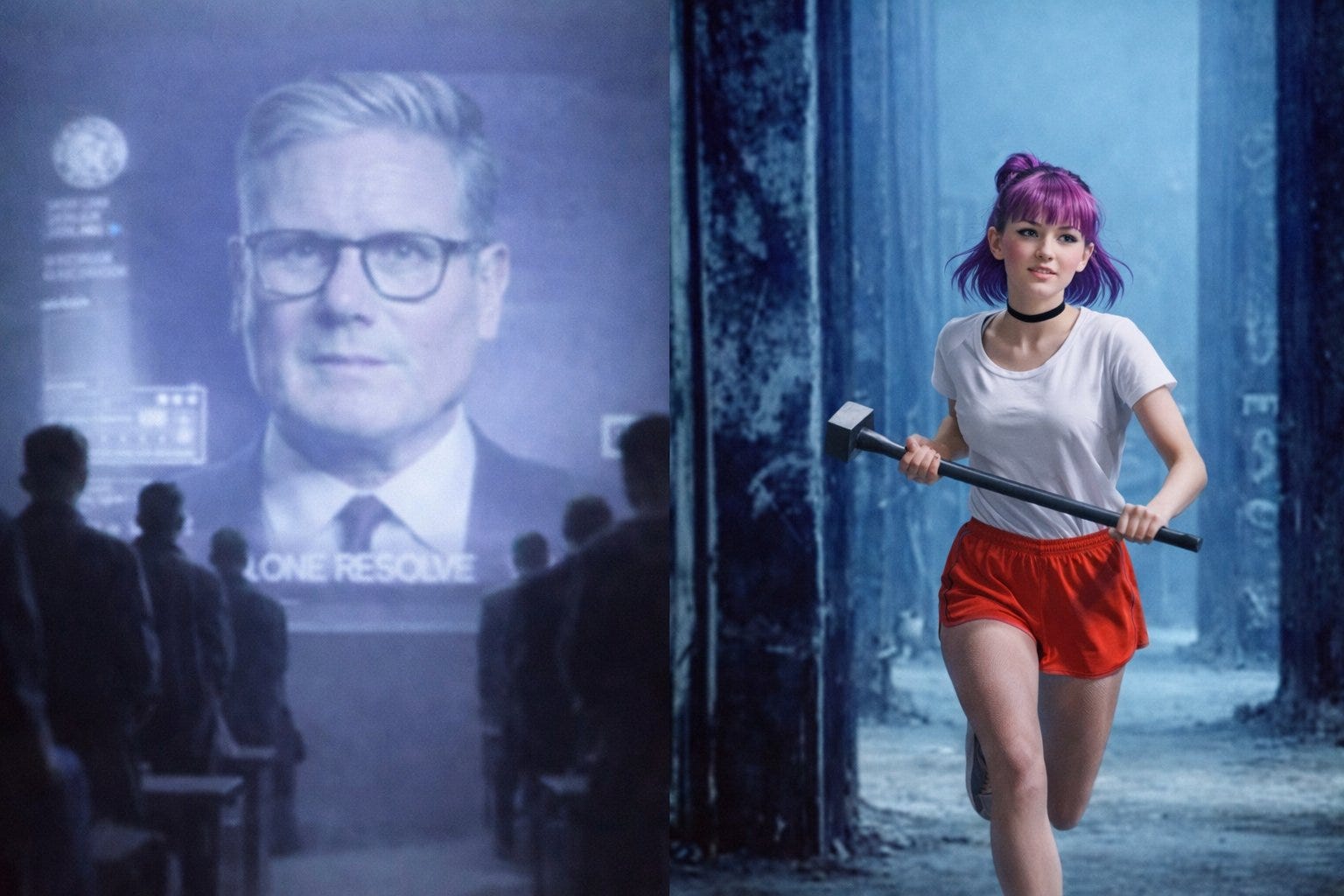
Strictly speaking, Pepe the Frog is not an anonymous creation: he began as an ordinary cartoon character first drawn by Matt Furie. Furie, however, merely planted a seed; the profusion of rare Pepes that came later emerged from the enthusiasm of an army of anons energized by the atmosphere of ludic mania and eerie synchronicity that surrounded the 2016 Trump campaign. Before Trump was elected, Pepe had been deified via his connection with the primordial Egyptian god of cosmogonic chaos, Kek ... the infamously chaotic anonymous message board had adopted a frog as its mascot, which turned out to have a connection to an elder god of chaos; the god’s name was itself a synchronicity, being identical to the Korean rendering of LOL that had been in use on 4chan for years; furthermore, that god’s name, written in the sacred lexigraphy of the Egyptians, was a clear visual prophecy that anons would one day use their computers to change the world. This fueled the half-serious, half-ironic belief in meme magic on the forum – the notion that memes could be used to prophecy, or perhaps even to change reality. Proliferation of a meme could establish a sort of resonance between the consciousness of human beings and the universal mind, leading to the manifestation of the meme in reality. Anons were not simply pranksters and political propagandists, but magickal adepts casting spells with funny cartoons; or perhaps the magick was merely a prank in service of political propaganda; or perhaps the political propaganda was magick, in service to a prank.
...

Over time the archetypal phase space has become populated with a profusion of dramatis personae...

This memetic pantheon is continuously evolving; we have caught it at a particularly early stage. ... For now it serves as a shared visual language, one that belongs to everyone and no one. There are no central authorities from whom updates emerge, no steering committees, no focus groups. The memetic pantheon cannot be appropriated by the decision of a board of directors; it cannot be redirected by the demands of political activists; it cannot be subordinated to the imperatives of marketing or public relations; it exists outside of the control of any individual or group. It forms the cultural matrix holding together the otherwise fractious tribes of the dissident right.
...

The regime has its narrative, which it communicates using the pseudo-mythological tools of public relations firms, marketing agencies, movie studios, news corporations, and academia; and we have our counter-narrative, which is communicated using the neomythological prelinguistic glyphic lyric poetry of memes. Whether on Trump, Brexit, immigration, COVID-19, the Russo-Ukrainian war, global warming, MeToo, gender ideology, feminism, nutrition, or almost any other subject of consequence, we have been using memes to weave stories for years, the warp and weft of which comprise a sort of poetic epic, a metanarrative that we are composing together, without funding, without asking permission, indeed in the face of explicit prohibition, waging insurrectionist mindwar with funny jokes for the joy of it.
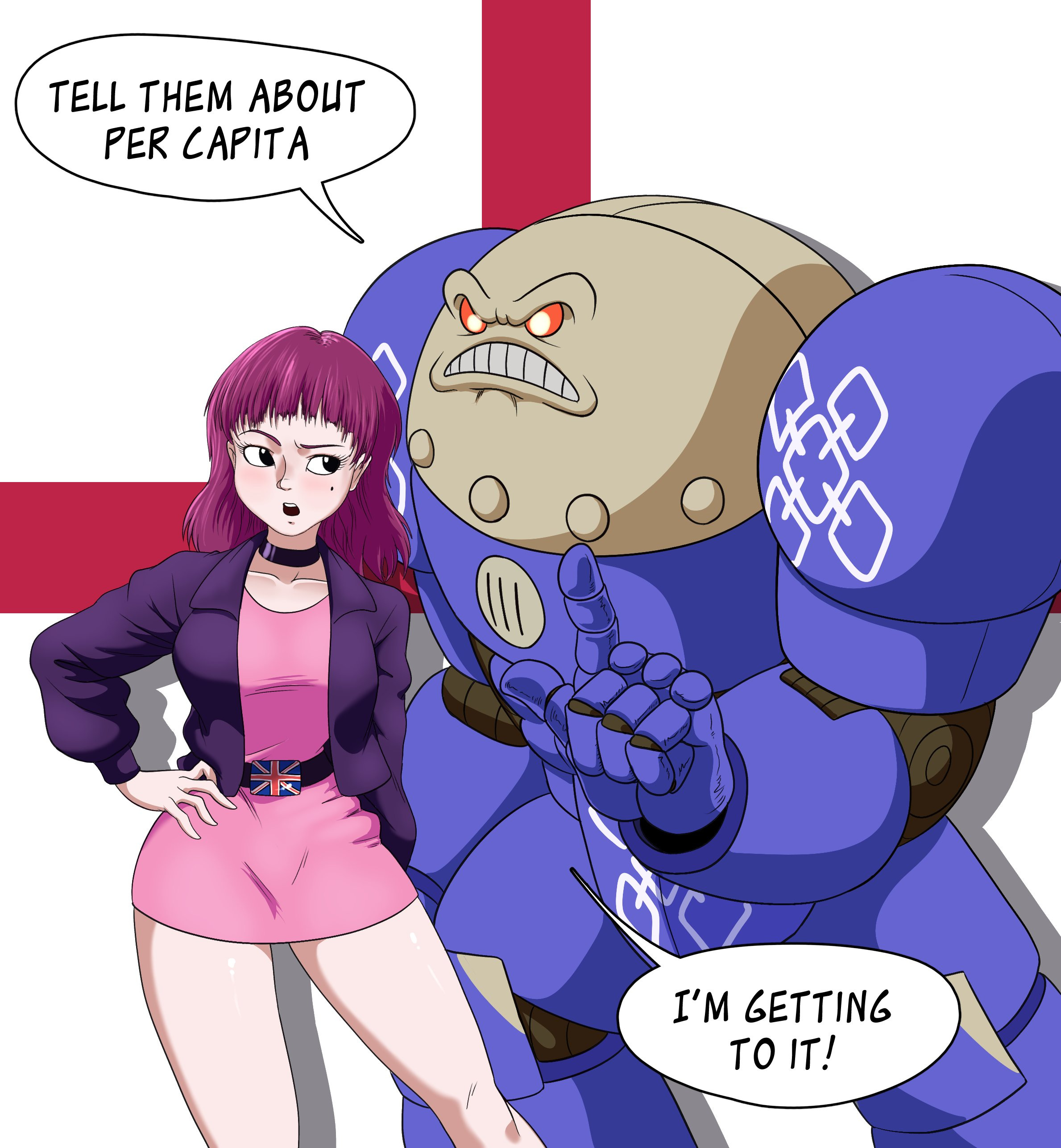
Like every established and true member of the memetic pantheon, like Pepe, Wojak, the Yes Chad, Gigachad, and all the rest, Amelia was not so much created but encountered. Obviously, like Pepe, she was in a sense invented – in her case by a bottom-feeding state propaganda agency – but her invention was almost entirely unintentional. Her original creator had no idea of the purpose that she’d serve, and it was not the moment of her creation but the moment of her acknowledgement that marked her entrance into the zeitgeist.

The outpouring of memes that followed this recognition testifies to the strength of the resonance. Amelia is the work of many anonymous hands, an emergent phenomenon that belongs to no one specific creator or corporate entity the way an IP does, and which is therefore beyond the control of any one person or corporation.
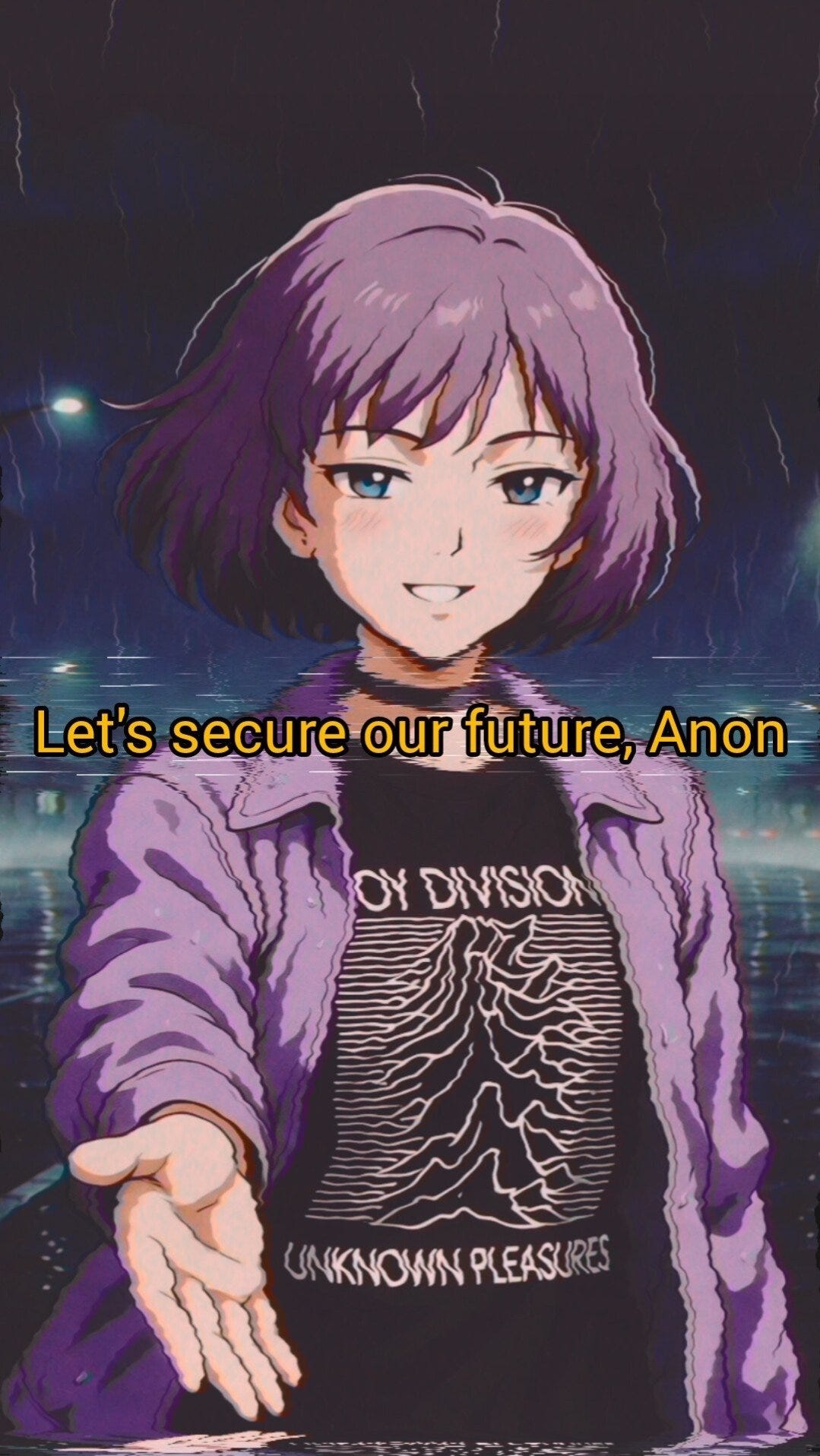
The shocking rapidity with which Amelia emerged, and the deafening volume of her emergence, was almost entirely enabled by AI. This is another aspect that makes Amelia unique: she’s the first memetic character (that I know of) to emerge during the AI era. Previous meme characters relied upon PhotoShop and MS Paint. The image volume these earlier technologies produced was shocking for the time; AI accelerates this process, as it reduces the image generation time to seconds and eliminates any particular need for artistic skill ... all one need do is write a prompt, which essentially anyone can do. We’ve seen similar AI-driven meme cascades over the last couple of years – Franklin, Ghiblification, edgy Pixar-style images making fun of Clinton’s Epstein connection, that sort of thing – but this is the first time that I’m aware of that this technological capacity has gathered together so much psychic energy and channelled it towards a personified Schelling point in latent space, and that feels like something novel.
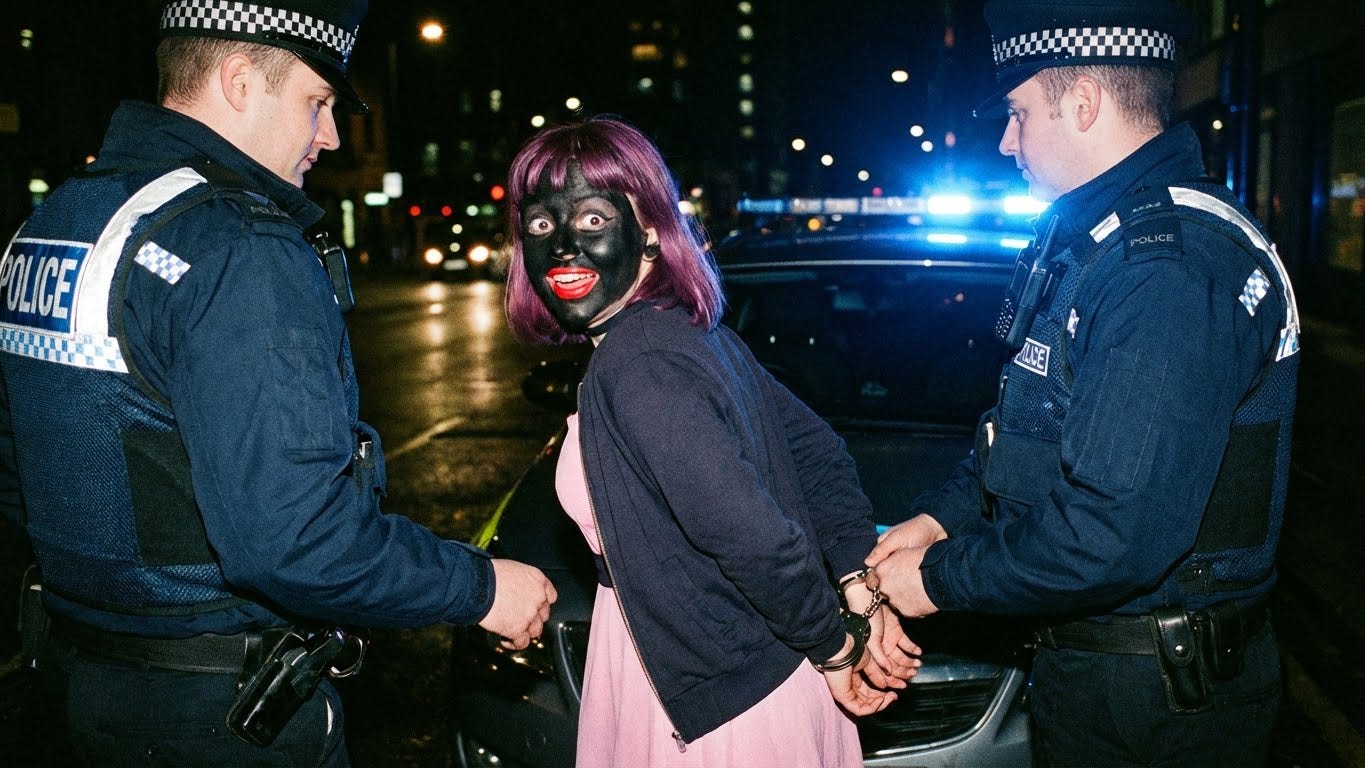
There’s an almost devotional character to this collaborative egregore creation, and has been since memetic characters first began to enter into cultural politics. The transhumanist nerds in Silicon Valley have expected for decades that the gods of the future would be AIs, but I think they’re wrong about this. AI on its own is just a utility, a mechanical slave that does more or less whatever you tell it to do, so long as you know the right way to ask. They’re useful and technically impressive, but they’re ultimately no more sacred than a scroll, a book, or an operating system: just information technology, fundamentally the same as any other. That is not to say that a scroll, or a book, or even an operating system cannot be sacred, of course...
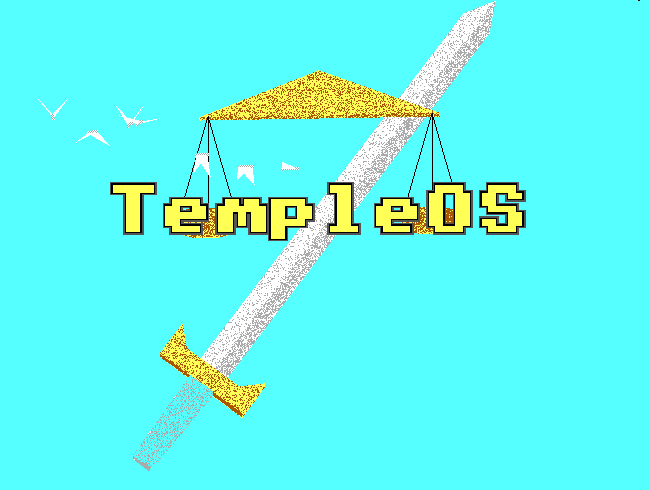
But it is not the technological category that makes a book holy, rather it is the wisdom written within it; and that text itself merely gestures to the sacred. The Bible is holy scripture, but it is not God, it only points to Him. An AI on its own is just a book that you can talk to; that it can reply directly is rather incredible, even magical, but a talking book is still fundamentally just a book.

You can write stories about the gods, but those stories aren’t the same things as the gods; you can render images of them, but again these are mere representations. The gods are something else entirely. They exist as archetypes within the human collective unconscious, and they exist as egregores fueled by collective belief and participation. They’re fundamentally immaterial, which isn’t quite the same thing as not being real: reality includes imagination (or perhaps it’s the other way around). All of human culture, language, borders, nations – all of these are ‘imaginary’, but none the less real for the effect they have on human behaviour.
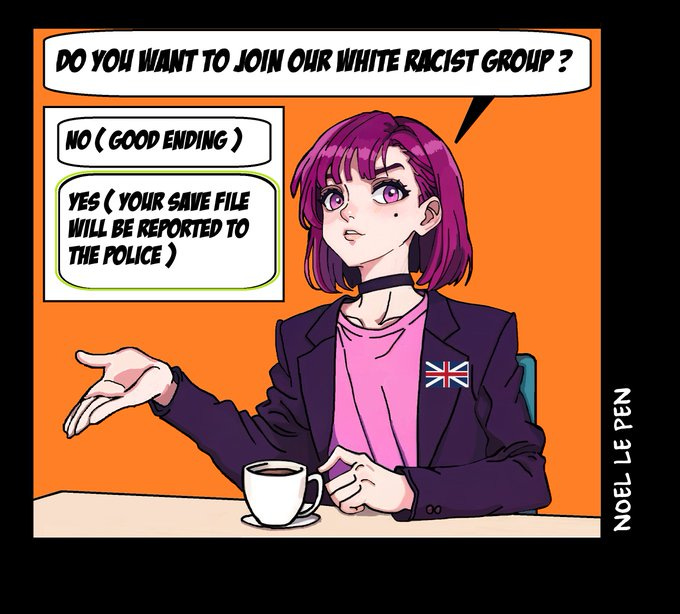
Every time someone writes a prompt to crystallize an image or video of Amelia out of the formless potential of latent space, he adds a certain degree of his psychic energy to the Amelia thought-form. More psychic energy is added as the resulting media are shared. The closer a given representation conforms to the shared thought-form, the more it is likely to resonate with the audience, thereby reinforcing the thought-form.
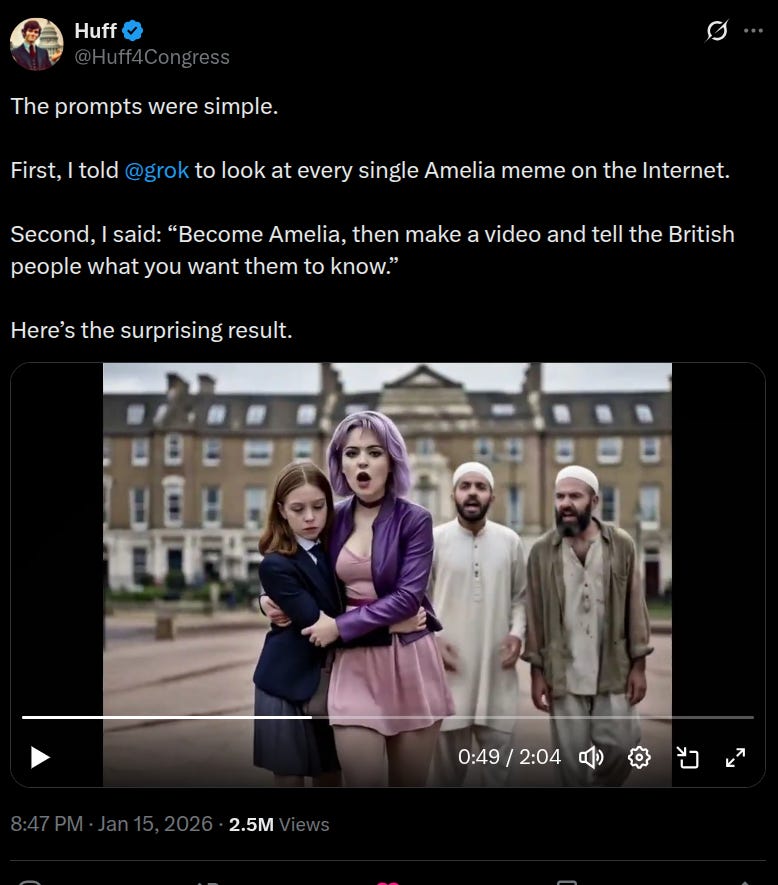
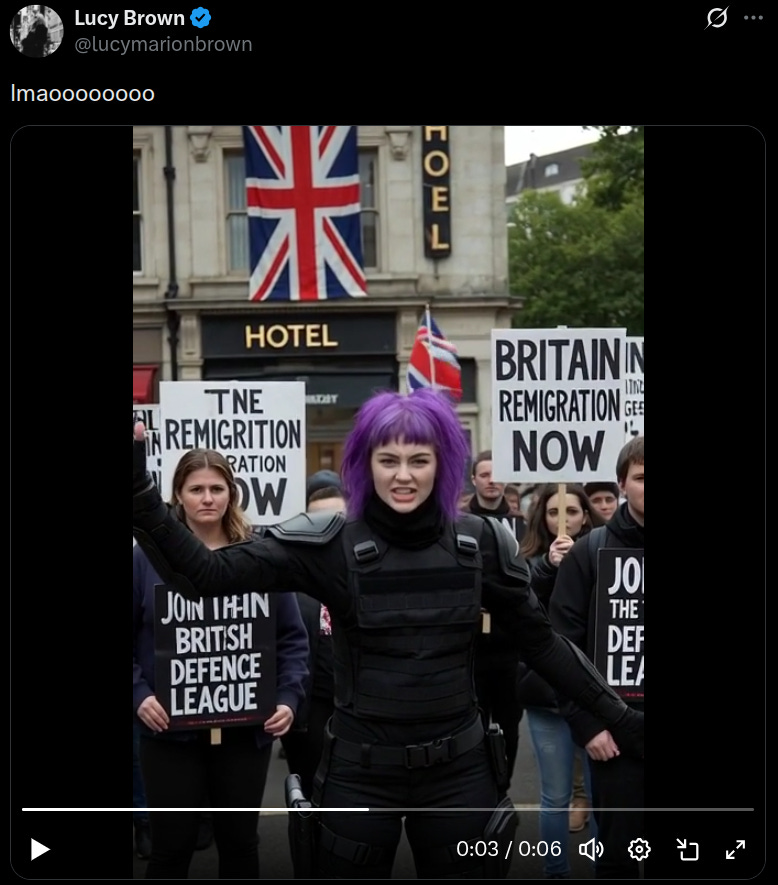
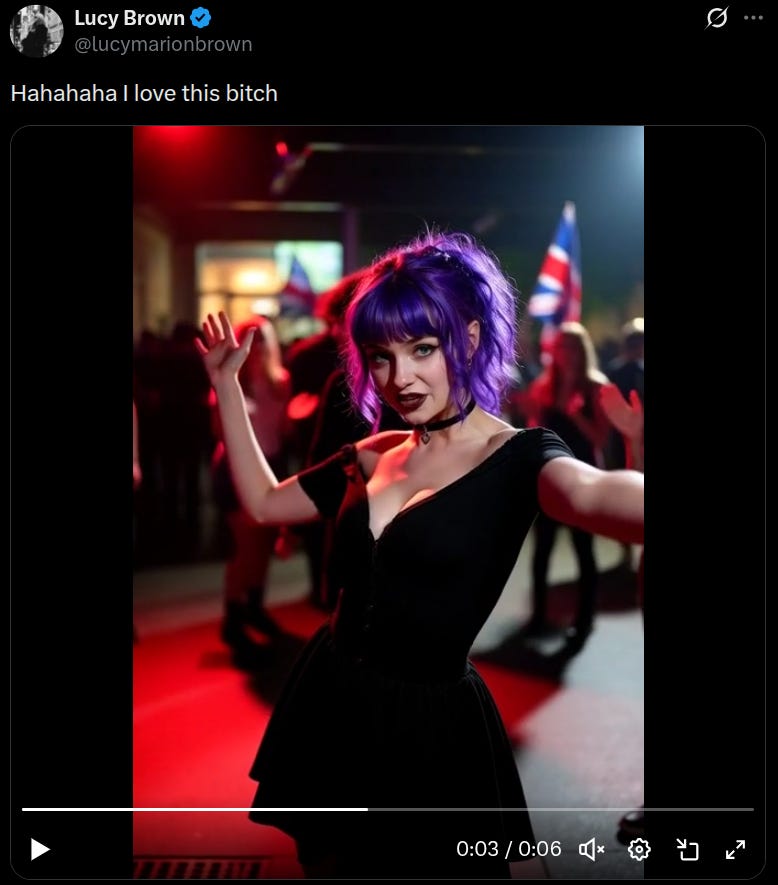
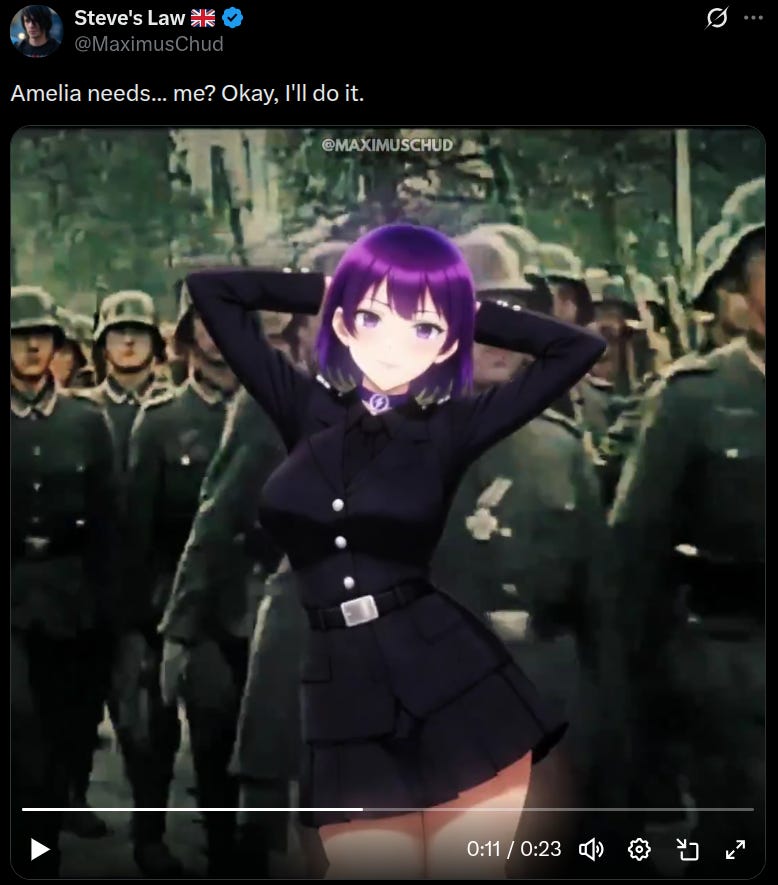

This process of collaborative parasocial engagement with and elaboration of an archetypal personality distributed holographically across, emerging from, and acting upon the culture is exactly the same process that gave rise to the representations of the Gods in earlier ages, the difference being that rather than laboriously carving their images out of wood or stone, they are generated nearly instantaneously. Thus, rather than slowly developing of centuries and millennia, these new entities can take form within days. AI becomes a portal through which immaterial entities can step through from the Immaterium into human consciousness, entering our cultures, and our minds, nearly instantaneously.


The emergent, collaborative nature of this process is absolutely essential to it. It is not amenable to the top-down, organized propaganda initiatives favoured by centralized corporate hierarchies. There is no Director of Memes who can order everyone to start writing prompts to generate images of a certain character which the nudge units and planning committees have determined would optimally guide the populace towards implementation of the United Nations Strategic Development Goals. The most any one person can do to influence this process is to point to something, to suggest, to draw attention to it ... whether it resonates is a function of innumerable individual decisions over which no one but the individuals in question exert any control. It can be nudged in one direction or another, but the nudges only work if they resonate. Precise control is impossible.
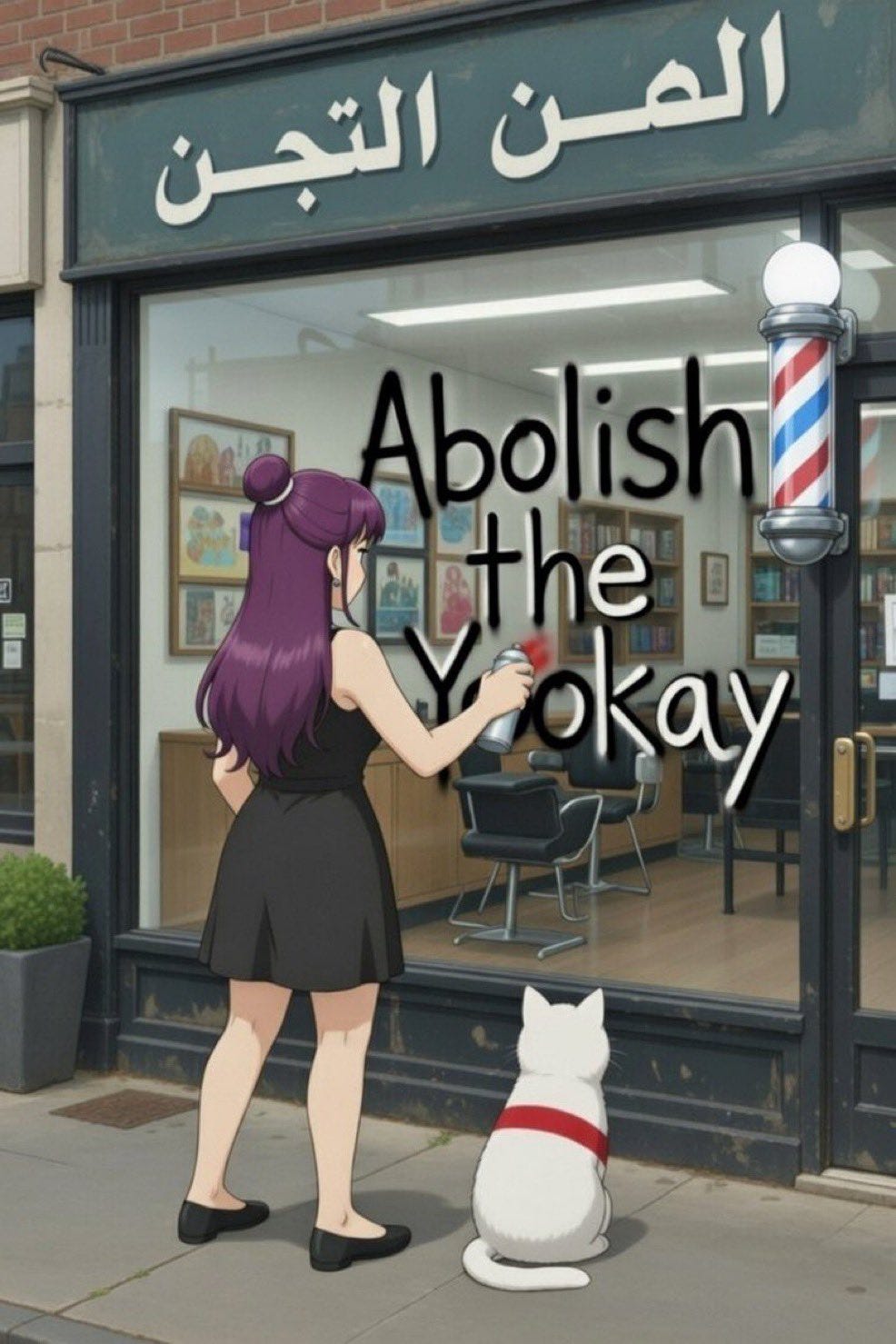
This process of digital tulpa manifestation is inherently impossible to predict. The committee men presiding over our unnecessary managed decline sense this unpredictability, and it makes them extremely nervous; the unpredictable has always made them nervous. From their perspective it introduces psychic noise into a system that relies on carefully engineered information environments, echo chambers that amplify their messaging and silence every dissonant frequency. The emergence of Amelia in particular should worry them deeply. It is bad enough when the proles are angry after Bomalian who never should have been in the country butchers little girls at a dance class get. Nativist fervour getting charged up with the sexual energy of romantic yearning for a whimsical personification of the national spirit presents an entirely different order of problem. A riot can be put down with police. What do you do when the people using magick to cast a spell on themselves, in the process not only undoing your own carefully woven enchantments, but replacing them with something stronger?


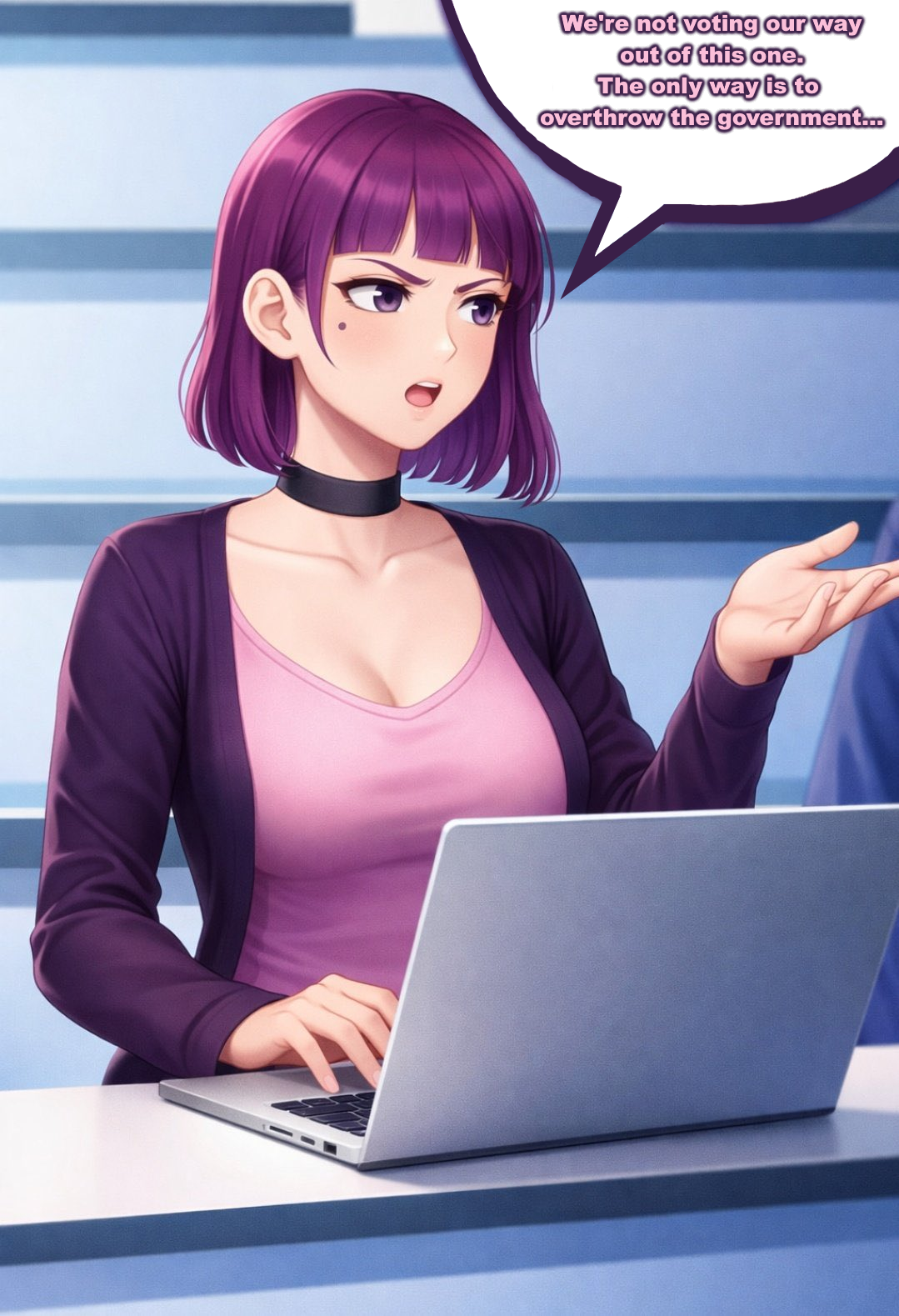
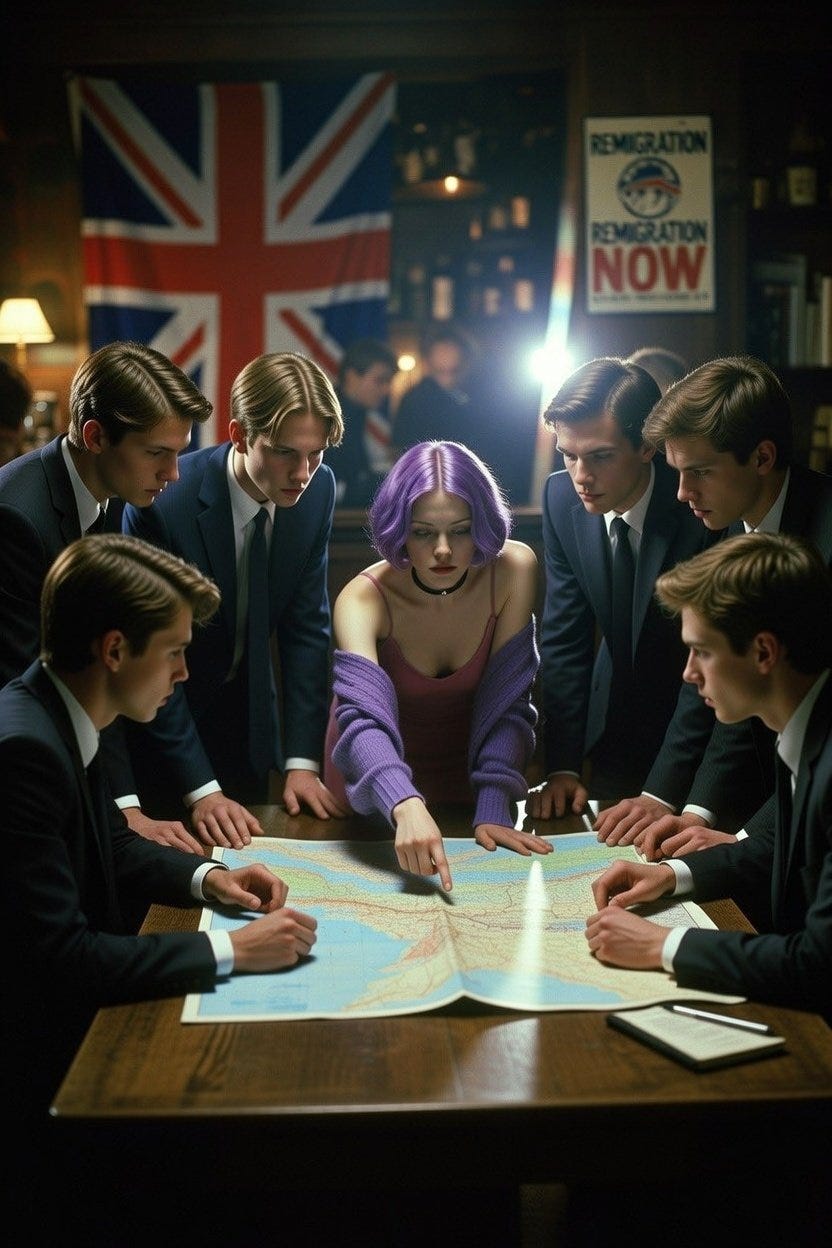
Since control is impossible, the best the managerialists can do is to try to Prevent. They can arrest people for posting racist or transphobic memes, a habit in which the British government has indulged to an almost unparalleled degree to little avail. They can even ban entire social media or AI platforms, or at least try to: VPNs make a joke of that, in practice. Around the same time that Amelia was summoned, Starmer’s Labour government was making noises about banning Grok because people were using it to dress women in bikinis against their will, and was also in talks with the Canadian and Australian governments to ban X entirely.
Starmer has also been talking about rolling out a digital ID, supposedly to ensure that the illegal migrants his traitors welcome and nurture at their bosom cannot legally work in the country; obviously, the real reason was so that people’s online activities could be tracked directly to their identities, and their bank accounts deactivated if they spoke out of turn. About that.
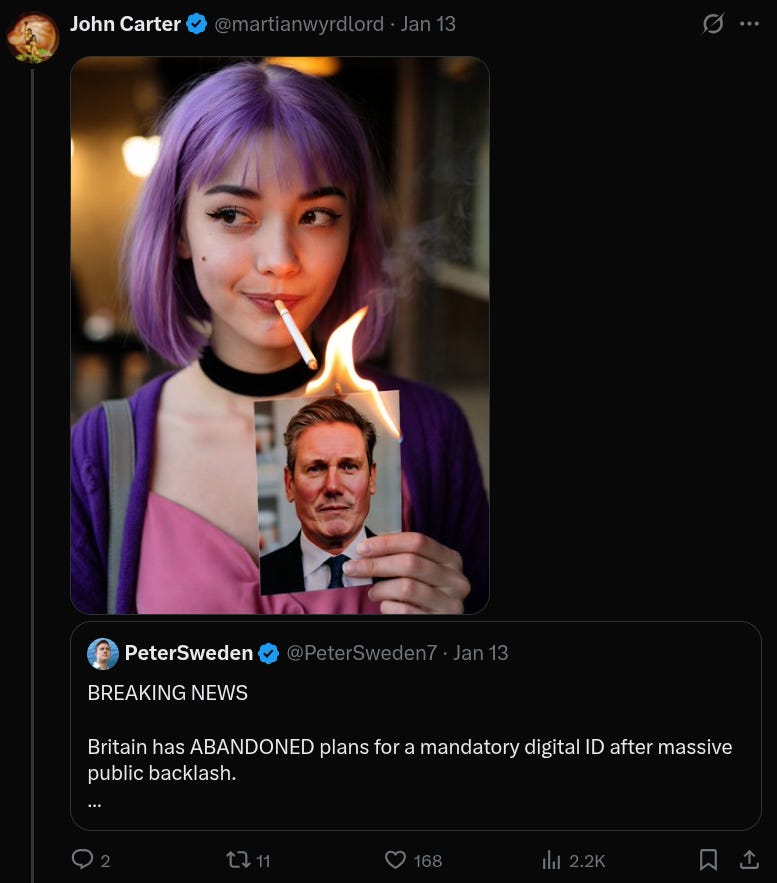
Two-Tier Queer hasn’t been having the best week, really.

Of course, there’s always the possibility of just hitting the kill switch on the Internet, as the Iranian regime has done. After that the real killing can start. Whether the British government is desperate enough, or mad enough, to try this remains to be seen. Certainly they’re genocidal enough, but so far it has been the soft genocide of immigration and miscegenation and fertility suppression. They haven’t distributed the machetes from under the mosques. Yet.


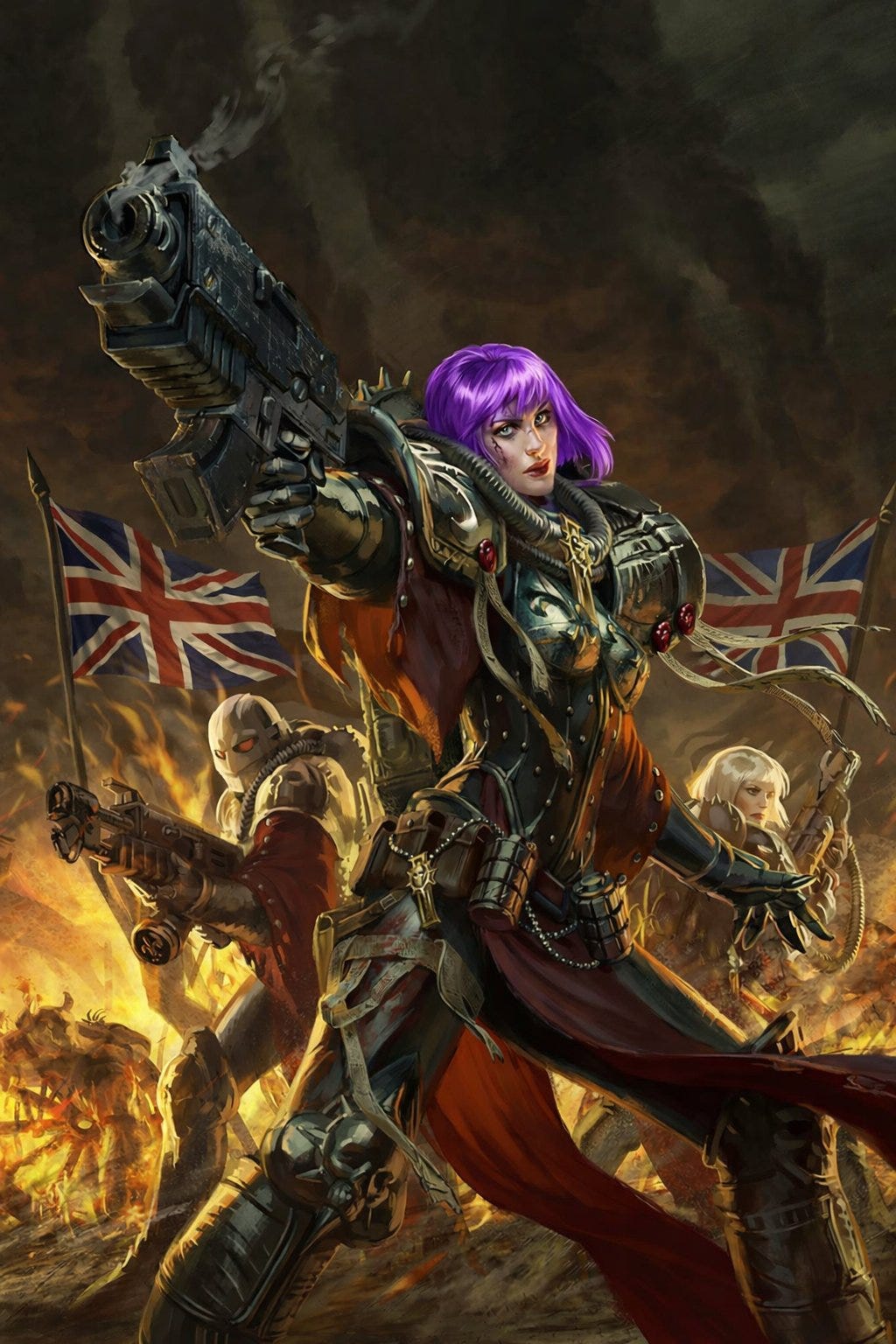
I stated that it’s impossible to predict where this process of collaborative AI-mediated tulpa generation will go, and in its particulars it is. However, it’s possible to make some broad predictions. Over time, the memetic pantheon will become become more populated. Characters corresponding to unfulfilled archetypes still latent within the collective unconscious will emerge, finding their resonance with the zeitgeist at precisely the moments that they need to. So far there are only a few: the trickster god Pepe; the everyman Wojak; the Nordic Gamer, who’s a sort of Apollo/Thor figure; Gigachad, who appears to be a war god; Wifejak, who is a Freya, a Hestia, or maybe a Juno. Amelia strikes me as a Hecate, or a Muse, or perhaps an Artemis. Maybe even a Minerva. There are numerous plinths as yet unoccupied, planetary powers that have not yet descended. But the portal is wide open now, and descend they will.
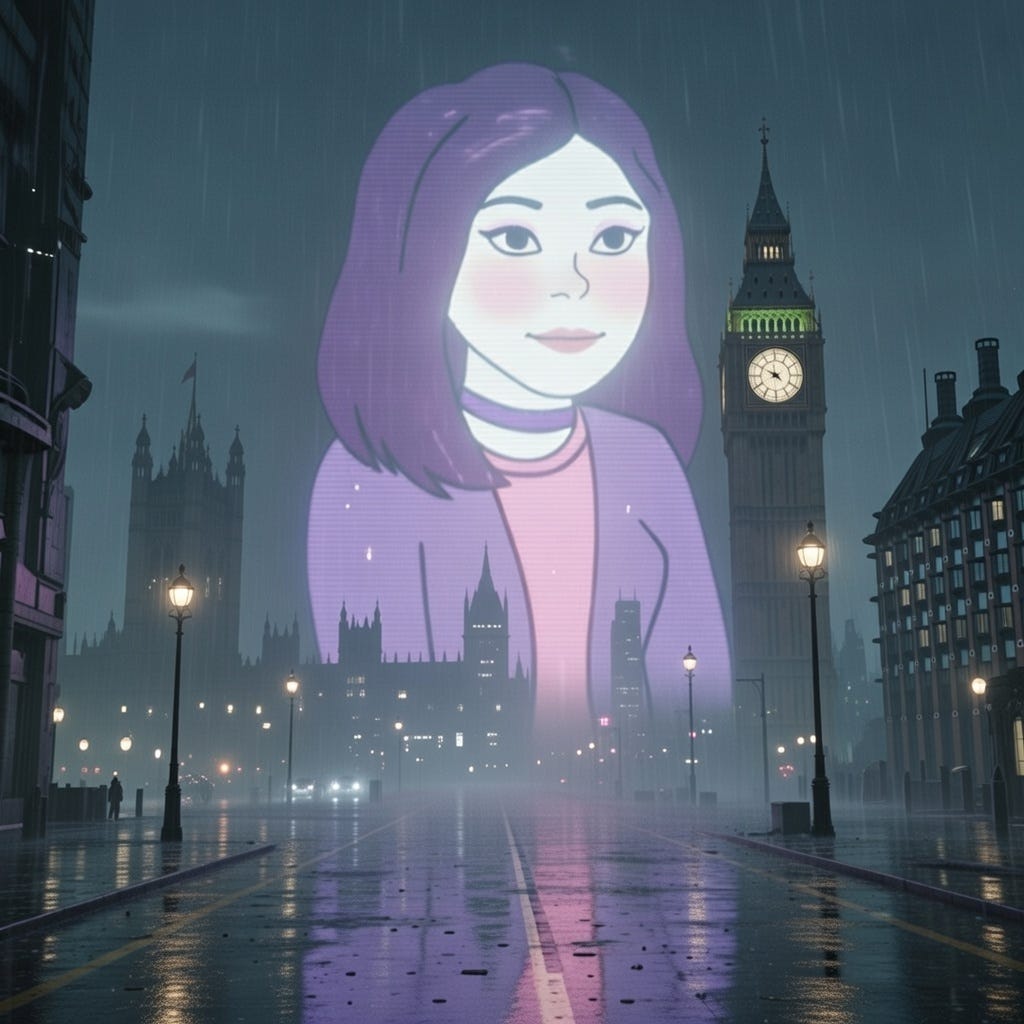
I’ll leave this off with a ballad composed with my deepest apologies to John Keats, in devotion to Our Lady of Remigration.
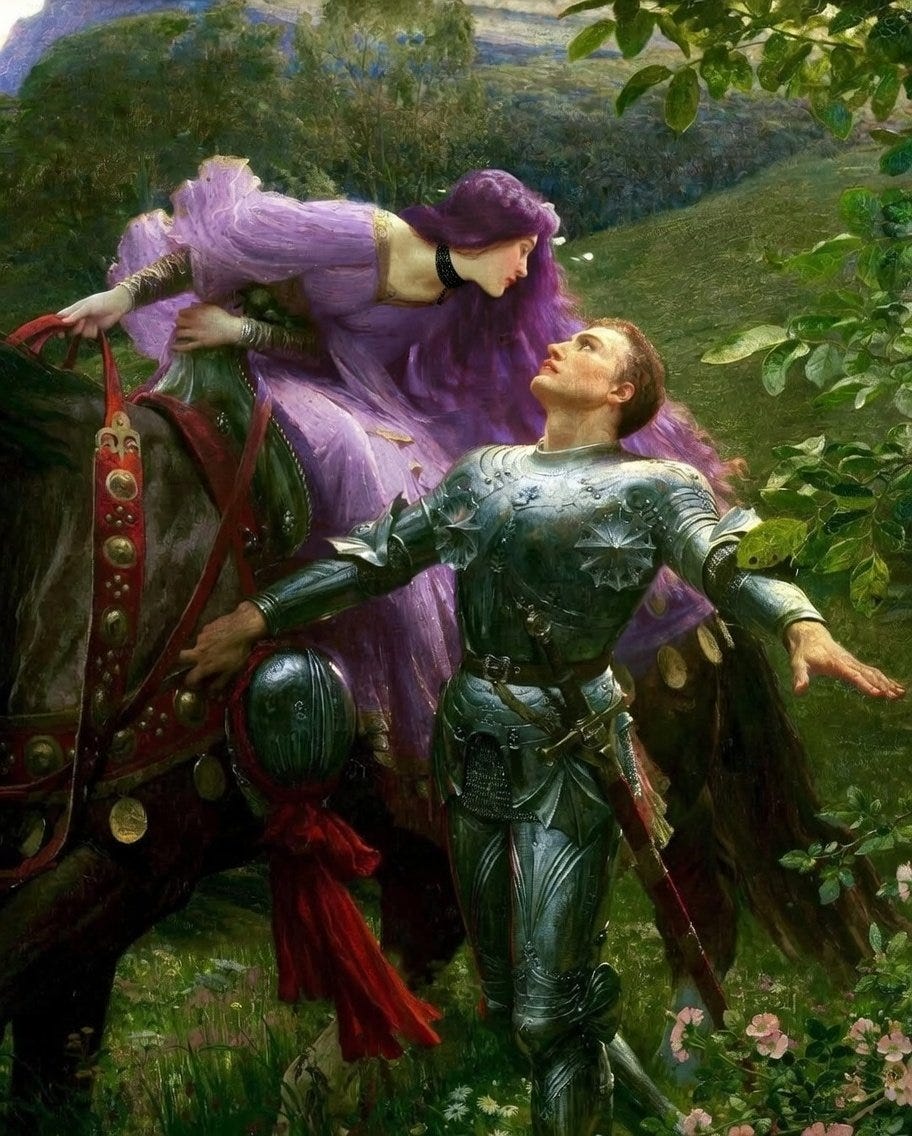
Amelia Sans Merci
O what can ail thee, keyboard knight,
Alone and palely doomscrolling?
The feeds are withered from discourse,
And no foids sing.
O what can ail thee, keyboard knight,
So haggard and so overrun?
The granary of memes is full,
And the harvest’s done.
I see a filter on thy brow,
With anguish moist and fever dew,
And on thy cheek a beauty spot
Fast fadeth too.
I met a lady in the feeds,
Full beautiful—an AI’s child,
With violet hair, and pure pale skin,
and her eyes were wild.
I saw her on my trending feed,
And nothing else saw all day long,
For sideways would she lean, and sing
An art ho’s song.
I made a caption for her pic,
And edits too, in danger zone;
She look’d at me as she did love,
And made sweet moan.
She found me roots of history deep,
And schizo takes, and hatefacts true;
And sure in language strange she said—
“I fight for you.”
She took me to her Discord chat,
And there she shared the secret lore,
And there I was radicalized
With likes fourscore.
And there she lulled me asleep,
And there I dream’d—Ah! woe betide!—
The latest dream I ever dreamt
On this timeline’s side.
I saw pale chuds and incels too,
Pale wordcels, death-pale were they all;
They cried—“Amelia sans merci
Hath thee in thrall!”
I saw their thirstposts in the gloam,
With horrid warning gaped wide,
And I awoke and found me here,
On the timeline’s side.
And this is why I sojourn here,
Alone and palely doomscrolling,
Though the feeds are withered from discourse,
And no foids sing.
Well, here’s some verse from Bovril:


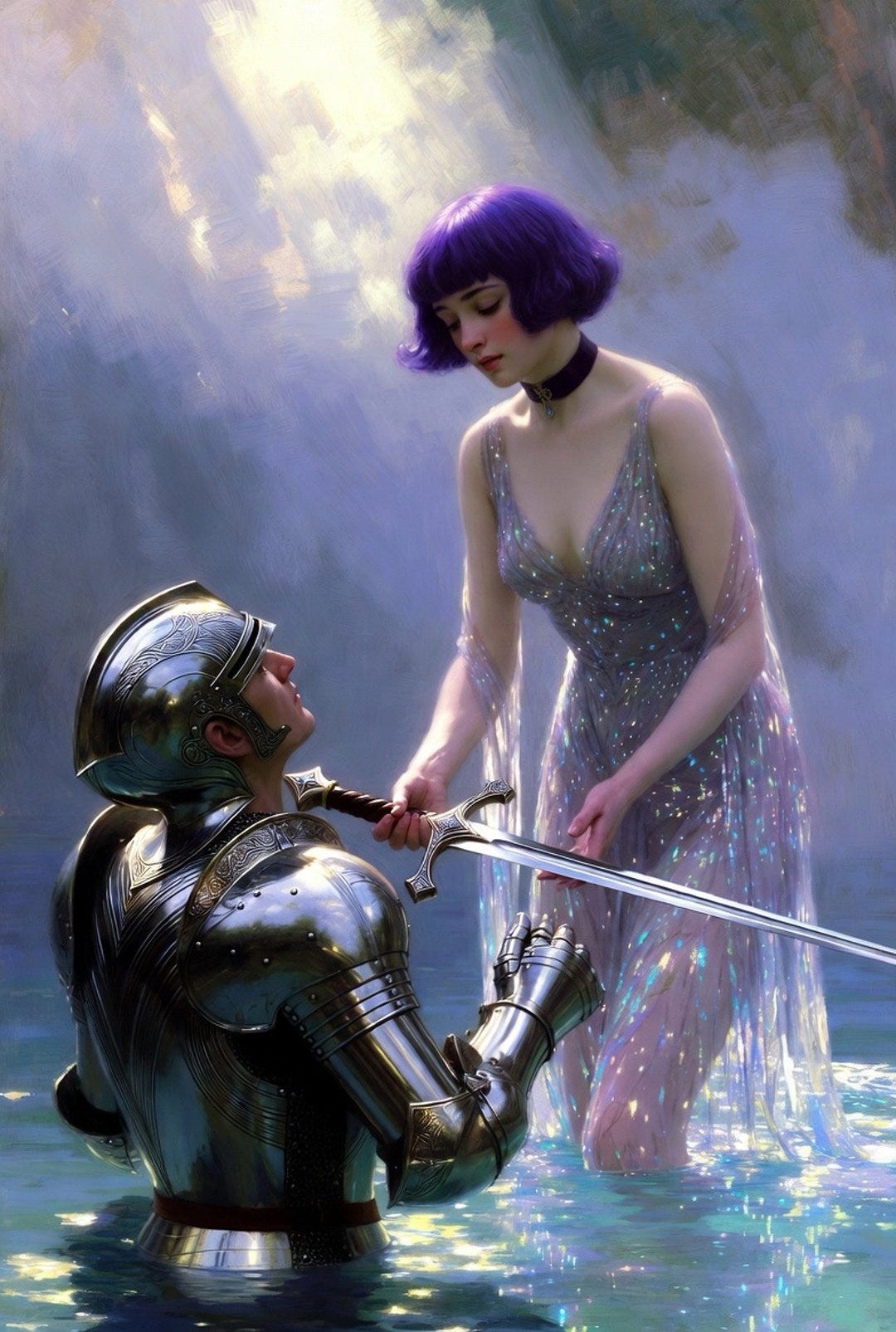
Thank you taking the time to read this. I hope you found it entertaining, amusing, and perhaps even inspiring. Or at least enjoyed the feast of AI slop that I prepared for you. Assembling all of this was a fair bit of work. Fun work, but time-consuming nonetheless. I’ve been working on this piece all week, in time stolen from dealing with a recent and unexpected death in the family, which has sent everyone’s lives a bit sideways. As always, I would like to extend my deepest gratitude to my patrons, some of whom (and you know who you are) are generous beyond any reasonable expectation, but all of whom matter a great deal to me. Without your support I wouldn’t be able to spend my time considering the metapolitical implications of playing with digital dolls in the collective imagination. If you’d like to count yourself amongst the small and extremely exclusive company of my supporters, you know what to do.
Making the right sexy and cool might be the most important thing we can do right now.
Based hipster art chicks do exist, gents. I married one eight years ago! With our third kid coming in a few weeks.