

On Iran
A disorganized core dump of my thoughts on all this

When I sit down to write, I usually have some idea of what I want to say – not only a topic I want to address, but a specific message I want to communicate. This is not going to be one of those essays. My feelings on the war on Iran are conflicted, to say the least. Nor do I feel that I understand enough about what’s happening to say much of substance. Nevertheless, on a matter that is of such potentially world-shaking import, I owe it to you not to be silent. So I’m setting out here to try and organize my thoughts on the matter. Whether they come to some conclusion or not, I have no idea. If nothing else, perhaps this will serve as a jumping off point for further discussion in the comments. Many of you, I’m sure, will have strong opinions on the subject, and many will also possess insights that I do not.
Will this war be of world-shaking import? That is perhaps the core of the matter. If it is not, and the principle of Nothing Ever Happens holds, then bombing Iran will not actually matter that much. A month from now, or even a couple weeks, the bombardment will fade back into the news cycle, the storm and fury of a million passionately articulated hot takes fading back into the warm, frothing ocean of discourse.
Certainly this has happened before. Trump has bombed Iran’s nuclear research facilities a few months ago, and assassinated the Iranian Revolutionary Guard Commander Qasem Soleimani a few years ago. Every time this kind of thing happens there are panicked shouts that thermonuclear Ragnarok is imminent, alongside outraged cries that Zion Don has betrayed MAGA by engaging in precisely the foreign interventionism that he repudiated, that he has been captured by the Neocohens, and that We Will Not Die For Israel. In each case, nothing much happened. Iran raised the red flag of revenge, or the gold flag of implacable annihilation, or the black flag of this time we really mean it, all of which amounted in practice to a few rockets being fired ineffectually in Israel’s general direction, to be absorbed by an Iron Dome that really seems to work quite well. There was no World War III. There were no boots on the ground. As I saw someone observe recently, We Will Not Die For Israel has become the groyper version of the Handmaid’s Tale: no one is actually asking anyone to die for Israel; there are no imminent plans for mass conscription; therefore protestations that one will resist a non-existent draft amount to the same kind of lurid masturbatory fantasy as declarations that one would never, pant, allow oneself to be confined in a harem, pant pant, and turned into, pant pant pant, breeding stock.
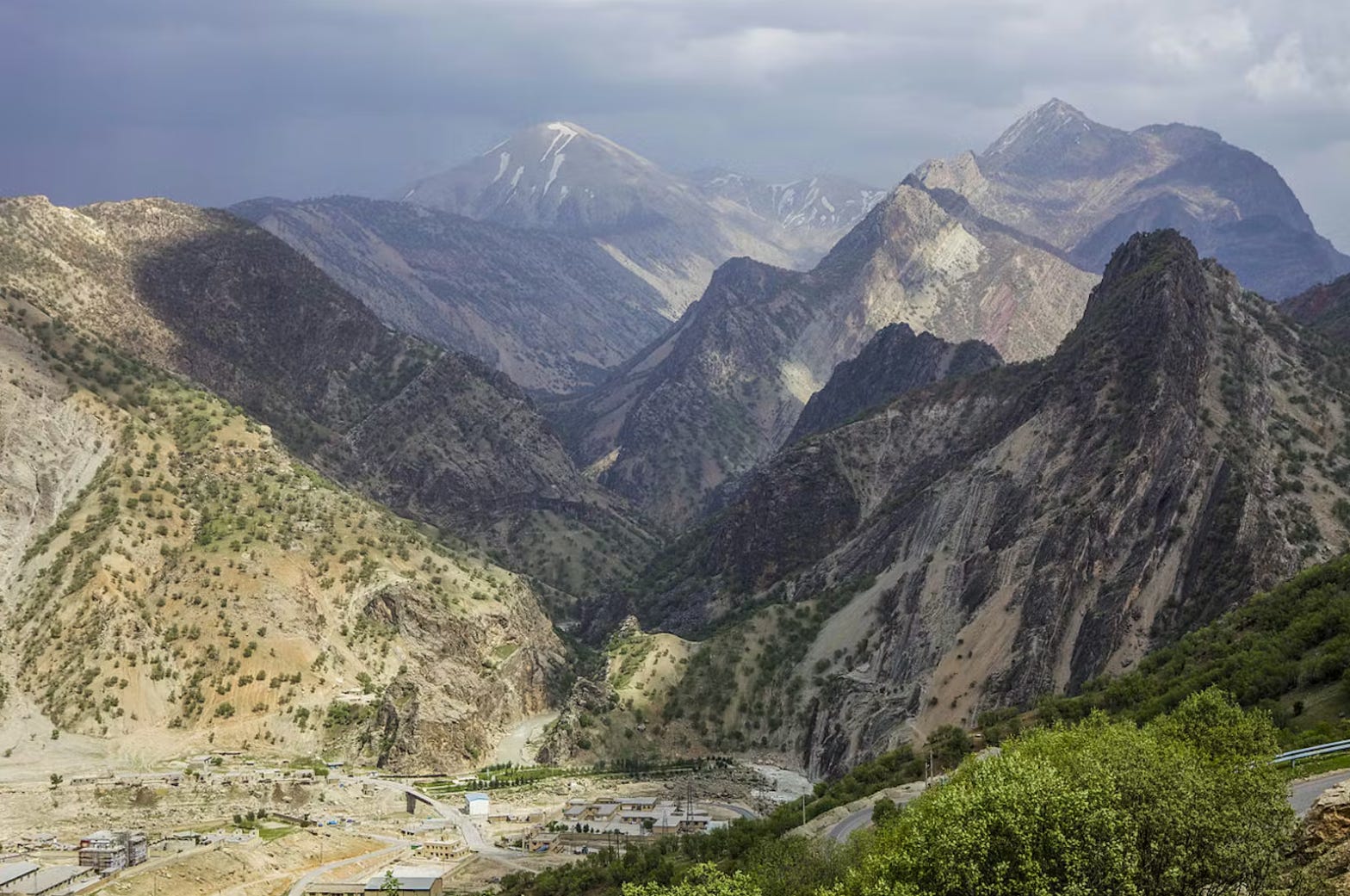
Maybe that will change. Maybe a year from now I’ll be ruefully eating those words, as American boys are being shipped off by their hundreds of thousands to run around blinded by Russian electronic countermeasures in the cold mountain passes of the Zagros, getting picked off by snipers and shredded by Chinese drones.
But I doubt it.
Modern warfare doesn’t have much use for conscript armies. That lesson was learned in Vietnam: conscripts generally have poor morale, they aren’t highly motivated, they aren’t usually of the highest quality, and so they are of limited usefulness on the battlefield. Soldiers are highly trained professionals who have chosen the military as a career. That makes them much less likely to mutiny. Moreover, modern warfare is highly technical: soldiers have to be extremely well trained to be any use at all. The young men who volunteer for military service usually do so with some hope of adventure and even danger. As such, they often positively look forward to war.
None of this should be taken to imply that Israel hasn’t played a massive role in orchestrating and precipitating this war. They clearly have. Marco Rubio let this slip when he admitted that part of the reason the US attacked when they did was that Israel had signalled that they were going to attack with or without America’s blessing or assistance; since Iran would certainly direct some of its retaliation against the Little Satan towards the regional assets of the Great Satan, America’s hand was forced. This is a bit like when your shithead friend has had one Jameson’s too many and you sit down next to him at the bar only to find that he’s about to throw hands at some asshole you’ve never met: you’re liable to take a punch to the nose no matter what you do, so you might as well have your friend’s back. You can call him a shithead later.
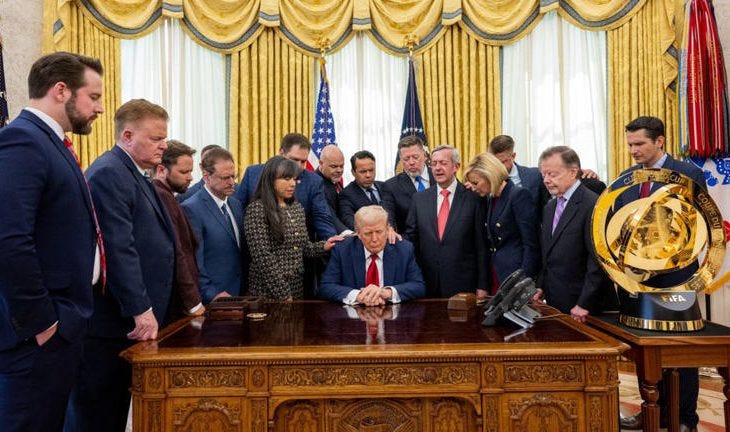
Israel’s involvement goes much deeper than this, of course. Zionism’s penetration of American conservatism is hardly a secret. There are Dispensationalists all over the Republican party, including the Secretary of War Peter Hegseth, and probably Marco Rubio (though technically he’s a Catholic). Republicans who shrug off open anti-white bigotry systematically directed against America’s core population in essentially all of its universities react with fury to campus anti-Semitism, threatening to withhold funding from any institutions that tolerate hurt Jewish feelings. Then of course there’s the big guy himself. Trump has never been much of a Christian, still less an evangelical ZioChristian, but he seems to have undergone something of a religious awakening after divine intervention saved his life in Butler, Pennsylvania. And who can blame him? It certainly doesn’t seem implausible that since then, Trump has been influenced by Zionists who have convinced him that G-d saved him so that he could save America and, more importantly, G-d’s Chosen People. “You are the second coming of Cyrus the Great” would be an appealing narrative to a man with a vast ego. It would be even more appealing given the political and economic support it would come with. Certainly there would be no shortage of avenues for approach: Trump’s daughter is married into the tribe, after all.
Putting the morality of war aside for a moment, Israel’s performance so far has been impressive. Iran, it turns out, built one of the largest surveillance networks in the world in order to control its restive populace. Word is that Mossad infiltrated Iran’s internal surveillance network, which the Mullah’s secret police use to identify women who aren’t wearing their hijabs, and subverted it to conduct an extremely thorough reconnaissance. It was thanks to this penetration, the story goes, that Khomeini was located and then assassinated, and it was also thanks to this that a double tap wiped out the next-highest echelon of Iran’s leadership when they were meeting to choose the Ayatollah’s successor. Sneaky, ruthless, and very effective. Classic Mossad, really. There’s an unconfirmed rumour that, as a parting shot, the Mossad wiped the morality police’s databases, so that they no longer had any record of which of their women have a habit of letting their hair down in public.
It’s very likely that Israeli intelligence played a role in the abortive uprising that the mullahs crushed in January. According to Iran, the three thousand or so rebels who were massacred were all essentially Israeli operatives or dupes. According to the West, the thirty thousand Iranians murdered by the mullahs were simply ordinary civilians dissatisfied with life under the heavy hand of an Islamic pariah state. I don’t know what the truth of the matter is, but I suspect it’s somewhere in the middle.
If the reactions of Iranian expatriates living in the West are anything to go by, the Iranian people – particularly the Persians – loathe the mullahs. They’ve been celebrating in the streets, flying the variant of the Iranian flag with the lion instead of the ridiculous Islamic scimitar onion. But then, is their reaction representative of public opinion in Iran itself? Expats are self-selected to be dissatisfied with their home country; that’s why they’re expats in the first place. On the other hand, the protests that rocked Tehran in January are certainly indicative of widespread discontent, and one constantly hears that the Iranian people – at least the urban, educated portion – barely tolerate the theocracy. Zoroastrianism is rumoured to be making a comeback amongst Iranian youth, as a repudiation of Islamic mind-control via conscious reconnection with their deep ethnoreligion. I have no idea how widespread Zoroastrianism really is in Iran; my suspicion is that it’s a very niche phenomenon, that adoption of the Faravahar in preference to the Crescent is the Iranian analogue to young Westerners abandoning the Cross and the Rainbow for the Mjölnir.

The parallels between Iran and Western countries are quite striking. There’s the aforementioned surveillance infrastructure, which will be familiar to citizens of the Yookay, whose police watch them like hawsk and punish blasphemy against Gay Race Communism with the same fervour that Iran’s morality police punish apostasy against Islam. Iran, like the West, suffers from low fertility, with a Total Fertility Rate of around 1.5. This is probably downstream of Iran’s high rate of female education: well over half of university students are women (peaking at around 70% in the 2010s), and over half of Iranian women enrol in higher education. Women are meanwhile exempt from military service, which is mandatory for men. This leads to a certain degree of antipathy between the sexes: women complain about the patriarchy forcing them to wear headscarves, while young men complain that the Islamic Revolution is just feminism in a hijab. Despite the high level of post-secondary education, youth unemployment remains high among both sexes (which also of course depresses fertility).
Doesn’t that all sound very familiar?
The TFR especially is an interesting datapoint, worth pondering by trads who hold that the West’s own natal collapse can be reversed by revival of that old time religion. That clearly didn’t work in the Iranian theocracy, no more than it worked in the wider Ummah (where fertility has also fallen off a cliff in recent years).
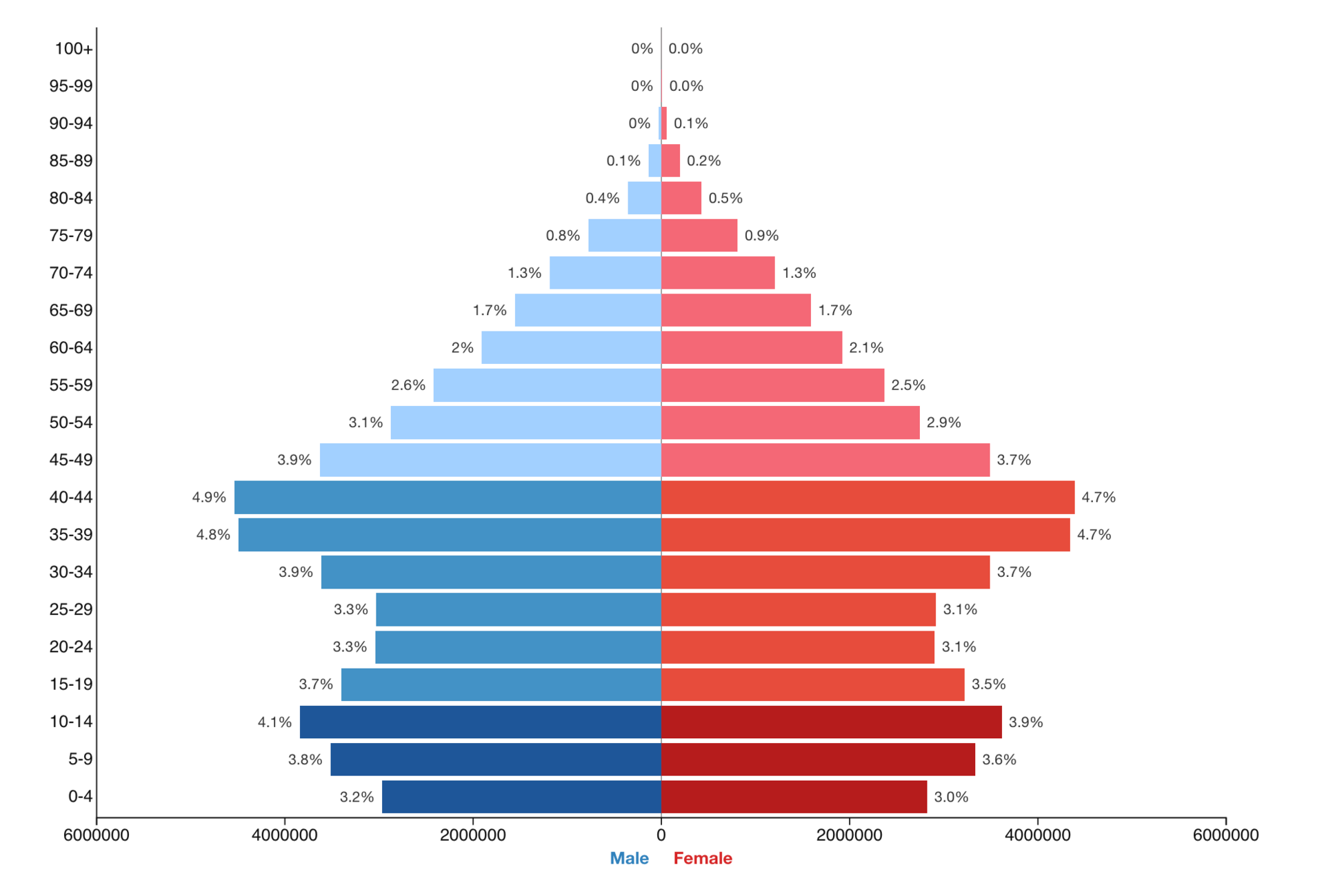
Iran’s demographics are worth pondering for a moment. The fertility collapse is recent; Iran’s population is actually quite bottom-heavy; half of the population is under 35. The mullahs are a council of conservative old men holding onto power over a restively bucking youth bulge via the judicious application of welfare with one white-knuckled grip and terror with the other. They are acutely conscious that if their hand grows too heavy they will be overthrown by youngsters who barely tolerate the imposition of religious ideals that they do not share. BAP has pointed out repeatedly that this situation makes war counterproductive: conservative old men tend to be cautious, rather than aggressive, more concerned about holding on to what they already have than reaching for glory and martyrdom. Assassinating the Ayatollah and dozens of other senior clerics may have been a bad move. Draining old blood from the system provides space for new blood to circulate. It seems likely that the US and Israel will now face a younger, more energetic, more aggressive, and more innovative Iranian leadership.
On that note, the Ayatollah’s successor has been reported to be his son, Mojitaba Khomeini. The new Khomeini is relatively young, at 56, and his sole qualifications appear to be that he is a hardliner, and that he is the former Supreme Leader’s son. Apparently those parts of Iranian social media that haven’t been blacked out are mocking the regime on account of Mojitaba’s inexperience: the whole point of the theocracy is that it leadership i supposed to be descend into the hands of the most eminent and learned cleric, rather than into the hands of the last dictator. Mojitaba, who is the son of the last dictator, is apparently somewhat middling as a cleric. Meet the new dynasty, same as the old dynasty.
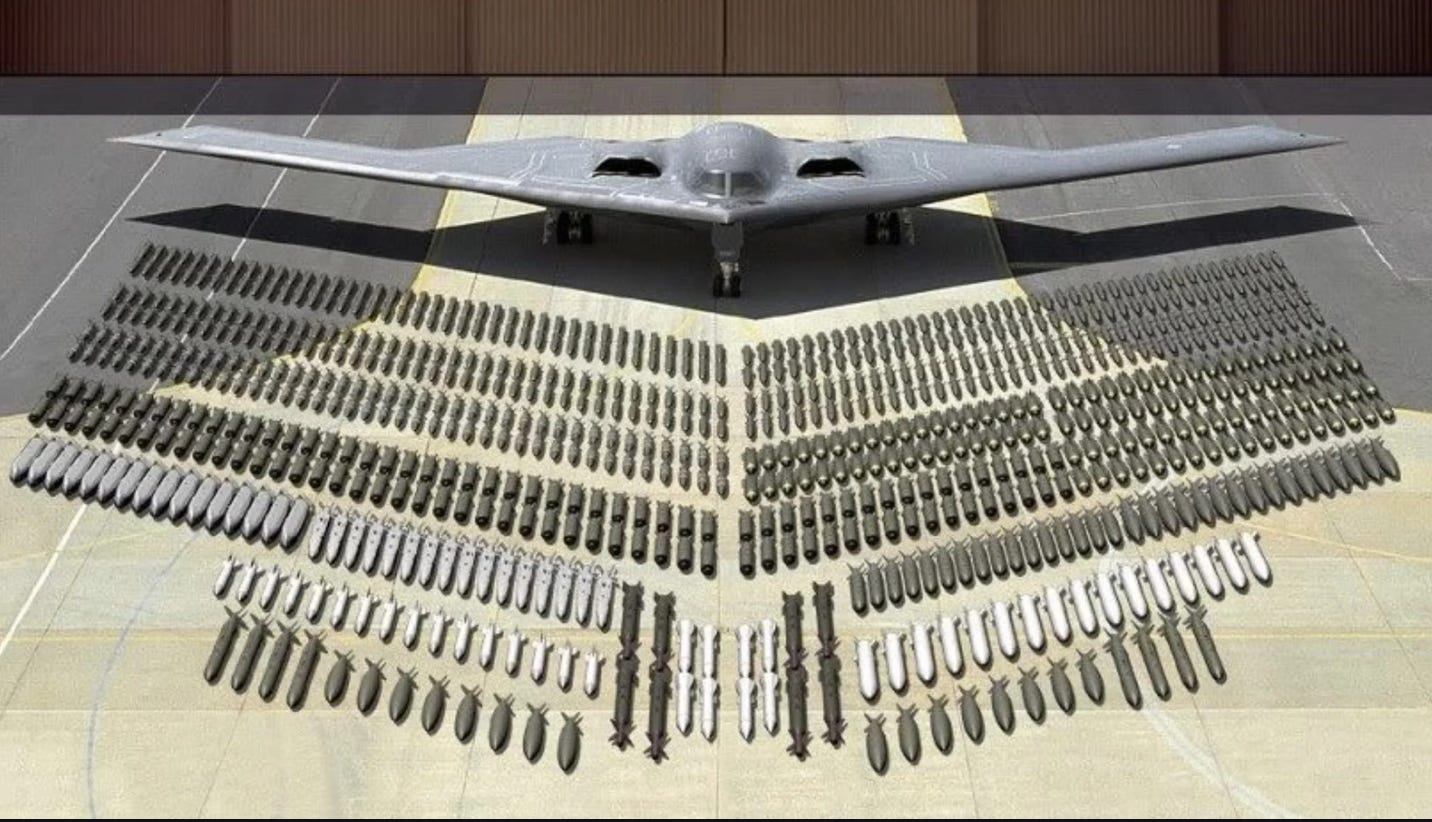
So far the war has been entirely an air war, and American air power remains unassailable. On the first day the bombing was conducted with B-2 stealth bombers. Within a few days, Iran’s air defences had been so thoroughly broken that the USAF was able to send in its refurbished WWII-era B-52s, which have giant Las Vegas style neon signs for radar cross sections. Zero American aircraft have been lost. Iran’s skies are American skies, from which America can bomb Iranian facilities at their leisure. The pilots must be enjoying the hell out of themselves.
This is all very well and good, but there are very few cases of a country being bombed into submission purely through air power. Before WWII, military theorists held to the wild hope that air power alone could win wars, as civilian populations would be so awed by the destructive potential of bombing raids that they would force their governments to sue for peace rather than endure them. To the contrary, Britain suffered through the Blitz with a stiff upper lip, and when Bomber Harris launched his revenge on Germany, the Germans also endured and fought on all the way to last bunker in Berlin. Tokyo surrendered after Hiroshima and Nagasaki, true, but this was only after the Japanese army and navy had been wiped out in the Pacific war, and the Japanese government was already on its knees and suing for peace via back channels.
The Iranian people may well hate the Iranian regime, but this does not mean that they will rise up against the regime when America and Israel are bombing them. For one thing, the Iranian people already rose up, and were slaughtered. For another, it is one thing to take to the streets during peace time, when one can plausibly claim to be a revolutionary motivated by liberal ideals of humanitarian justice or whatever; it is quite another to take to the streets when the enemy’s munitions are blowing up your country, and the government’s inevitable argument that you are all nothing more than the enemy’s traitorous catspaws will inevitably carry the day. It certainly doesn’t help the case of would-be rebels when, on day one of the conflict, 160 little girls were killed when their school was blown up. People intuitively understand this rally-around-the-flag effect. Nationalists in Europe and Canada have been experiencing a small taste of this dynamic in recent months, complaining that Trump’s truculence towards their governments makes it too easy for local regimes to paint local dissidents as unpatriotic.
So it seems unlikely that the Iranian people will revolt against the Islamic Revolution, at least as long as the bombings continue. The Trump administration seems to tacitly agree: initial declarations that one of the goals was regime change appear to have been quietly dropped, or at least de-emphasized.
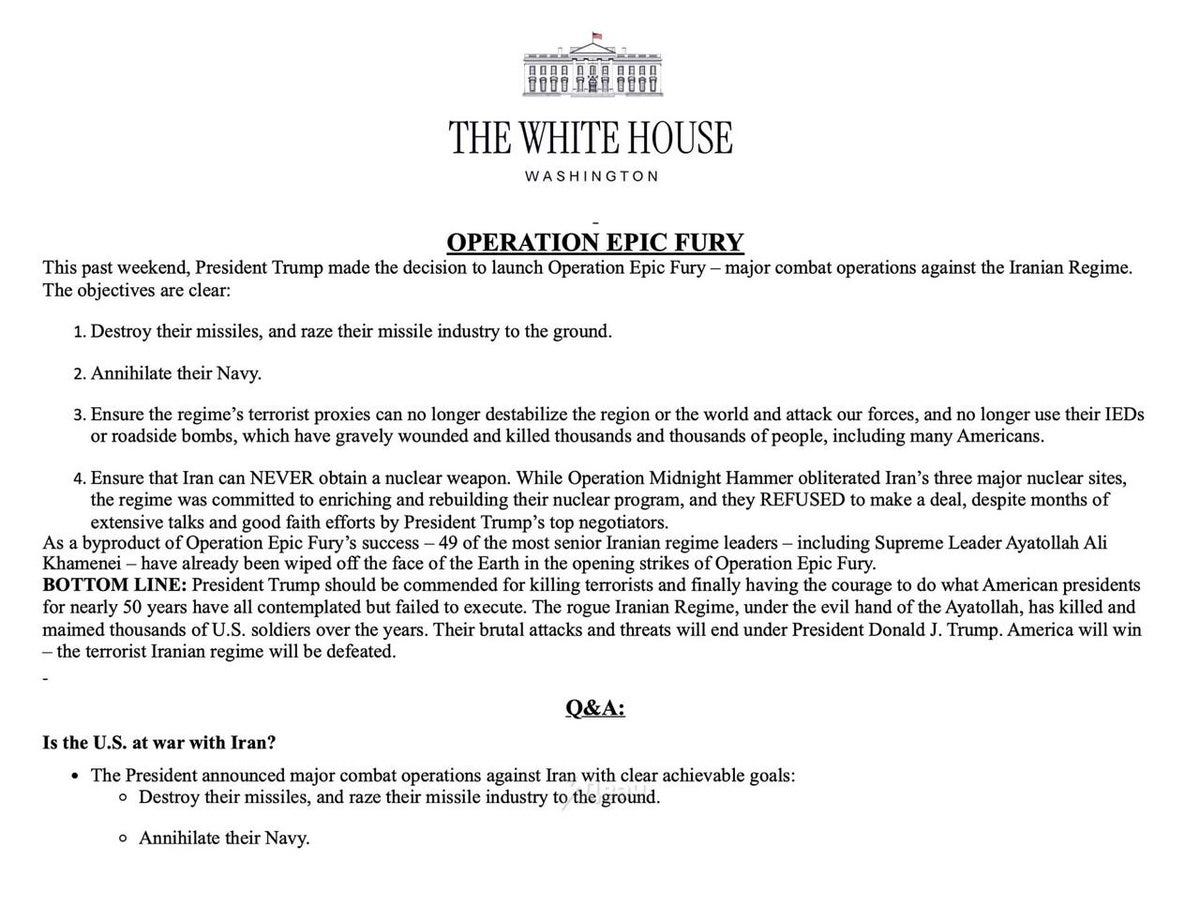
Of course, one might still envision regime change via continuous decapitation, a kind of pruning via assassination. Kill off every leader who emerges, until such a time as you get someone you can do business with. Sort of like gardening by weeding, without bothering to plant anything. Perhaps that’s the plan. Whether that’s a good plan is another question entirely. The early success in killing the Ayatollah and his top men had the advantage of surprise. Subsequent Iranian leadership will take operational security much more seriously: avoiding in-person convocation, hiding the locations of key officials, and even hiding their identities.
If regime change is no longer a plausible goal, that opens the question of what, precisely, the goal of all of this actually is. Is it simply to degrade Iranian military capabilities to the point that the country no longer threatens its neighbours? To destroy the Iranian Navy, so that it lacks the ability to close the Straits of Hormuz? To prevent Iran from ever developing a nuclear capability? Is the goal to destroy Iran’s capacity to export oil to China? Is the goal to take Iran off the board as a Chinese proxy state? Is it just getting revenge for the 1979 hostage crisis? Is the goal just to remove a thorn in Israel’s side, by destroying the ability of Iran to support Hezbollah?
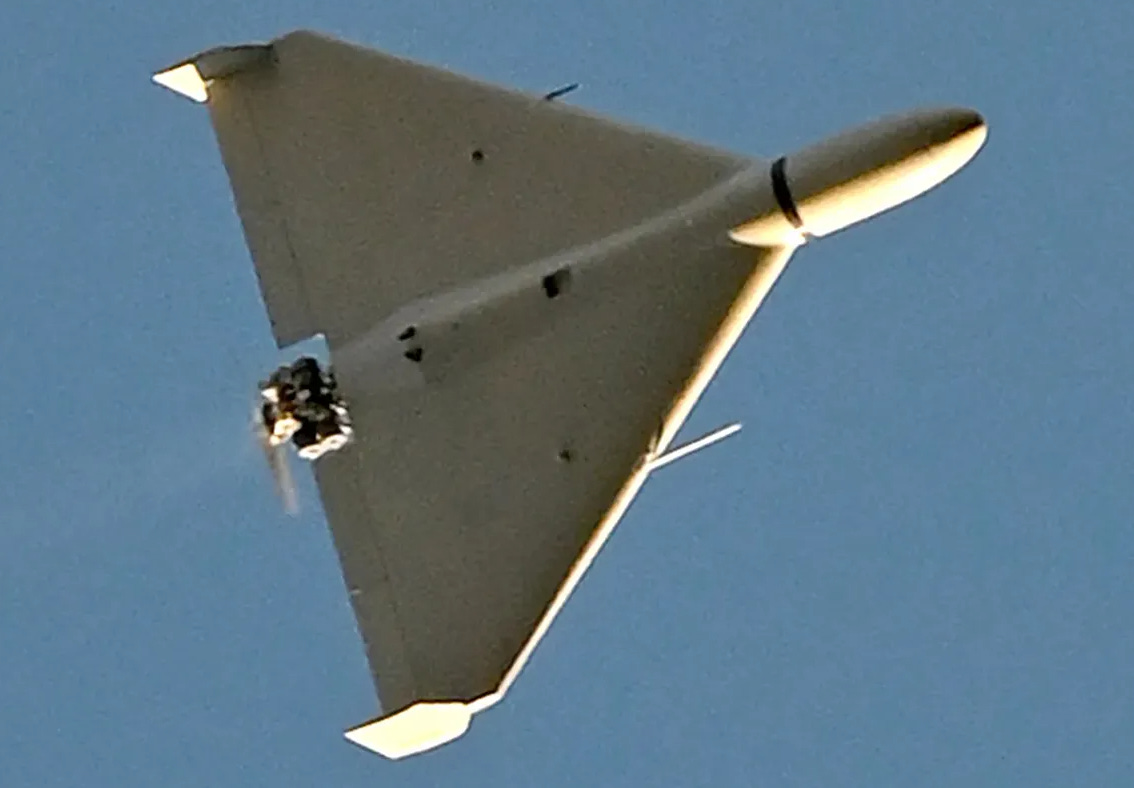
I suppose the goal is probably ‘all of the above’, and I think it has to be admitted that the US has been somewhat successful in at least some of this. After its initial flurry of ballistic missile and Shahed drone strikes on surrounding countries, the volume of Iranian air strikes has dropped precipitously. To a certain degree this is due to Iran shooting its wad; to a certain degree, it’s due to launch facilities being identified and destroyed; and to a certain degree, it’s due to the IRGC husbanding its remaining munitions. Iran retains substantial stockpiles hidden in hardened underground facilities.
Iran also retains a huge ground force, with 1.2 million uniformed personnel; something like 3/4 of these are conscripts with dubious morale, but in the event of a defensive insurgency, the Iranians would still have one or two hundred thousand combat effective troops, many of whom are not conscripts.
Now that Iran’s air defences have been destroyed, the focus has shifted to degrading Iran’s industrial base and command-and-control infrastructure. Standard air war tactics, really. The Iranian regime doesn’t seem to have much of an ability to do anything but watch helplessly as their infrastructure is dismantled from above. Does that mean that they don’t have the ability to do anything at all?
Iran doesn’t have much force projection capacity, so Iran’s army is almost certainly no threat to anyone who doesn’t step foot on Iranian soil. Over the years we’ve heard a lot about Iranian sleeper agents infiltrating the US, ready to sabotage US infrastructure or initiate terrorist attacks. So far none of that has happened, from which a few possibilities follow: 1) Iranian sleeper agents are largely imaginary, a consensual hallucination sustained by Iranian propaganda feeding American paranoia; 2) for whatever reason, the IRGC hasn’t given the word yet; 3) word has been given and attacks are in preparation; 4) the sleeper agents are quite real but have all gone native because life as an Uber driver in NYC is a much better deal than life under the mullahs, so they’re just ghosting their handlers.
An asymmetric terror threat is probably the most effective response left to the Iranians. Whether it would be effective is another question. They could cause blackouts in key facilities by sabotaging transformer stations; they could force the evacuation of towns and cities by sabotaging chemical plants; they could shoot up schools; they could do all kinds of nasty things. Whether they could do anything that America doesn’t already do to itself via a mixture of social breakdown and sheer incompetence is a good question. If planes are already falling out of the sky because of Indian engineers and women pilots, does hijacking them make a difference? If troons hopped up on SSRIs are already shooting up schools, do people even really notice when the shooter is an Iranian terrorist? The question of terrorism in the US is a little bit like the question of cancer in whales: despite being massive animals with long lifespans with lots of cells that have lots of time to mutate into cancers, whales don’t die of cancer, because they’re so big that by the time their tumours get large enough to be a problem, their tumours get tumours.
Perhaps that’s why there haven’t been any terrorist reprisals yet. Activating a sleeper cell is almost the same thing as burning it, as the risk of exposure and elimination is extremely high with each action; you want to make sure that burning the asset is worth the cost, and it’s actually much harder to come up with attacks that exceed that cost/benefit threshold.
I’m not saying that there won’t be terrorist reprisals on American infrastructure or civilians, simply that the sheer level of entropic decay of the United States of Weimerica is its own kind of perverse defence. Introducing chaos into the American system is a bit like adding another layer of distortion to an industrial deathcore track.
Perhaps there are other options open to the Iranians or, for that matter, their allies. Beijing has been notably silent. Cyber-attacks, for example, on US financial infrastructure, could be quite effective. Whether the Iranians possess the ability to do this is another matter. American cyber-warfare capabilities are among the best in the world, and given the way that Iran’s surveillance network was pwned by Mossad – and, several years earlier, the way its nuclear research program was sabotaged by Stuxnet – it seems doubtful that Iran’s own netrunners are on the same plane of 1337. China’s might be.
Just because I can’t imagine what kind of crippling Find Out the Iranians or their friends might respond to the American/Israeli Fuck Around with, doesn’t mean that there won’t be one. The history of empire is littered with warnings against hubristic expeditions launched by leaders who felt themselves to be invulnerable, who imagined that Providence had given them the mandate of heaven, and who were brought low in consequence of their wishful thinking and lack of imagination. As the oracle at Delphi told Croesus, “If you go to war against Persia, you will destroy a great empire.” Though, in fairness, Persia is no longer a great empire.
The ramifications of this war must be understood globally, and no doubt they are intended to be global. Oil is already up to $100 a barrel, which is great news for countries whose economies depend on oil exports (such as Canada and Iran, not that it will do Iran much good), but not so great for everyone else. Whether prices rise more and bring on a global recession depends on how long the Straits of Hormuz remain closed. Currently the US Navy is planning to escort tankers through the straits. There are rumours that the US is going to try and steal the business of insuring global shipping from the City of London, which has dominated it for centuries. These rumours imply that the one of the advantages enjoyed by Lloyd’s of London was back-channel intelligence connections to the American security state, which have recently been closed. Certainly America’s erstwhile partners in the United Kingdom appear to have been taken completely by surprise, suggesting that Washington is no longer sharing intelligence with Five Eyes partners it now views as adversarial and compromised by foreign influence. I’m sure that had nothing to do with Westminster inviting the Chinese to build the world’s largest embassy in the heart of their city, or giving away the Chagos Islands and its strategic Indian Ocean airbase to a Chinese client state. Canada was similarly blindsided, which surely has nothing to do with our parliament being heavily infiltrated by Chinese intelligence, or with our prime minister having announced a ‘strategic partnership’ with the People’s Republic. Not that it really matters. NATO’s military contributions in the GWOT amounted to little more than a fig leaf of multilaterial consensus, and the Trump White House doesn’t care much about such pretenses.
European countries in particular are especially leery of getting involved, due to concern that their own imported Muslim populations won’t take it well. This underlines the position taken by Vance and Rubio – presumably an expression of the State Department’s position – that a Eurabian Union will not be a reliable ally, as the sympathies of Muslims will naturally lie in the Dar al-Islam rather than the Dar al-Harb. Already in the Yookay there are mounted Islamic vigilante patrols chasing down Persians protesting in favour of the air strikes.

Personally, I’m rather in favour of kicking this particular hornet’s nest under the mosque. Agitating the Muslims will polarize the population further, making the consequences of continued mass immigration, and the desirably of remigration, all the plainer.
One concern many European nationalists have expressed, not without cause, is that if Iran collapses into civil war or simply failed state status, it will lead to a wave of Iranian refugees pouring into Europe, no doubt accompanied by chancers from Africa and who knows where else riding in on their tattered coattails. A Syrian reprise certainly seems plausible. Of course, Europe can always choose to simply not let them in, and proper nationalist governments would do exactly that, as we’ve already seen with Hungary and Poland. However, as things currently stand, Western European governments remain firmly in the hands of the traitor class, who would be only too happy to throw open the gates for a fresh tranche of neurosurgeons and rocket scientists (and given that the Persians are in fact rather well-educated, such a characterization would not be as laughably implausible as it was in 2016). That said, popular opposition to immigration is considerably more robust than it was a decade ago; an attempt to repeat Merkel’s Mistake could well bring the EU’s governments to their knees, particularly if it’s accompanied by widespread Muslim race riots.
Finally, not because it is the only thing left to talk about but because this is already quite long enough, there’s the question of how this might affect domestic American politics. Much of Trump’s base, particularly the younger voters, are furious: they elected him to deport a hundred million people, not to start another pointless desert war for Sheldon Adelson. Attempts to paint the mullahs as barbaric reprobates for forcing women to wear hijabs, signing off on marriages to 9-year-old girls, or forcing gay men to get sex change operations fall quite flat when young American men are living in the romantic wreckage of MeToo’s male purdah, American schools have been trooning American children for a decade as a matter of government policy, and not a single member of the American elite has been arrested in connection with the Epstein files. Younger voters are in a bad mood in any case due to the economy: however well the stock market is doing, however much manufacturing is reshoring to America, it doesn’t seem to be turning into jobs yet. There’s a real danger that much of this demographic may decide to stay home in the midterms and let the Democrats retake Congress.
Trump’s mandate was to fix America’s domestic problems, not embark on new foreign adventures. Americans have always been dispositionally isolationist, and there’s especially no appetite for foreign entanglements in the wake of the humiliating disasters of the GWOT. Perhaps there’s a domestic upside in this, though. It has not escaped notice that Trump can stride across the globe like Zdeus, but is forced into the role of a fiddling Nero when at his burning home, were he’s tied down like Gulliver by a thousand judicial strings, while a recalcitrant GOP sits on his chest, slow-walking his every reform. Patience with this state of dysfunctional affairs of state has become as thin as the onion-skin paper of an old pocket Bible, and a lot of American voters are carrying that Bible full of enumerated grievances around in their back pockets everywhere they go. If a Caesar is effective abroad, how effective could a Caesar be at home? Many are asking this question.
Trump is not Caesar, of course. He’s at best Pompey, or John the Baptist – the one who prepares the way.
As furious as MAGA is about Iran, it’s worth emphasizing that we’ve been here before. No one wants ‘boots on the ground’, but there’s nothing Americans like more than watching their air force pound the ever-living snot out of someone. Trump’s style so far has been more gun-boat diplomacy and less hearts-and-minds nation-building. He seems to prefer the punitive expedition to the occupation, and if he holds to that pattern – and, just as importantly, if it does not spin out of control into catastrophe – it’s likely that voters will forget all about it by November, which is forever and a day away in news cycle terms. It also shouldn’t be forgotten that a huge part of Trump’s base are not angry young radicals who want to burn it all down, but grumpy old boomers with Cold War nostalgia for Top Gun training montages and a chip on their shoulders that’s been itching since 1979. That part of his base is loving the bombardment porn. And in the end, it’s worth remembering that Trump has a way of stumbling towards victory, pratfalling into a bed of roses without ever being pricked by their thorns. That doesn’t mean it will work out this time, of course. Every winning streak comes to an end at some point. Still, there’s a pattern here.
I started this by warning you that I didn’t have any clear conclusion in mind, that there’s no point to this other than to try to organize my own scattered thoughts, and I’m afraid that this has in the end proven to be the case. I don’t know exactly what’s going on here, and I don’t think anyone does; I don’t know what to expect the result to be, and I’m skeptical of anyone prophesying either success or disaster, as I’ve generally found such pronouncements to be unreliable, particularly when they come wrapped in the moralism that is so very unsuitable to the Machiavellian anarchy of imperial geopolitics. I find a lot of people who get emotional about these things have some sort of axe to grind, either because they’re America ride or die, or because they want nothing more than for America to fall; both types are liable to engage in wishful thinking. I’m rather more ambivalent about all of this. I hope it works out. I hope Trump doesn’t screw everything up. I hope the Iranian people free themselves, and don’t end up even deeper in the clutches of a hardened, embittered theocracy.
And, of course, I hope you found the time you spent reading this sloppy core dump of my thoughts to be time well used. As always, thank you very much for taking the time to read, and to those of you who support Postcards From Barsoom with your generous patronage, a thousand thank yous, for it is thanks to you and only you that I am able to make something of a living writing for all of you.
I’m interested to hear your thoughts in the comments.
A thoughtful article, and I respect your honesty in saying it might be a bit meandering. Unlike some who have commented, I don't see that as a weakness: I'd rather your honesty than the faux-assuredness of so many on the internet...even on Substack.
Keep up the good work.
John, I usually am in strong agreement with what you write, but on this one you are off the reservation. Whether you love or hate the Iranian regime, and most of us are in the latter camp, to pretend that this war is in any way similar to last years war or somehow a "nothing ever happens" conflict is completely and totally wrong
This war lives and dies in the Strait of Hormuz. As we speak, oil has jumped to $120/bbl but that is just a price, just a number, it is meaningless. What IS meaningful is: 20% of global oil production is disconnected from the market. 20% of global LNG production is gone. 10% of global aluminum production is gone. Jet fuel and other refined fuels are fragile supply chains and the effect of the closure is even more acute; expect planes to be grounded soon and fuel shortages to hit many countries. Already near-region nations; Ethiopia, Pakistan, and others, have implemented rationing. China has already declared export bans of refined products. Then there's the myriad of petrochemicals, fertilizers, sulfur, nitrogen, what have you.
I could go on and on and on and on, I have a front row seat to this, and I am telling you this is a calamity far in excess of whatever you imagine.
A week ago I was more or less pro-Trump, he was doing good things pretty much all over. Now he has thrown it all away just to bend the knee to Tel Aviv.
And if you think the Iranians will give up soon; just have a look at what they suffered in 1980-1988. They can hold their breath longer than we can; they can out-suffer us. And the new Khamenei is more hardline than the old Khameni, and fought in that war too. Oh and he also saw his mom, dad, wife, and little girl get blown up during the assassination on opening night. Am sure he is feeling very cooperative.