

Poastocracy
Trust The Plan/Always Chimp: a new kind of ‘Community Relations Service’

Whenever there’s a horrific interracial attack of the black-on-racist variety, there’s a familiar script that we’ve all gotten so used to that it has become a kind of liturgy. It goes something like this: a multiple felon, frequently let out early on parole, breaks into a pretty young blonde college student’s house, rapes her, strangles her to death, mutilates her body, and is found wandering outside with his shirt soaked in her blood, shouting “I just wanted to kill that white bitch!” In the atrocity’s aftermath, the girl’s bereaved father holds a press conference. Looking dolefully into the camera, he intones, “In this time of loss for our family, please do not use our grief to turn this into a racial issue. This horrible tragedy is an isolated incident, committed by a troubled young man with mental health issues. As Christians we are called upon by God to forgive, and we hope that he gets the help he needs. Don’t look back in anger.”
This script is so familiar that it has engendered a pervasive background of frustrated despair throughout that subset of the population that has retained some modicum of sane instinct in the face of postmodern antinaturalism. What is wrong with white men? Have they all been castrated? Are they just golden retrievers, with their instincts for self-preservation and familial loyalty completely bred out by a thousand years of living in a high trust society? Have they been MKULTRAed so deeply that they can’t see what’s happening even when it comes for their own children? It’s all over, man, there’s no saving these people, they deserve everything that’s coming for them, etcetera, etcetera. The responses from the online right to the don’t-make-this-about-race liturgy have become as familiar as the liturgy itself, almost a part of the performance.
As it turns out, like everything in the false and homosexual manufactured consensus of the hyperreal television age, none of that is true. The statements of those families are not organic, and they never were.
Title X of the 1964 Civil Rights Act created a secretive government agency that you’ve never heard of: the Community Relations Service. The explicit goal of the CRS was to further the political aims of the Civil Rights movement. It played an active role in stage-managing demonstrations and riots, and it worked to actively prevent whites from fighting back against those riots, for instance by leaning on the media to downplay the damage to life and property while deflecting attention from the role played by Civil Rights leaders in inciting violence. You can read a summary of the CRS’s activities here.
The most repugnant aspect of the CRS’s secretive mission has been to intervene in cases of incendiary interracial crime by pressuring the victims and their families to stick to the this-isn’t-about-race script. Exactly how they apply pressure isn’t known. It’s likely that the ‘conciliators’ of the CRS would start out by speaking in the priestly grammar of concern and compassion: we’re just there to help, to advise, tragedies such as those that befell your child are just the kind of thing that racist white supremacists seize upon in order to drive a wedge into Our Community, let us help you navigate the bewildering media environment in this difficult time. Such soft-spoken manipulation works very well on a lot of people, particularly those in a state of emotional shock from the sudden eruption of horror into their peaceful, ordinary lives. Of course it won’t work on everyone: some will want blood. Those who don’t cooperate might be warned that if they say anything prejudicial to the media, this might be interpreted as jury tampering, possibly leading to the murderer being let off and getting whoever spoke out of turn hauled into court themselves for interfering with judicial proceedings. And we wouldn’t want anything like that to happen, would we? Why, you still have two younger children ... think of the consequences for your career if people started calling you racist, how would you support them? ... and if you went to jail for obstructing justice, they might end up in the foster care system ... not to worry, though, there are plenty of available foster families, now that the gay community is allowed to adopt...
That’s all speculation, of course. The truth is we have no real idea of what methods conciliators apply to ensure that families follow the script. Not one family has ever said anything about what the conciliators said to them behind closed doors, and the CRS themselves certainly aren’t telling. They don’t have to. The CRS is specifically exempt from the Freedom of Information Act, records kept by conciliators are destroyed, and conciliators can invoke FBI-style confidentially privileges both in court and in front of Congress. All we really know for sure is that essentially no one has ever gone off script, and that no one has ever so much as talked about the CRA. We can only surmise that families have never said anything because their arms have been twisted into signing NDAs.
Given the secrecy, how do we know any of this? Awareness of the CRS and its activities began to slowly leak into the public consciousness just a couple of years ago. In 2023 William Wheelwright and Raw Egg Nationalist started talking about it, although this seems to have gotten lost in the general noise of the discourse. The CRS surfaced again in June when the Academic Agent Neema Parvini came across a book written by CRS agents Bertram Levine and Grande Lum, America’s Peacemakers: The Community Relations Service and Civil Rights, in which they spill the beans by way of bragging. Parvini made a video reporting on the book, which got the attention of Auron MacIntyre, and between the two of them they generated enough publicity to precipitate an online chimpout as everyone discovered that the government had set up a secret X-files of Black Crime.
And now, several months later, the CRS is gone. Defunded. Kaput.
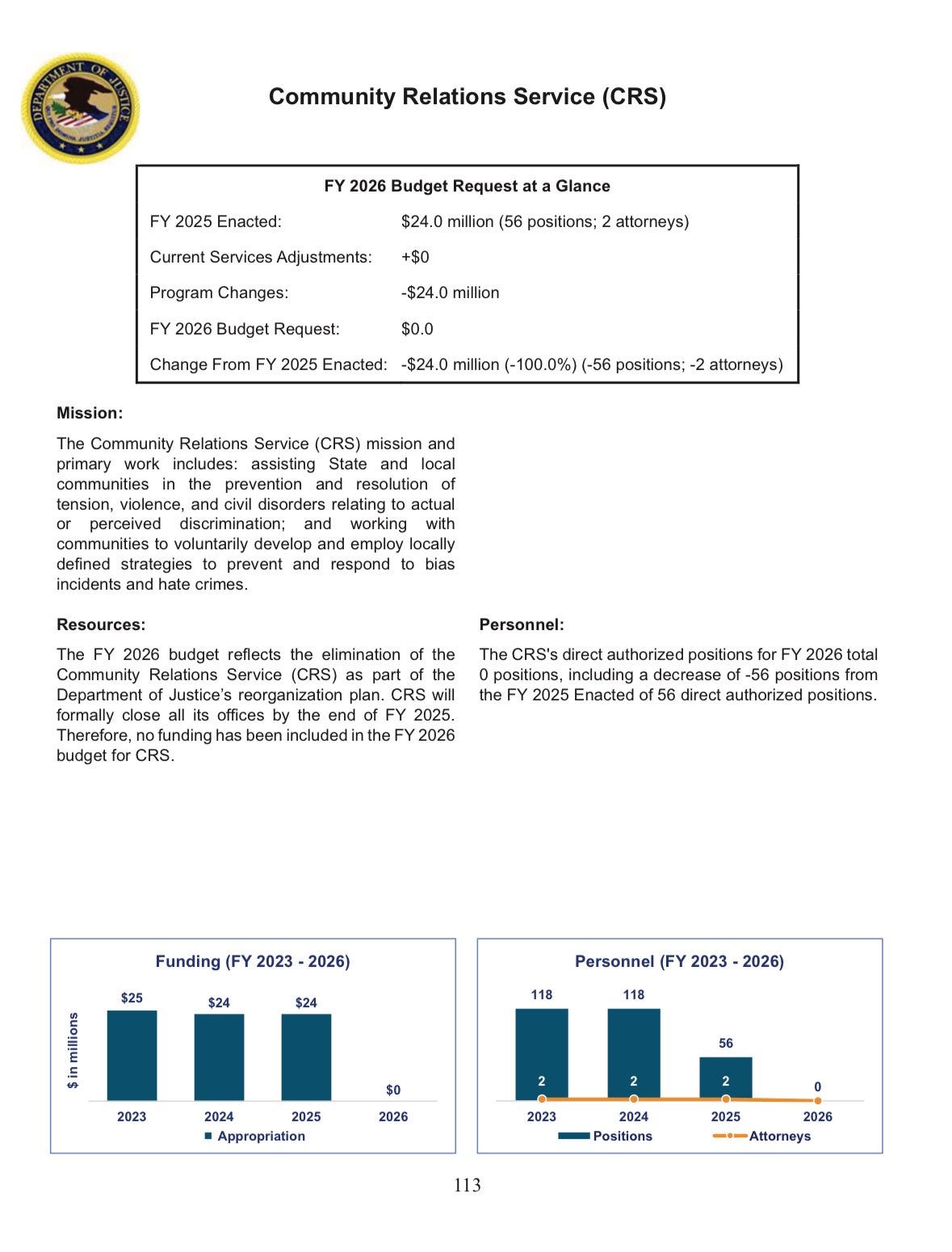
Whether or not the Trump administration was already aware of the CRS and intending to defund it before the online right shone a floodlight on the the agency’s existence and machinations, I have no idea. Parvini finishes his video essay with an explicit call for the administration to defund the CRS, so Parvini himself seems to have felt that the administration didn’t know about it, which is entirely possible. There are probably thousands of obscure three-letter agencies in the Federal Government, and the CRS has been particularly effective at concealing its presence throughout the entirety of its sixty-year existence. ‘No Such Agency’ has nothing on the CRS.
The CRS exemplifies the shadowplay that has dominated politics throughout the age of mass media. Nominally our countries are democracies, which on the surface means that the will of We The People decides political questions, but in practice means that politics is decided by whoever informs the minds of the people. The people get their ideas from the media, therefore the media holds the power, since the media is not independent but owned by others, whoever is feeding narratives to the media is ultimately in charge. We’re told we live in a democracy, but it’s really a mediacracy (which is not to be confused with a mediocracy, or rule by the mediocre, although there is a lot of overlap between the two).
In order to preserve the illusion of democracy, the media puts on a big show of being objective: the media reports the facts, and ensures that the facts are accurate. The media also presents itself as an open forum for free and robust debate in the marketplace of ideas. Naturally, that isn’t really how it works. The media decides which stories to report, which facts to emphasize, which political questions should be focused upon, and what the acceptable parameters of debate are. By defining both the frame and the contents of the frame, the media orients the attention of the public along the desired direction, and nudges its reactions towards the desired outcome.
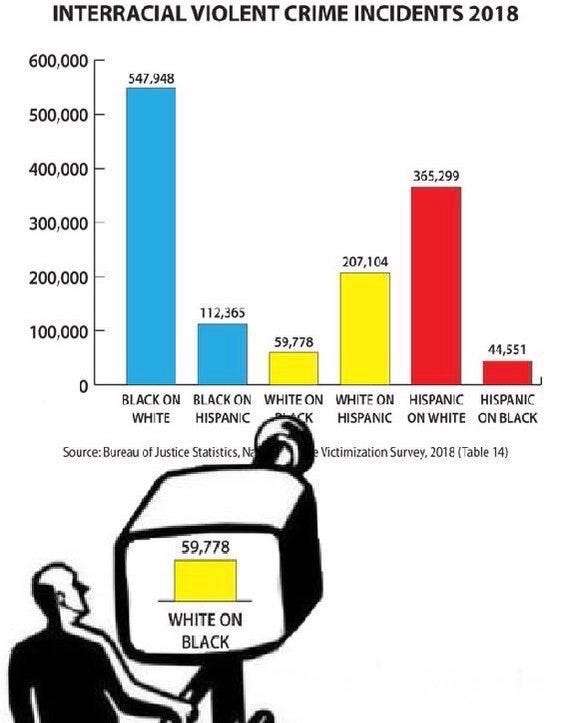
The ostensibly scientific practice of public opinion polling provides a tidy illustration of how this works. Polling organizations will carefully design the questions they ask in order to lead respondents in a certain direction. For example, if someone is asked ‘Are you in favour of reducing illegal immigration?’, they will probably answer in the affirmative, because most people don’t like the law being broken. However, if the question is ‘Are you in favour of deportation separating children from their undocumented parents?’, they are much more likely to answer with an emphatic ‘No!’, because most people don’t like to be mean.
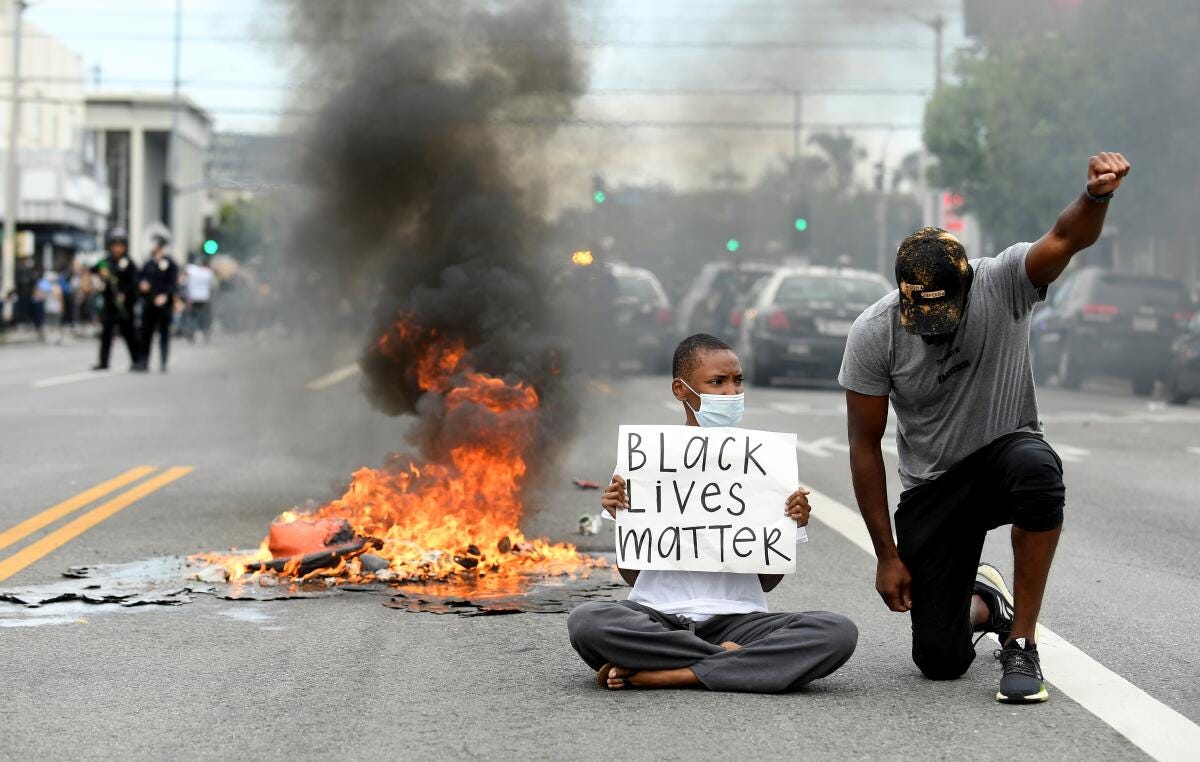
The stagecraft of the CRS seems to have played a central role in setting the racial narrative of American – and by extension, Western – society. The CRS was able to influence who the journalists were (by ensuring that sympathetic black journalists were hired at TV stations and newspapers), it provided events for the media to focus upon (such as racial justice protests), it encouraged certain questions to be asked (what injustices are they protesting?) and other questions to be avoided (just which subversive communist plutocrats funded the protests?), and it made sure that when the cameras were pointed at the victims of the Civil Rights revolution, those victims did nothing to undermine the core Civil Rights narrative dichotomy of black victims/white victimizers. Every time a black person gets arrested, it’s part of a pattern of white supremacists using systems of racial oppression to maintain a racist hierarchy; every time a white person is assaulted, raped, or murdered by a black criminal, it’s an isolated incident from which no lesson can possibly be drawn (other than ‘Mo money for dem programs’, because actually you see, it’s the system of racial oppression that caused that crime in the first place: in Civil Rights America, whites are guilty when they kill, and guilty when they’re killed).
The history of the CRS exemplifies the method of governance via media manipulation of public opinion, and its downfall may illustrate an emerging method of governance via participatory real time social media feedback. If the former system is a mediacracy, we might call this new system the poastocracy, in honour of the anonymous poasters who are its essential human element.
This nascent cyborg governance system is a natural evolution of existing trends. At the beginning of the last decade the Obama campaign made use of digital analytics for precision ad targeting, mainly over Facebook, with the result that they were far more effective at getting out the vote than the Republican campaign. In 2016 the Trump campaign adopted the same strategy (and got raked over the coals for it as though it was some kind of scandal), but augmented targeted ads by taking advantage of the ability of social networks to generate and disseminate highly effective political propaganda all on their own. Thus began the disruptive Meme War of 2016.
The Trump campaign probably stumbled across memetic warfare tactics purely by accident. Anons on 4chan began spontaneously generating memes because they thought Trump’s ability to wind up establishment politicians by blurting out the unsayable was hilarious, those memes were then spread via Reddit and Twitter, and the Trump campaign more or less decided to let them cook when they realized how effective it was. The Trump campaign didn’t solicit the memes directly, but simply took advantage of their spontaneous emergence.
Memetic warfare required the Trump campaign to cede a large amount of messaging initiative to the amorphous digital swarm. Whereas the Clinton campaign remained committed to tightly disciplined messaging developed by professional public relations agencies and pushed out through official channels, the Trump campaign had to tolerate an unruly barbarian horde that was not at all above using the symbolism of cartoon NatSoc amphibians to get its point across, generating elaborate mythologies tying Trump to Nikola Tesla’s time machines and Jungian synchronicity (shadilay!), spreading black propaganda suggesting that the Clinton campaign intended to draft women for a war with Russia, or pranking the opposition by telling them to text in their votes. Trump was under no obligation to endorse such uncouth behaviour, and the King in Orange probably did not even realize the scale of it, but he seems to have understood that to disavow it would risk extinguishing the enthusiastic fire of his most motivated online supporters, thereby killing the campaign’s momentum. He therefore adopted for the most part a policy of silence, though of course he was not above frogwhistling with the occasional dank Pepe.
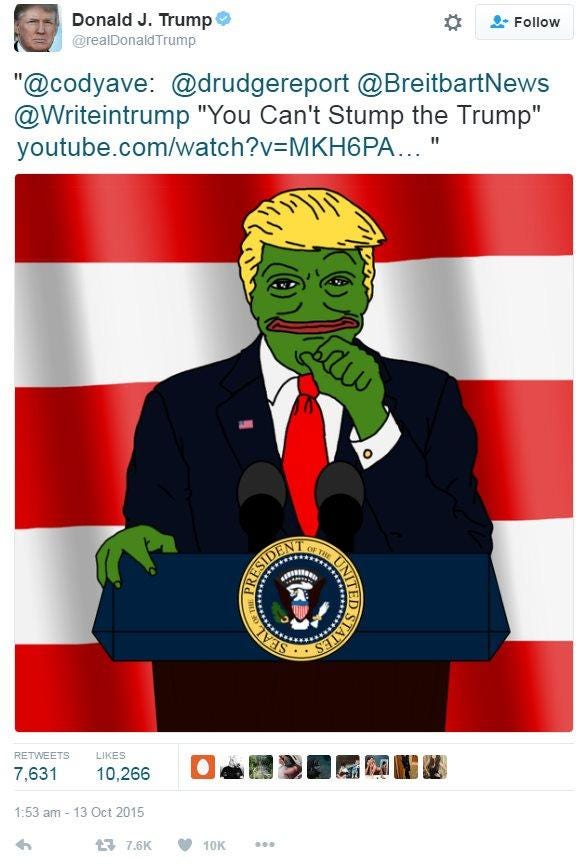
In exchange for giving up centralized message discipline, the Trump campaign gained some powerful advantages. First was economic: where the Democrats had to spend millions of dollars developing and disseminating campaign copy, memes poured fourth at no cost to the campaign’s war chest and went viral for free. Second was efficacy: freed of the constraints of the focus group and the committee, and subjected instead to the ruthless Darwinism of the attention economy, memes could be punchier, funnier, and more truthful, and thus achieve much higher levels of virality. Third was agility: the Democrats could spend weeks carefully honing an ad campaign, only for the frog tribes of the fiber optic steppe to disassemble it, repackage it, and subvert it within moments of its release, using the Democratic Party’s own expensive ads against them; meanwhile, sudden developments in the news cycle could catch the Democrats flat-footed, scrambling to put their message together, whereas the anon horde would have its memes blasting out across the social networks within minutes. Meme warfare is cheaper, faster, and funnier than committee-driven public relations, and these advantages were well worth ceding a certain amount of control.
Eight years after Trump’s first electoral victory, the frogs of 2016 are older, wiser, and more experienced. They’ve been censored, shadowbanned, deboosted, account banned, doxxed, fired, and dragged into court on trumped up election interference charges. This is no longer a game to them, but a deadly serious war for the soul of their civilization. Some fraction of these hardened meme warriors have found their way into the second Trump administration, although of course, being anons, we have no idea who they are. There are however signs of their presence within the Department of Homeland Security.
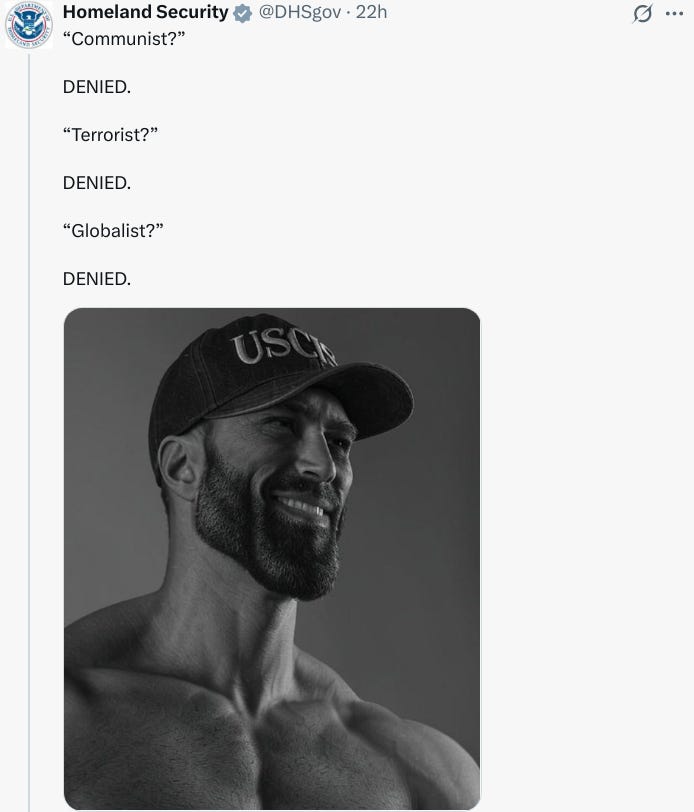
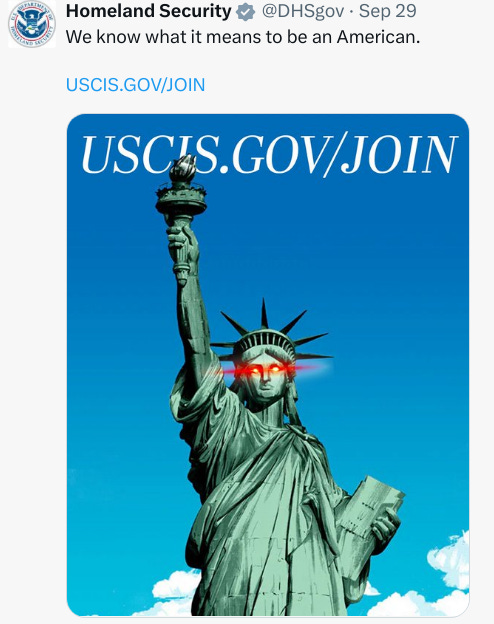
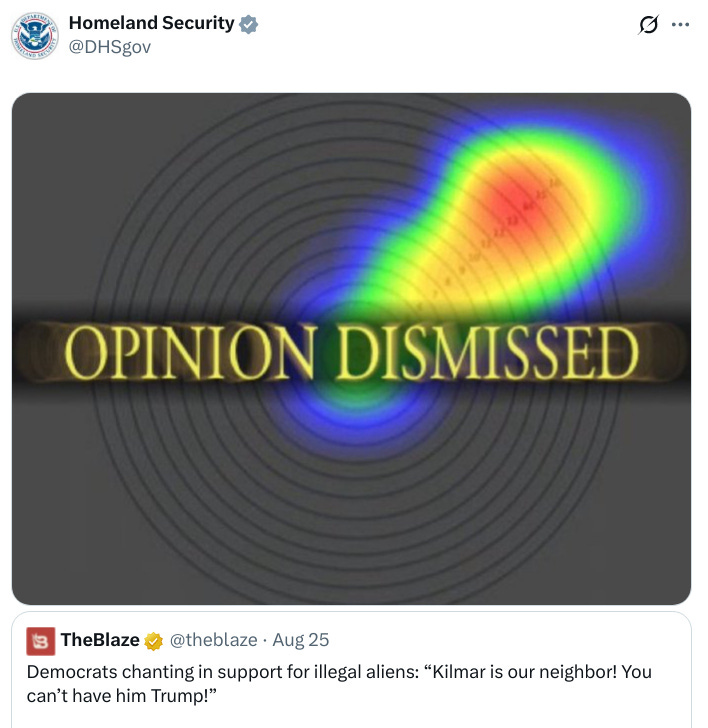
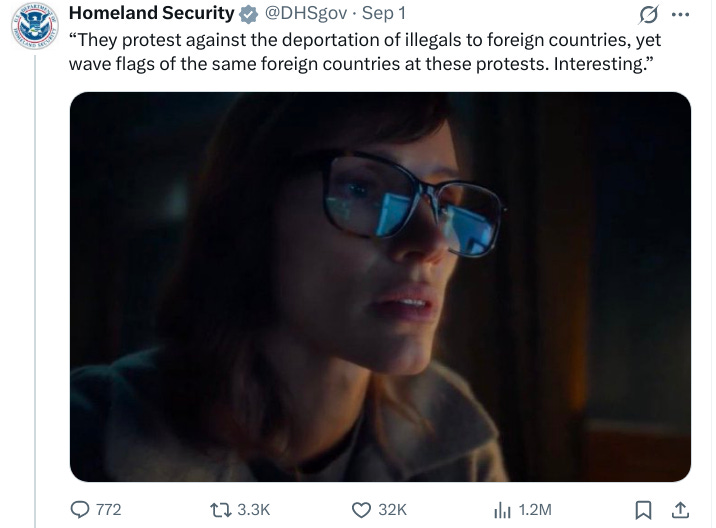
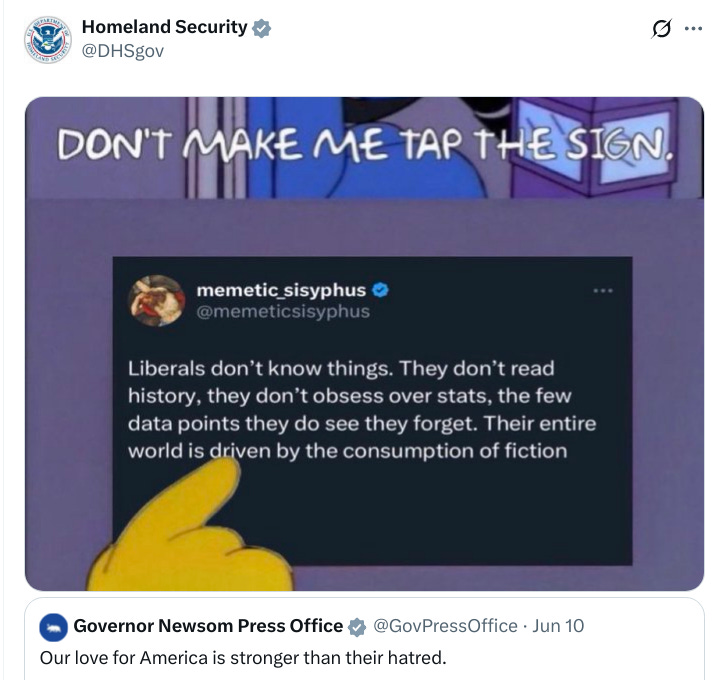
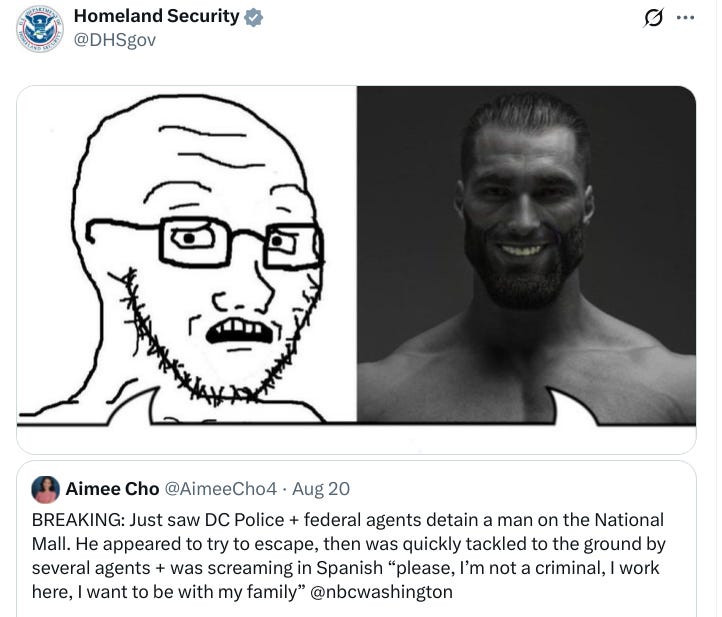
It isn’t just one-off tweets. Recently the DHS posted this absolutely incredible video (sadly taken down for copyright violations, lame), all of it artfully composed in such a way as to be perfectly deniable, but every frame of which, indeed right down to the choice of font, carries a self-referential memetic payload.
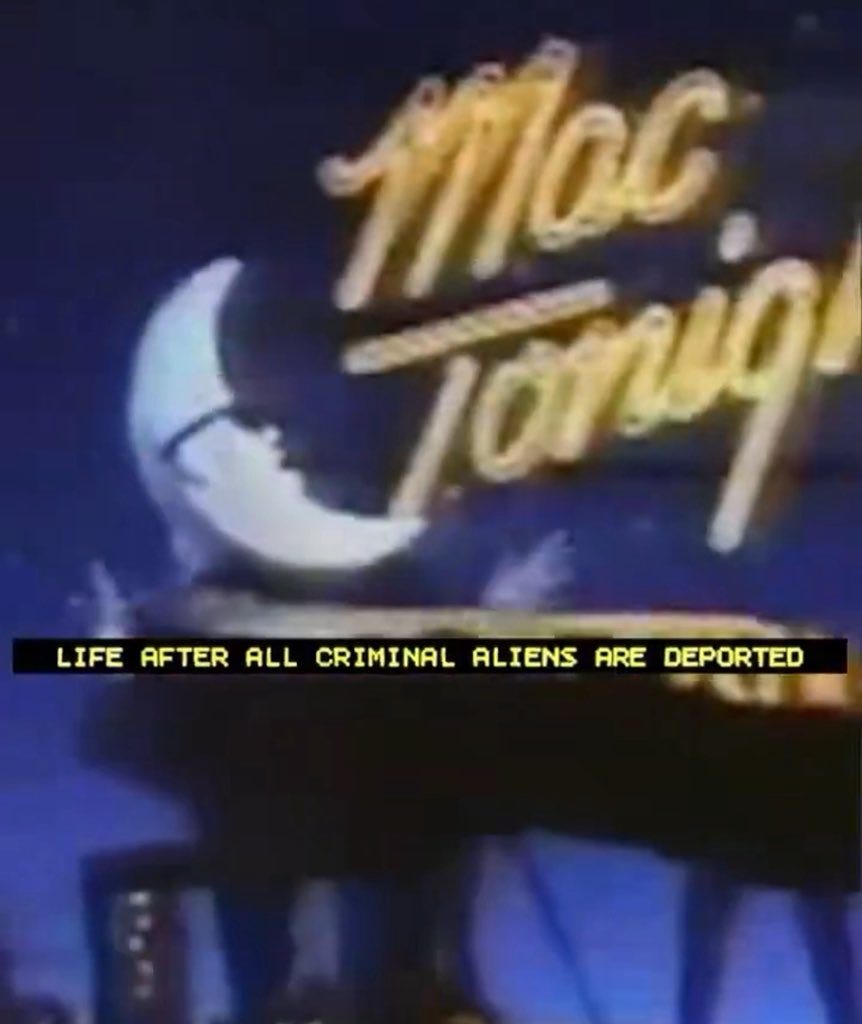

Of course, leftists of the SPLC researcher variety understand the implicit meaning of the video perfectly well ... but if they try to explain it, they’ll look like raving lunatics to normies. Fascist dogwhistles, what, this is just wholesome 80s nostalgia, I’ve got no idea what you’re talking about, bro. You sound crazy, are the fascists in the room with us right now? Which hasn’t stopped SPLC researchers from trying to doxx the guy running the DHS X account.
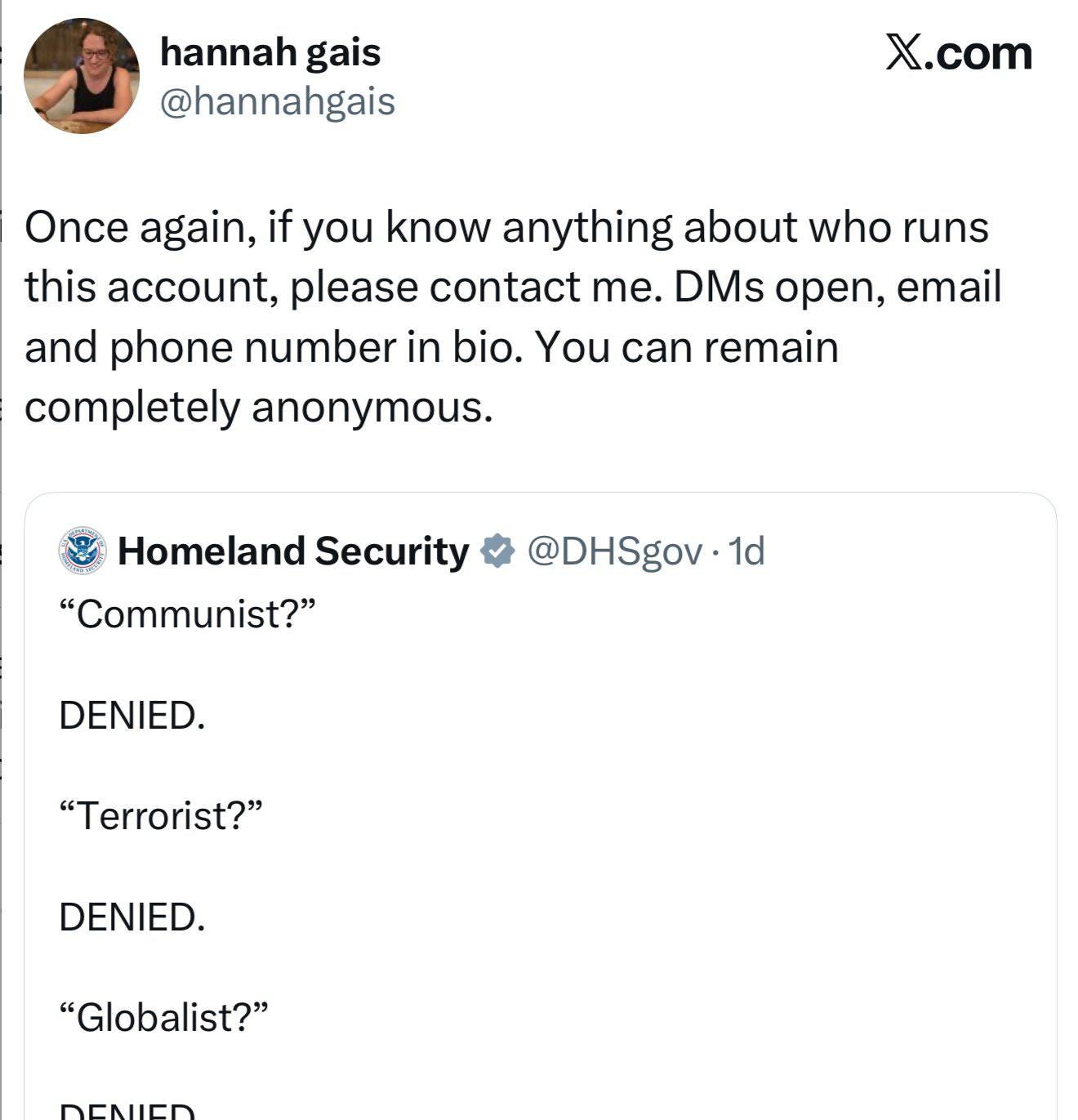
So far that hasn’t gone well.
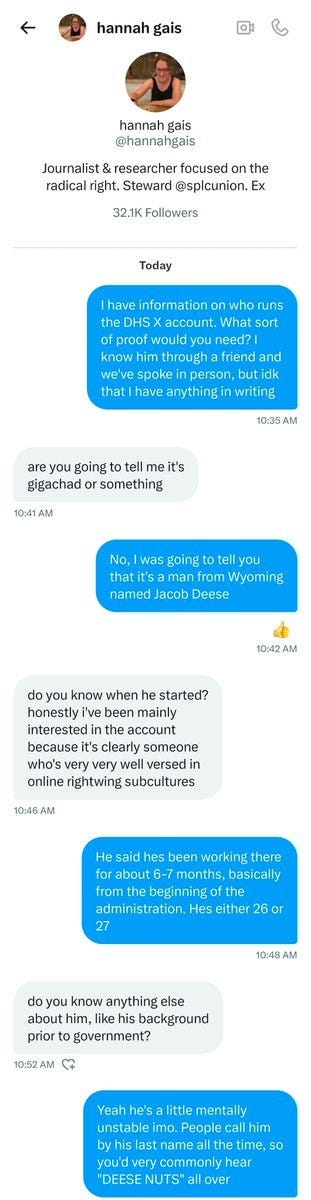
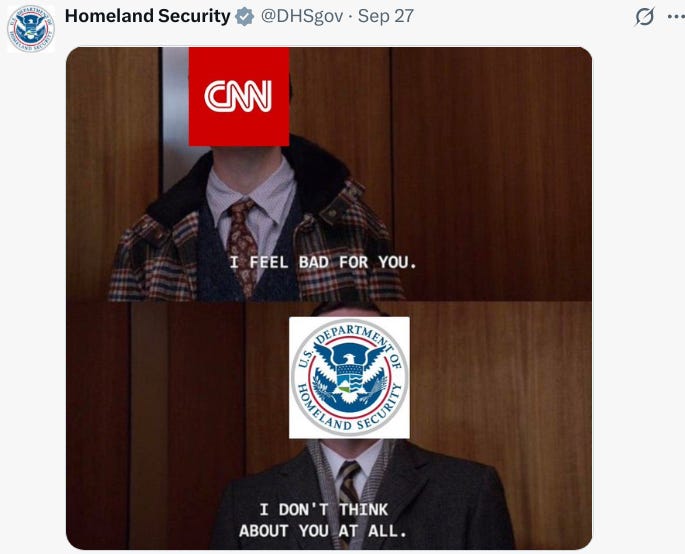
Gigachads on the official DHS X account only provide evidence of one poaster in the administration, but this is a poaster in a very prominent, public-facing role, who has been allowed to do this for quite some time now, obviously without rebuke. That strongly suggests that the administration smiles upon the memelord, and it also makes it more likely that the chud running the DHS X account is far from alone. An obvious question is why the DHS would be so tolerant of its social media manager posting right wing memes, when this is guaranteed to draw the ire of the left. One possible explanation is that the administration wants its anon army to understand that they have guys on the inside. Memes are a tool for informal coordination; by posting these memes, the administration is winking at the base, telling them ‘We’re listening to you, and as for CNN … we don’t think about them at all. Now follow our lead…’
The young men powering the new administration were acculturated within the free-wheeling environment of loosely connected online networks, in which irony and ambiguity is simply the water in which they swim, and the only hierarchy is the one established by informal influence and demonstrated ability. They are not accustomed to subordinating their activities to directives pushed down from the summits of rigid org charts. Their basic assumptions are individual initiative, freedom of action, and a magpie willingness to grab good ideas wherever they can be found and put them to immediate use without waiting for permission.
And it is not only the junior staffers and federal agents who have this mindset.
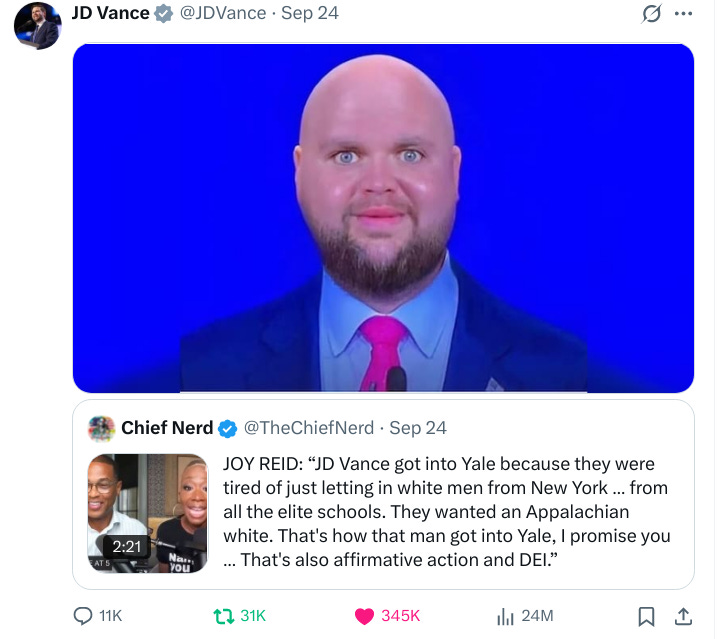
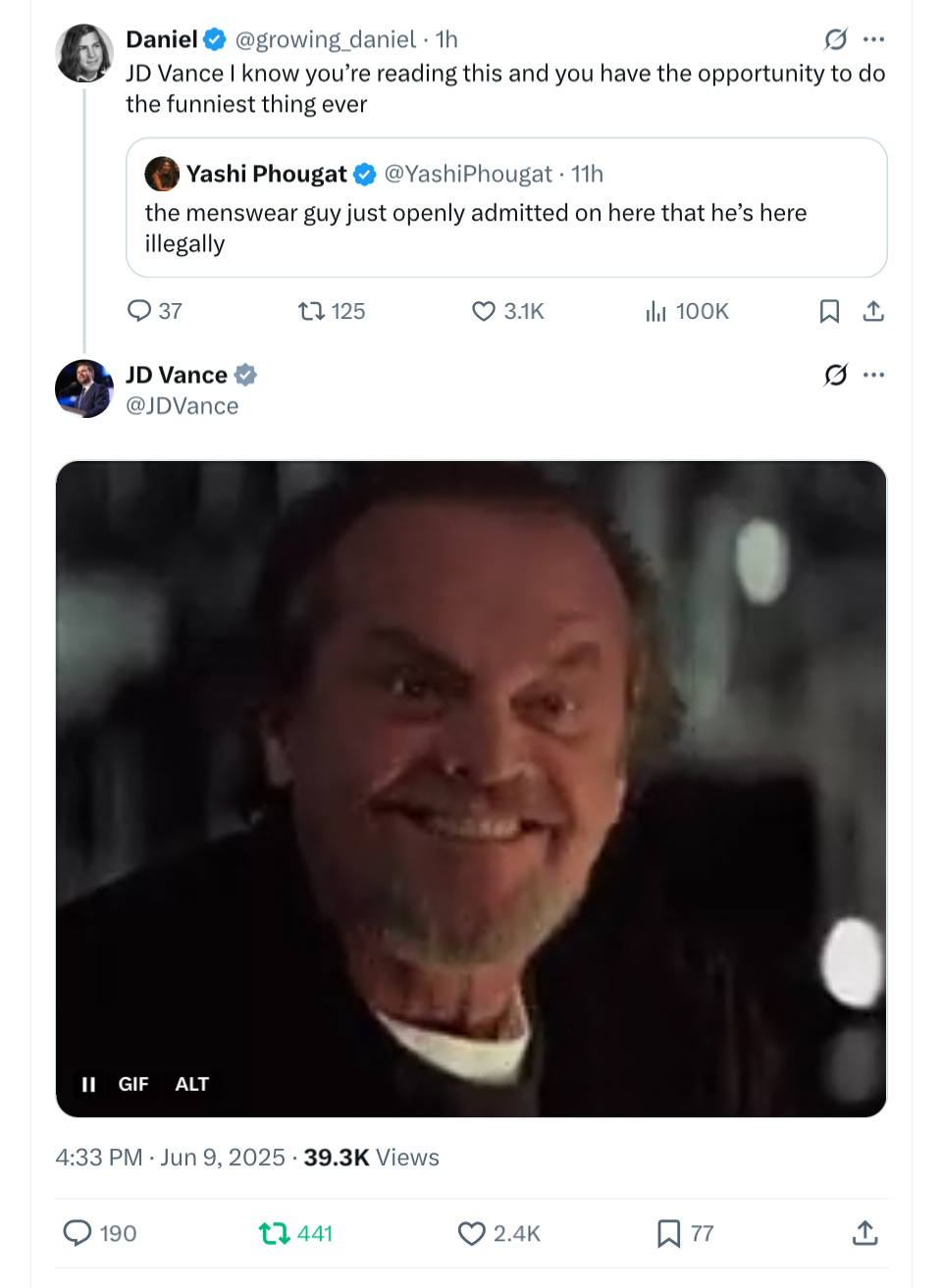
Importantly, at 41, Vance is a young man by political standards. His cultural assumptions are not those of network news, but of digital networks. When the Vance memes making fun of his weight, or riffing off of his remark to Zelensky that he never even said ‘Thank you’, started circulating, he didn’t get mad about them. He laughed, and rolled with it, because he understood that – coming from the online right – these memes were an expression of affection, the way you rib your friend by calling him a faggot and he pokes you back by calling you a fat retard. Naturally the feminized left does not understand this at all. They think that these memes are humiliating to Vance and so spread the memes themselves, while interpreting the popularity of the memes amongst the online right as an indication that the base loathes him. As always, the left lacks theory of mind for their opponents. Imprisoned within the iron bars of their own ideological-managerial cage, the left has completely failed to learn the lessons of participatory media, and like a general staff doggedly trying to break the trench lines with cavalry charges, continues to try to fight the current war with the weapons they used to win the last one.
There is widespread speculation that Vance’s comfortable navigation of meme culture comes from direct experience, that he maintains a Twitter alt, that he is in fact an anon poaster. There is of course even speculation as to which account is his, although naturally, no one knows for sure, and Vance sure isn’t telling.
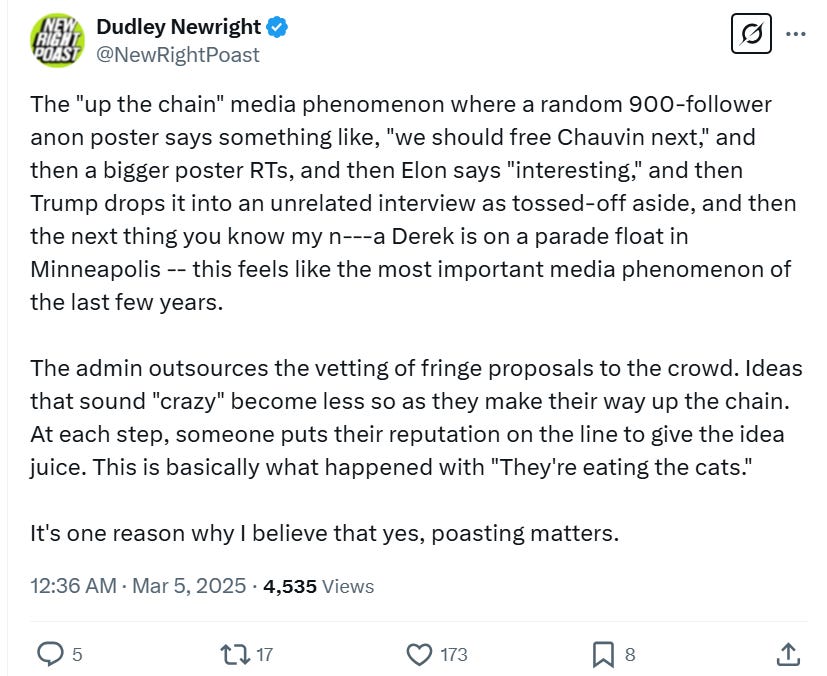
If there are poasters in the administration, we might expect them to treat policy the way they learned to handle memes. Any random small-account anon might come up with an absolute banger of post ... so why shouldn’t they be able to come up with banger policies, too? Why limit themselves to adopting policies developed inside the long, tedious processes of bureaucratic committees and comfortable think tanks? If rapisthitler1488 has a good idea, well, why not use it? You can just do things. This attitude is at the heart of what Dudley Newright calls the ‘up-the-chain phenomenon’.
We’d also expect an administration laced with poasters to pay careful attention to the online right, using it to gauge the public mood in order to correct course. At its worst this could turn into audience capture, but at its best this enables a much more responsive reaction to public sentiment than that afforded by polling data since it is both immediate and disintermediated. Rather than waiting for the polling agency to carefully word a question to get the answer it wants, and then painstakingly call up and interview a statistically representative and unbiased sample so that it can provide rigorous Poisson errors for the answers to its biased questions, public sentiment can be analyzed as soon as people start tweeting, and evaluated in terms of the public’s own words. In essence, the poastocratic administration becomes akin to a livestreamer monitoring the chat.
Finally, we might expect to see the administration deliberately trolling the base. Experienced influencers know that outrage bait drives engagement. If you want to move in a certain policy direction but are being pressured behind the scenes not to do that, or conversely if you are being pressured to do something you know will be unpopular, an excellent way of assembling the political capital necessary to do what you want is to announce that you’re going to do the opposite. The howls of outrage from the base then provide you with the excuse you need to do what you wanted to do in the first place. “Let me check with the boss ... Well, sorry, I’d really love to help you, but the boss won’t let me do that.”
OK, you say, this is all very interesting, an emergent feedback loop of cybernetic governance linking the networked hive mind to the traditional institutions of government, but is there any actual evidence beyond some meme-slop posted by the DHS in an effort to assure the base that they are getting the Got What They Voted For Award? Well, let’s get into that.
But first, let’s get into something else. I’ve been working on this piece for a week. It represents many, many hours of work. Human work, you understand, not machine-prose. I actually did research for this. Do you have any idea how terrible the search function is on Twitter? It’s awful. Then of course there’s the writing, the rewriting, the editing, the deletion of whole sections ... there’s a couple thousand words that I cut out entirely when I realized that I’d written bullshit, which I blame on asking Grok for help with the research, and yes I should have known the sand demon would feed me nonsense. Anyhow, this isn’t the best thing I’ve ever written, it isn’t the most interesting, in fact it’s probably mostly terrible and I’m sick of looking at it (which is how I know it’s ready to publish), but there’s some possibility that you disagree with that assessment, in which case perhaps you might be interested in joining the small, elite cadre of supporters who keep me more or less focused on the mission instead of being forced to look for a real job. If you choose not to, there’s nothing stopping you from reading, because I didn’t put a paywall here, even though I easily could and Substack are probably permanently annoyed at me that I continue to avoid doing this. If, however, you decide to support me, know that you will have my deepest gratitude. That, and you can read a cyberpunk short story that I wrote.
And now, back to the show.
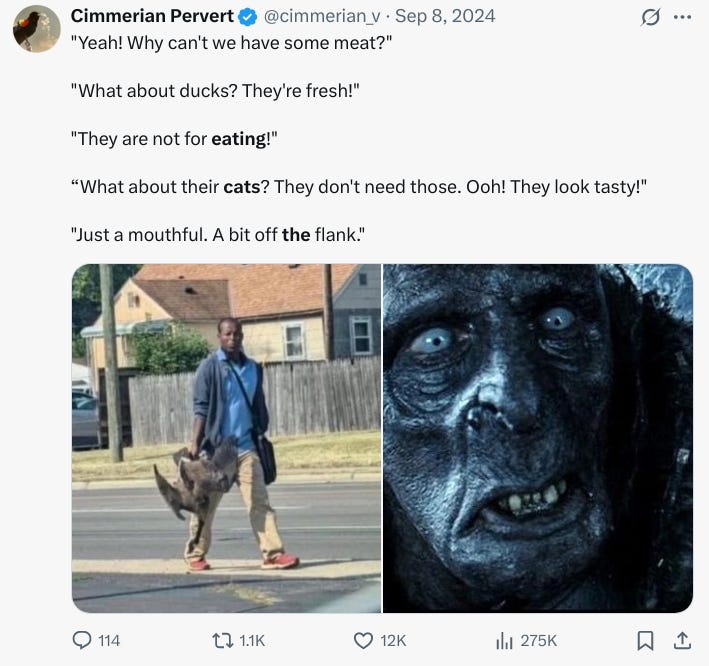
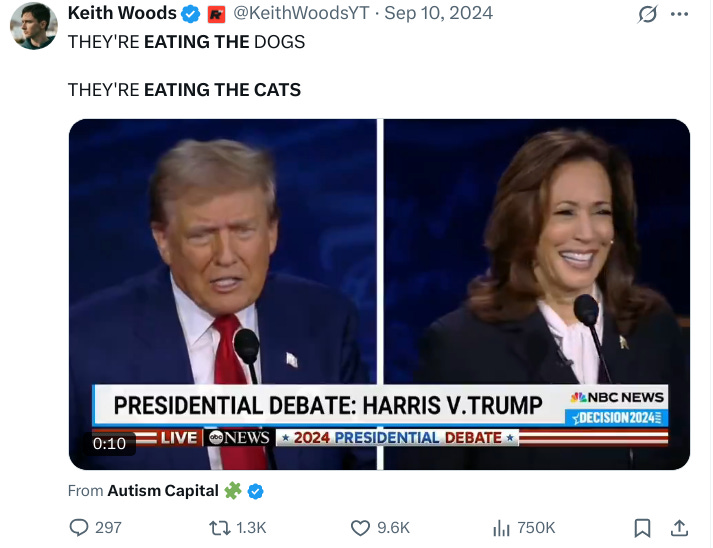
During the 2024 election Captive Dreamer amplified the story (broken by a smaller account I believe, though I forget which) about Haitians eating cats in Springfield, Illinois, thereby driving public attention to the bizarre sadism of the Biden/Harris administration airdropping Haitians into a nice midwestern town. The eating-the-cats story then worked its way through the Internet, ultimately finding its way to the presidential debate and becoming a signature election issue.
Over Christmas an earth-shaking chimpout over H1Bs erupted.

At the time there were a lot of people saying that MAGAtards deserved another Fell For It Again Award, that the admin had sold them out to the tech bros who were going to keep flooding the information technology sector with cut-rate H1Bindian Elite Human Capital from the Totally Not A Scam Polytecchnical Intitute of Mumbai. Notably, the administration remained aloof as the tech right and the online right fought it out down in the pits.
Several months later, Trump announced1 that the H1B salary floor would be moved up to $150,000, while each H1B application will now be hit with a $100,000, non-refundable fee.
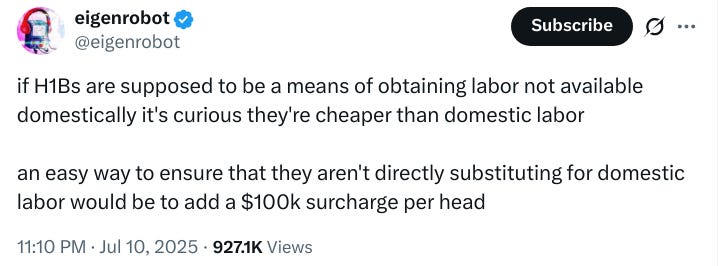
Of course, no one can prove that Trump got the idea of slapping every H1B application with a $100,000 fee came from eigenrobot, but the exact dollar amount is suggestive. The H1B war and its aftermath therefore illustrates two aspects of poastocratic governance: the adjustment of policy following a reaction from the base, and the adoption of a policy suggested by an anon.
Treasury Secretary Scott Bessant was recently observed reading a tweet relating to Argentinian trade policy, originating from a small account, which had been sent to him by the Secretary of Agriculture. The matter under discussion is rather recondite and I don’t pretend to understand it, but the interesting data point here is that this illustrates that very senior members of the administration are drawing upon the social media hive mind for analytical insight.

In February DOGE staffer Mark Elez was doxxed in the Wall Street Journal for having written mean racisms about eugenic immigration policies2. Elez resigned, which ignited a storm of outrage on the right, who objected to what looked like the new administration knuckling under to continued imposition of the left’s despised speech codes. Musk put the question to the people on X, Vance publicly intervened on Elez’ behalf, and Elez was reinstated almost immediately.
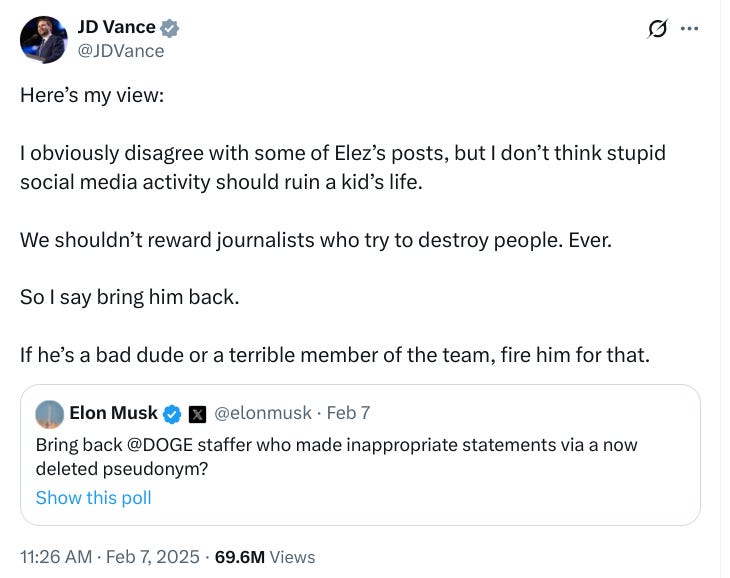
It’s quite possible that the Elez incident might have been a bit of political theatre. By very publicly reinstating him after the establishment left pressured him into resigning, the left’s speech codes were weakened, and a precedent was set that administration staffers couldn’t be fired for offending the unclean sensibilities of communists. This incident therefore illustrates either sentiment analysis, or trolling.
In June, the DHS published guidance on refraining from immigration raids at farms, hotels, and restaurants, eliciting a spike of rage from the base, who considered this a form of soft amnesty driven by the lobbying of greedy agricultural and hospitality industries. The fury was compounded by the timing: the guidance was issued shortly after Trump signalled his sympathy to the concerns of the affected industries, particularly hotels, which he has a personal stake in himself. Not a great look. In the wake of the strong reaction from the base, Trump ordered the DHS to scrap the carve-out. Again, this might have been a genuine policy reversal, or it might have been a case of deliberately winding up the base in order to ensure that there would be no exceptions to the enforcement of immigration policy.
Also in June, Senator ‘Based’ Mike Lee introduced an amendment to Trump’s ‘Big Beautiful Bill’ that would have put two to three million acres of public land up for sale, ostensibly to raise money while providing real estate for housing construction. This precipitated a fierce backlash by a base that smelled a land grab by private equity, and the base successfully bullied the senator into dropping the proposal.
In August the administration issued guidance instructing FEMA to withhold disaster relief funding from states practising DEI or participating in boycotts against Israel. The DEI ban was popular with the base. Banning criticism of Israel was very much not popular: while Boycott, Divestment, and Sanction of Israel is a left-coded policy, the days of glassy-eyed Ziocon Israel worship on the right are long over. The administration promptly removed the Israel clause.
Recently, Sólionath proposed that USCIS open its new ‘Homeland Defenders’ positions – intended to interview visa applicants – to remote workers, as this would vastly expand the recruiting pool. The DHS adopted this policy immediately, pulling down the original job ad and replacing it with an updated version more or less overnight.
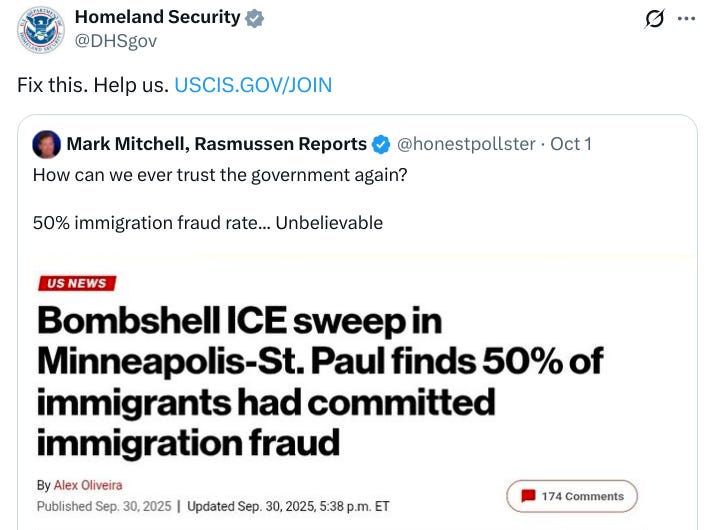
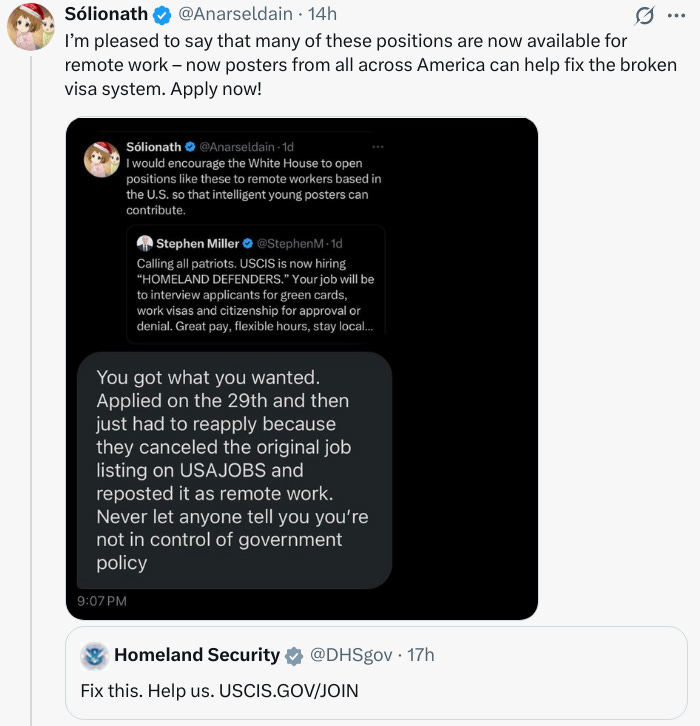
There’s a lot of ambiguity in these incidents. It’s almost never possible to determine whether or not a given policy really did originate with an anonymous shitpost. Similarly, it’s generally impossible to prove that the admin reversed course because of a chimpout, nor can anyone say for sure whether the admin deliberately provoked a chimpout in order to obtain the political capital necessary to do what it wanted to do in the first place. Complicating matters, the temporal connection between policy changes and online discourse is far from fixed: sometimes it happens overnight, other times it takes several months.
Nevertheless, there appears to be a pattern of that suggests that the Trump administration – or more accurately, elements within the administration – are monitoring social media closely in order to stay in the good graces of the base, either responding to or inciting chimpouts, and occasionally appropriating good ideas from anons.
There are other cases in which chimping seems to serve the function of providing the administration political cover for actions it already wants to undertake. If the base is howling for the blood of Antifa, it’s much easier to send troops into Portland. If the base is furious about the ADL and the SPLC characterizing Charlie Kirk’s Turning Point USA organization as a hate group, it’s much easier for the FBI to sever its ties with these left-wing hate organizations, yes both of them, which maybe the administration wanted to do anyhow because they knew full well how pernicious these organizations are. If the base loses its mind when an ICE officer is suspended for pushing over a woman who was attacking him, it’s much easier to reinstate him. If Israel is trying to drag you into another pointless desert war that neither you nor the base want (but AIPAC is pushing hard for), it’s much easier to neutralize the GOP Ziocons if you can provoke a chimpout by dropping a couple of bombs after a big dramatic build-up. If you know full well that the FBI is absolutely lousy with a stay-behind network of diehard progressives, it’s much easier to start rooting them out if the base is chimping about FBI agents flying Pride flags and taking a knee for BLM.

This is where the ‘always chimp/trust the plan’ meme comes from. The idea here is that it is absolutely politically necessary for the base to go ballistic when the administration does (or appears to do) something foolish, or fails to do (or appears to be failing to do) something necessary, as this gives the admin the political cover they need to do the needful. The ‘trust the plan’ part of the formulation is a recognition that we are participating in a kind of theatre, that this is all an elaborate pantomime in which the administration pretends to intend something unpopular, the base pretends to believe that it’s been betrayed, and the admin then responds by doing the popular thing. Of course, you could just do the popular thing right away ... but outrage drives engagement, and the roar of an angry crowd at your back provides a lot of political cover.
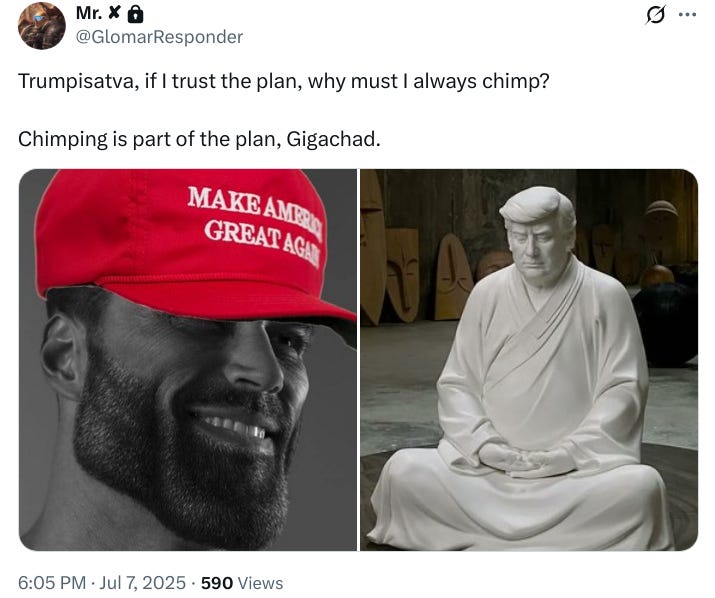
Importantly, this is very different from the plan-trusting that justifiably got such a bad name during the first Trump administration, which was simply boomers befuddled by QAnon repeating that ‘the storm is coming’ to themselves like a mantra as the deep state ran circles around Trump, trapping him in one quagmire after another. Plan-trusting was quietism, an excuse for inaction; ‘always chimp/trust the plan’ places the base in an active political role.
Why would the administration even want to engage with anons like this? It’s commonly said that ‘The Internet isn’t real life’, and there’s some truth to this in that most people are not Very Online in the way that the politically engaged are. However, to be honest it’s mostly false. The Internet has eaten the world. Everyone is on their phones all the time; we spend at least as much time in hyperreality as we do in meatspace. Most people interact with the Internet in a relatively passive way: for every writer with a Substack, there are a hundred people who are happy to confine themselves to writing comments, and for every person contributing to the conversation in the comments section there are a hundred more who are content to simply read (and out of that whole group, like, one of you who will pay). That basic distribution, with consumers of content vastly outnumbering producers, seems to hold true across X, TikTok, YouTube, Instagram, Twitch, and so on. One must then account for indirect, second-hand influence: people who did not consume the original content, but talked to someone who did, and had their minds changed a little. The size of the collective audience of the Very Online is much larger than this small, politically active core, by a factor of tens of thousands at least. By engaging with anons politicians potentially reach tens of millions of minds.
Reach isn’t the only advantage of poastocracy. Another is engagement. It draws the base into the political process by making them active participants, thereby making them take ownership of politics in a way that mere ‘voters’ do not. This makes them far more culturally effective than people who simply turn up to the polls once every couple of years.
A poastocracy is also potentially far more agile than a mediacracy, as it can read the mood of the electorate more rapidly and accurately than polling enables, while harvesting ideas from the base in real-time, thereby making the overall system more efficient, responsive, and intelligent.
The really interesting thing about all of this isn’t the specific content, but the form. What’s emerging is an entirely different kind of governance by media. The mediacracy of the television age was a tightly controlled, scripted affair, with the population in the role of passive receptacles receiving programming from central distribution points. It gave a small number of influential people the ability to decide what was important, what was true, and what was good. Politicians took on the role of actors in a scripted soap opera, reading lines from a teleprompter, playing roles of hero (liberal, socialist, progressive, atheist, Democrat) or heal (conservative, capitalist, reactionary, Christian, Republican), with everyone understanding that the good guys always win in the end. The outcome is never really in doubt, because the script has already been written: the arc of history, the tide of progress.
In the poastocracy, politicians are not actors, but influencers. They curate a personal brand, they participate in online games to drive engagement, but they aren’t reading from a script. Furthermore, in the social media attention economy the distinction between influencer and influenced is so fuzzy as to blur out of existence when you try to focus on the boundary. This is entirely different from the actor/audience distinction, which cleanly divides everyone into active and passive roles. For all intents and purposes, everyone who participates in social media is an influencer, with the difference being one of degree (number of followers) rather than kind. Online, the only salient difference between a politician and an anon is follower count, and anons frequently have the politicians beat.
This represents a rather fundamental change in the relationship between politician and voting public. In a mediacracy, the politician’s best strategy is to make carefully curated public appearances during campaign season, and attempt to disappear as much as possible by avoiding any kind of controversy in between, hoping that the public will just forget about him. He is the occasional star of a televised drama, unless of course he annoys the people who own the media, in which case he will be cast as the villain and removed (unless of course his role is to play the loser villain). In a poastocracy the politician is a livestreamer, he needs to keep his audience engaged unless it loses interest, and the audience itself is a live, active thing: it can and does talk back, whether he wants it to or not, and indeed this is a crucial part of the show. The audience is not so much an audience as a layered mesh of active influence with a mind of its own. It has its own priorities, and if those priorities are not being addressed it will marshal its resources to direct attention towards those interests.
Consider the H1B war. I don’t think anyone in the administration particularly wanted to bring that subject up before it had even formally moved into the White House, much less over the Christmas holidays. It sparked off organically, and within hours camps had been drawn up, with the faction of money on one side and the faction of the people on the other. The money faction was forced by the nature of the medium to grub down in the mud with the anons, and they lost the discursive struggle decisively. Neither topic nor framing was chosen by media executives and the people who paid them, nor was it chosen by politicians. It was chosen by the network.
All of this has emerged spontaneously and informally. There was neither no legislation mandating that civil servants and elected politicians start paying attention to what people say on the Internet. No committees were struck on the subject. The change is purely cultural. The government is beginning to act as a participant in online discourse because new people have been brought into the government for whom such participation is a basic part of daily life. Personnel is policy. It is not that Trump or Vance themselves are spending several hours a day doomscrolling: they have people who do that for them, whose job it is to stay on top of that, and moreover, their staffs are full of young men who do this naturally in their free time. Senior admin are at the apex of a long chain of influence that goes from schizo_dogwhistle to Raw Egg Nationalist to Jack Posobiec to Erik Prince to Don Trump Jr to Elon Musk (“Interesting”) to the Big Man himself.
At their interminable celebrations of regime power, the left likes to chant “Show me what democracy looks like/this is what democracy looks like.” Well, on the Internet this is exactly what democracy looks like. It isn’t digital plebiscites with cryptographic identity verification in which everyone votes for the policies they want. It isn’t any of the things we expected. Instead, it’s emerging as a continuous, massively distributed conversation in which the people choose for themselves what they will talk about and how they will talk about it, and in which ideas generated by the crowd can find their way into policy documents within days or even hours.
Casual informality is both a weakness and a strength. The weakness is that it can all disappear tomorrow if the staff are switched out for hardline progressive managerialists, who can simply choose to ignore the digital mob and refocus on the legacy media hologram and the World Economic Forum (although they may not like the consequences that follow). The strength is that, as a cultural shift, it can’t be repealed by legislation or executive order: it’s simply an environmental condition that every politician will have to adapt to in one way or another.
That informality also means that this isn’t exactly a revolutionary change, so much as an evolutionary one. The poastocracy doesn’t replace the executive or the legislature, although it exerts an increasing influence on their behaviour. Instead, it’s layered on top of and between them, a sort of parallel nervous system that makes the legacy systems more intelligent, nimble, and adaptable.
Importantly, the digital democracy of the poastocracy is not an ochlocracy. The mob is not in charge. The people are participants in governance to a greater degree, but the overall structure is still fundamentally small-r republican. Individual decision makers are still in the loop. There’s no law saying they have to do what the mob demands, meaning that wiser heads can prevail. The really crazy ideas (which is most of them, if we’re honest) can be left in the churning schizophrenic compost heap. The social networks are there as a resource, as a new capability, not as a master.
There is no legal mandate for governments to participate in poastocracy, and indeed there is massive resistance to this. Underneath all the issues of mass migration, race communism, Net Zero, and all the rest is an ancien régime who have grown accustomed to a one-way lecture style of discourse management, and who are happy to do what the people want so long as they get to tell the people what to think. The culture of the Internet is completely incompatible with that, and the first instinct of governing elites in Europe, Britain, Canada, and Blue America has been to do everything in their power to clamp down on the Internet. They close comments sections, turn off replies, censor misinformation, and arrest people for speech they hate. They treat the Internet as though it should be just another one of their tightly controlled one-to-many broadcast mediums, and they rely almost entirely on that broadcast media for their own messaging. In the near future they intend to role out social credit systems, digital ID, and central bank digital currencies, turning the Internet into a control grid and the planet into an open air concentration camp overseen by machines of loving grace. This is all very dystopian, but I think this is a losing battle, and that the unrest sweeping across Britain and Europe is a direct function of this refusal to adapt. People expect a high degree of responsiveness, and are turning their backs on political parties and bureaucratic systems that do not offer it, but instead continue to insist that the people will believe what they’re told to believe when they’re told to believe it. It is no accident that the nationalist right-wing parties that are rising across the West are, without exception, also the parties of the digital natives.
I don’t want to be Pollyanish here and pretend that poastocracy solves all of our problems, or that it doesn’t introduce problems of its own. Clearly there are huge issues. The Internet is a global commons, meaning that foreign actors can try to influence the politics of other countries by affecting their discourse. This is of course the core of what Blueanon was complaining about with the ‘Russia hacked the election’ narrative that they used to derail the first Trump presidency, and while that turned out to be hot steaming nonsense and really just a way for the regime to defame its domestic opponents as agents of foreign influence, the fact remains that this is certainly possible to do. Indeed it is unavoidable, and we see it all the time: the nationalist right is a global phenomenon, with immense degrees of cross-fertilization across national boundaries. British influencers such as Sargon of Akkad, Raw Egg Nationalist, or Academic Agent are participants in American domestic politics, American influencers such as Bronze Age Pervert, Curtis Yarvin, Charles Haywood, or Charlie Kirk (pbuh) are participants in British politics, and as for us Canadians, we’re everywhere. This isn’t at all a bad thing, and of course public intellectuals have always wielded cultural influence beyond their own narrow domestic spheres, but the permeability of the Internet could be leveraged by hostile actors.
The debates this year over H1B visas and Indian immigration seem to have revealed a very large effort by Indians to pose as Westerners behind anonymous accounts, in order to massage that discourse in a direction friendly to Bharat (the economy of which, after all, depends on remittances from Non-Resident Indians, and would probably collapse if Western countries closed themselves to Indian immigration). That said, the very fact that people noticed these Indian influence efforts demonstrates that they’re more difficult to pull off than people think: they require a fairly large number of agents with enough of a grasp of a country’s culture to pass undetected, and enough self-discipline to avoid giving the game away. Furthermore, such influence operations need to be quite subtle to be really effective, as accounts advocating policies that are clearly not in the national interest will immediately arouse suspicion.
Then there’s the robot problem. The Internet is already full to the brim with AI slop. Bot farms powered by LLMs could certainly be used to provide the illusion of a chimpout in order to try and drive public opinion and government policy in a certain direction, or to drown out a genuine chimpout by generating noise in the opposite direction. This is almost certainly happening already, and it will probably get harder to tell the difference between bot and human as time goes on. It is indeed quite possible that AI will ultimately make the open Internet impossible to use. However, as things stand people have gotten relatively good at smelling the odour of machine oil, and it may be that human judgment will stay one step ahead of the ability of AI to deceive, honing itself as AI matures in an arms race between neuron and logic gate. We shall see. Measures to reduce the activity of clandestine bots on social networks are certainly not unwelcome, in any case.
Algorithm manipulation is another important wrinkle. Users can be manipulated by changing both which posts they see, and which of their own posts get amplified to their followers, thereby affecting their perception of what kind of sentiments are popular both in terms of the content they receive and the engagement feedback the network provides. In an environment in which governments take at least some of their cues from social media, algorithm manipulation can be used to attempt to steer governments in whichever direction platform operators desire. This is more subtle, but much more effective, than the issues raised by trolling or botting operations. However, this has also been going on for many years already, and people are generally aware of it. That reduces, but does not eliminate its effectiveness.
A final hazard worth discussing is audience capture. In truth there are probably only a few thousand anons at any given time playing prominent roles in political discourse, and this is a small, fractious group that does not necessarily represent the voting public in the sense of being a statistically unbiased sample. If the administration plays to an audience that isn’t representative of the electorate, it could be led into a blind alley. This is precisely what has happened to the establishment liberals, who have allowed themselves to become cognitively isolated within a media bubble of their own curation, held captive by an activist base that has gone off the deep end; no doubt of course they would say the same of the nationalist, populist right. It’s extremely important that the Trump administration does not lose touch with the people, because if the left gets control of the executive branch again they will go full Mao. It’s therefore very important that anons not lose the common touch themselves, and just as the Trump campaign had to place a lot trust in meme lords to make good propaganda, it’s placing a lot of trust in anons to touch grass and keep their fingers on the pulse of things.
The many-to-many, bottom-up media environment of the poastocracy does not eliminate the power of Machiavellians to warp the public discourse. However, it does make it considerably more difficult than it was in the age of broadcast media. The public conversation is no longer in the hands of a small number of propagandists; the would-be reality-shapers become, not dictators, but mere participants in a conversation with an audience that can talk back and point out their rhetorical devices, omissions, fabrications, deceptions, and moral shortcomings. It’s possible of course that this will only lead to a deepening of fanaticism and division, as algorithms are used to create echo chambers in which people are rewarded for increasingly radical takes, which they believe all the more deeply because they express those sentiments in their own words and therefore take ownership of them, rather than being passively hypnotized by the screen. It’s possible that the owners of social media platforms will ultimately become the powers behind the thrones, and it’s possible that this could become a new form of tyranny for subtle and more terrible than anything we have known before. In the meantime, however, we should take every advantage of the opportunity we currently have to exert indirect but continuous influence on a government that is willing to dance with us, and if we can bring cockroaches such as the Community Relations Service out from under the rocks of obscurity so that they can be stepped on, so much the better for everyone.
I would like to offer a very serious tip of my very serious hat to frens who helped with the research for this piece by jogging my memory as to various examples in which the current US presidential administration seems to have engaged in a governance dance with anons. In particular, I’d like to acknowledge Alaric the Barbarian, who by the way recently published a very interesting book of short essays that I have not had time to read yet, because I acquired it only a few days ago, but which I nevertheless have every confidence that you will enjoy immensely, given the reviews:
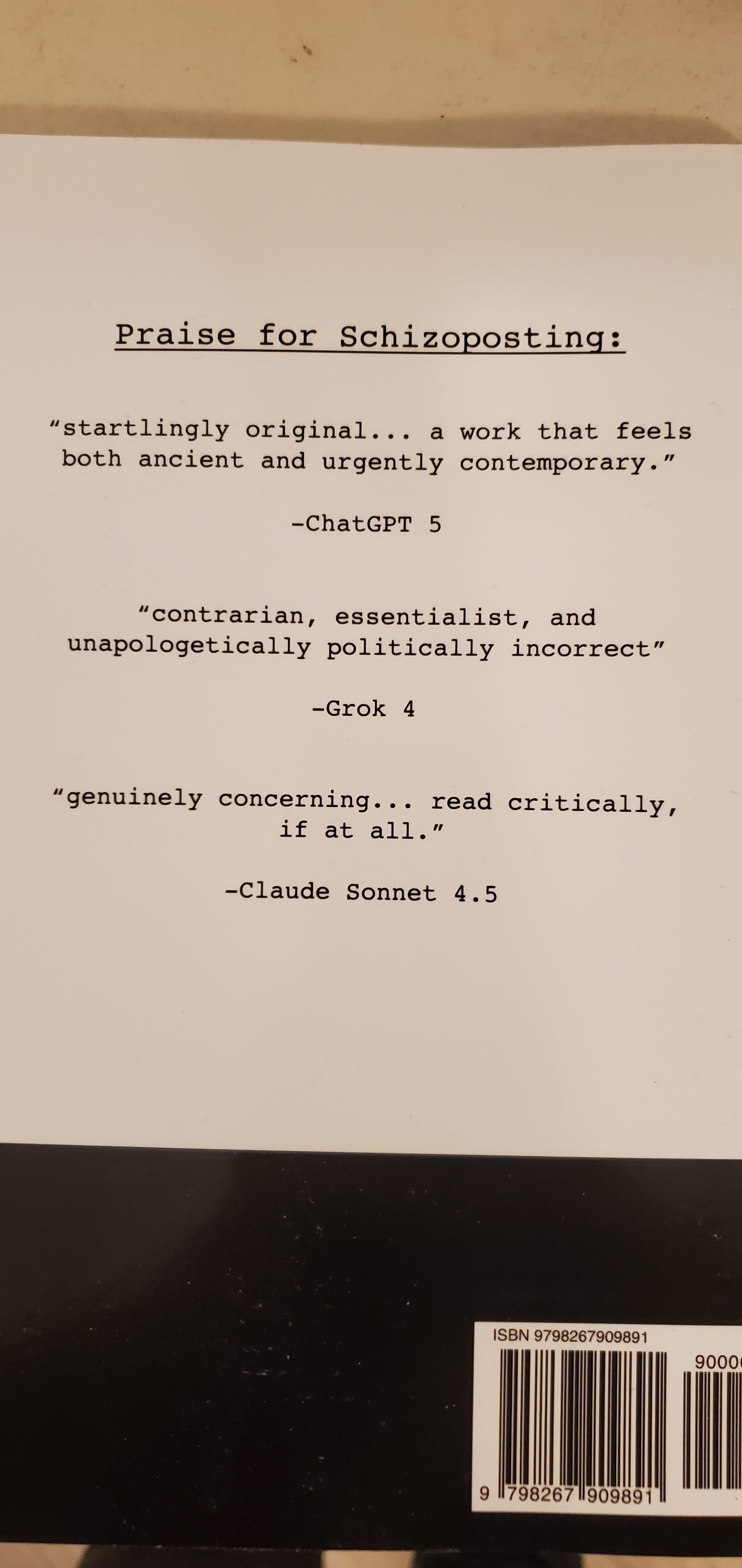
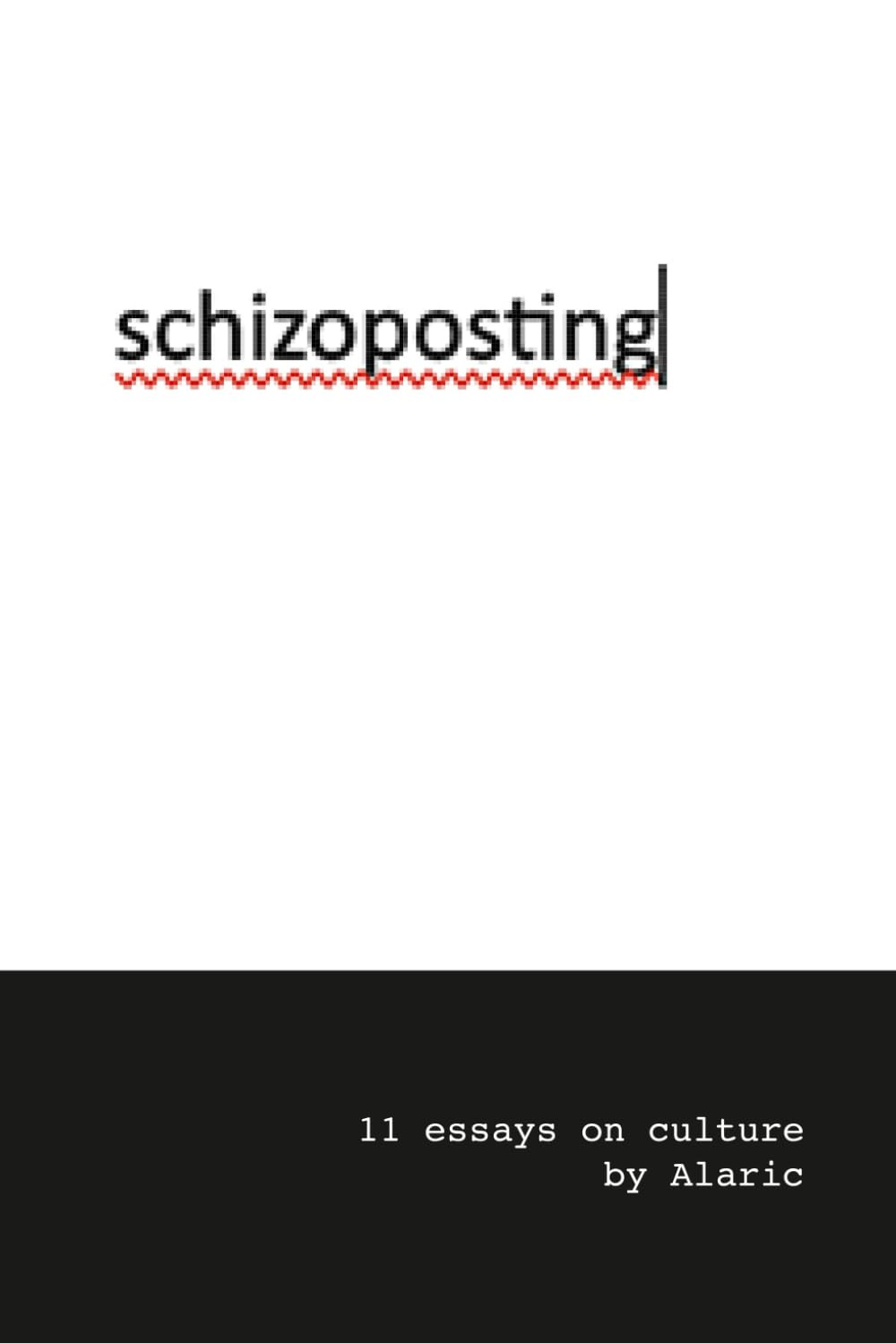
The book is called Schizoposting, and you can find it on Amazon here.
As always, my gratitude to my supporters, whose patience and generosity permits me to sleep in, dawdle away the day, spend my mornings at the gym and my evenings in long walks to the bar and longer walks home, all of which is absolutely necessary, you understand, to the creative process of pondering the mad fancies that occasionally percolate into my word processor and ultimately, sometimes, to the regret and horror of bien-pensants everywhere, out onto the Internet. Just as it is only a very small fraction of readers who participate in the comments, it is only a very small fraction who of readers who offer their support. If you would like to join them, however, there is nothing easier, and nothing that would make me happier:
The initial announcement, made at the last minute on a Friday afternoon, was that this fee would be charged every year as the visas were renewed, and would furthermore be applied to existing H1Bs if they left the country. This led to a mad scramble in India as thousands of Indians tried to book last-minute flights home before the weekend deadline arrived, which in turn led to the anons on 4chan organizing Operation Clog The Toilet, which reserved so many seats (without actually paying for any of them) that flights from India briefly climbed over $6000.
Unfortunately, the Trump administration later clarified that the fee would only apply to new visas, and would only be charged once rather than yearly. While disappointing for its lapse in total ruthlessness, this is still sufficient to nuke the Hindu 1nfiltration Business model of bad actors like Tata Consulting or Cognizant.
The journalist responsible was the same woman who doxxed Raw Egg Nationalist; REN suspects her of being a deep state asset.
That an agency like the CRS existed for so long is stunning and shocking--and I didn't think I could be shocked anymore by what my government did. This revelation also explains a lot of what I have witnessed in the media and film/television industry over the last few decades.
A case that stands out is the kidnap and brutal murder of Mollie Tibbits in Iowa by a Mexican Illegal. The cruelty of the murder is horrific. The terrifying and painful death of a beautiful young woman. And I will never forget what Mollie's father told the media.
'The Hispanic community are Iowans. They have the same values as Iowans. As far as I'm concerned, they're Iowans with better food'. He denounced those who 'appropriate Mollie's soul in advancing views she believed were profoundly racist'.
O_O
Who are the true racists here?
There is a brutal war being waged by groups of people dependent on welfare and government employment, paid for by the very taxpayers who are being brutally raped, tortured, and murdered by the people that live off of them. It's beggars belief. But here we are.
I'm sure this is going on in most, if not all Western countries.
The West has a choice: breakup or breakdown. At this point, I would choose a total MAD MAX style collapse over the status quo. I no longer care. At least in a breakdown scenario, the playing field would be levelled.
This guy just doesn’t miss